
Buying an aluminum crusher machine is not simply a question of motor power or nominal throughput. The real issue is whether the process can accept your feedstock, liberate attached materials, remove unwanted fractions, and deliver aluminum that fits the next step.
Aluminum profiles, extrusion offcuts, window and door frames, and fabrication scrap are common candidates for crushing and sorting. The key question is what is attached to the aluminum.
Window-frame scrap may contain steel screws, plastic thermal breaks, rubber strips, paint, or dirt. Long profiles also feed differently from short offcuts. Before selecting equipment, record maximum dimensions, approximate wall thickness, bulk density, and visible foreign material.
MAXIM machinery’s scrap aluminum crusher machine is designed for raw aluminum, machined aluminum, broken-bridge aluminum and aluminum alloy. It can combine crushing, magnetic separation, screening, eddy current separation, conveying and dust collection.

Castings, wheels, and mixed aluminum pieces need closer attention to density and embedded parts. A heavy casting behaves differently under impact from a thin extrusion, while assemblies may bring steel inserts, coatings, or rubber residues into the stream.
For mixed feed, estimate the shares of aluminum, ferrous metal, plastic, rubber, and fines. That composition determines whether crushing alone is enough or whether more separation stages are justified.
Not every aluminum stream should enter the same line. Clean sheet offcuts may need only volume reduction. Fine chips or turnings behave differently from bulky profiles, while oily, wet, sealed or potentially hazardous items require separate assessment.
The practical rule is to identify the feed form first, then select the reduction and sorting route.
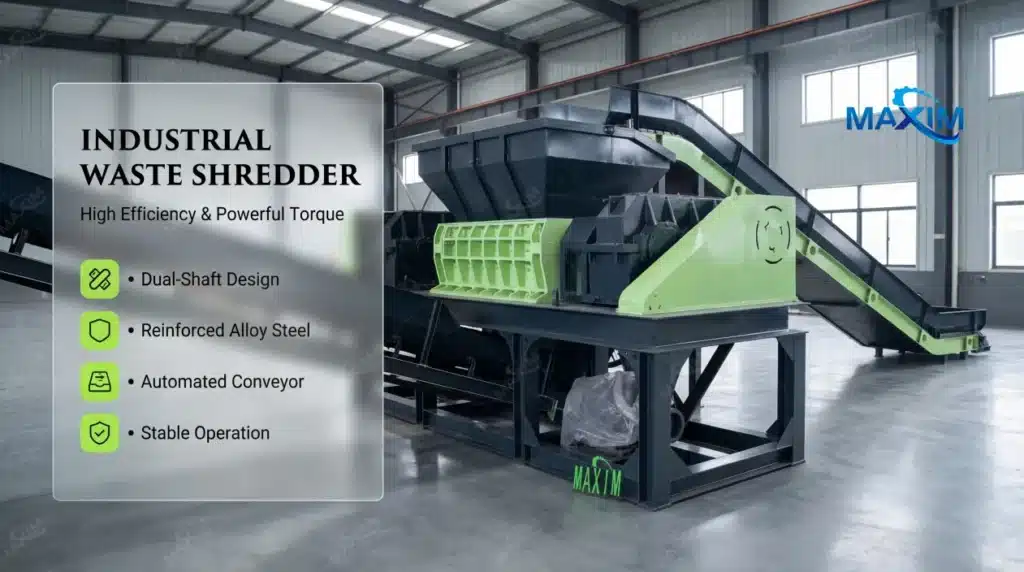
A shredder and a crusher solve different stages of size reduction. In a complete scrap metal line, a pre-shredder handles primary reduction of bulky material, while a hammer crusher performs deeper reduction before separation.
| Decision point | Shredder | Crusher |
| Main role | Primary size reduction | Further reduction and liberation |
| Feed issue | Bulky or irregular scrap | Material needing smaller fractions |
| Main purpose | Make feed manageable | Prepare material for sorting |
| Selection basis | Geometry and toughness | Target size and separation need |
Some plants need both; others do not. An unnecessary stage adds capital cost, power demand and maintenance without guaranteeing better recovered metal.
A useful equipment discussion starts with a feed audit: photos or video, maximum dimensions, thickness, bulk density, hourly tonnage and contamination profile.
Describe contamination by type. Steel screws call for magnetic separation. Plastic or rubber mixed with liberated aluminum may justify eddy current separation. Dirt, coatings and light fractions affect dust handling.
MAXIM machinery offers aluminum crusher models with capacities from 2.5–3 t/h to 40–50 t/h, depending on model, and input-size values from 1000 to 2200 mm. Final selection still depends on the real feed and target output.
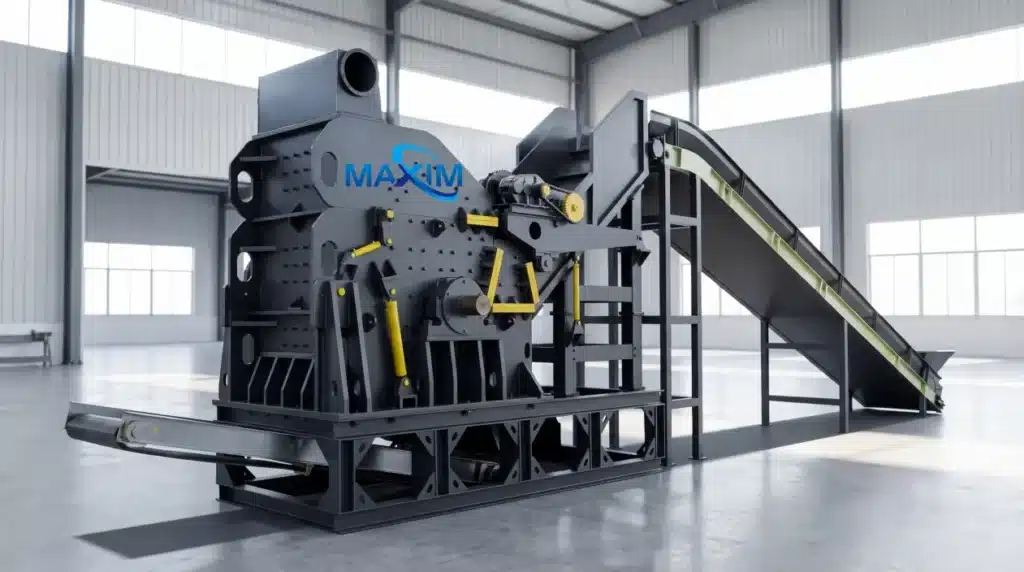
Magnetic separation removes ferrous material after crushing, including steel screws, inserts and other magnetic attachments. This protects the non-ferrous fraction from unnecessary iron carryover.
A magnet cannot remove plastic, rubber or other non-conductive contamination, so it is one separation step rather than a complete purity solution.

An eddy current separator is useful when conductive non-ferrous metal must be separated from non-conductive material. In our aluminum process, size-classified material can pass to eddy current separation so aluminum is separated from plastic after magnetic removal and screening.
Our broader scrap metal line also combines magnetic and eddy current separation to separate metals from non-metallic impurities.
For clean, segregated aluminum, the extra stage may not be necessary. For mixed profile or assembly scrap with liberated non-metal fractions, it can be important to output quality.
Sorting works best when the upstream process creates a stable, separable stream. If steel, plastic or rubber remains attached to aluminum, a separator cannot fully recover what has not been liberated. Very wide particle-size ranges also make screening and separation less consistent.
The goal is controlled reduction: enough crushing to expose attached materials without creating unnecessary fines.
An illustrative case study is a recycler processing painted window profiles with steel screws and plastic thermal breaks. A suitable route may use primary reduction where required, hammer crushing for liberation, magnetic separation for ferrous pieces, size classification, and eddy current separation for the aluminum/non-conductor split. The exact layout depends on the incoming mix.
Output quality is created by the whole line. A MAXIM machinery scrap metal process can include controlled feeding, primary pre-shredding, secondary hammer crushing, screening and conveying, ferrous separation, non-ferrous separation, dust collection and recovered-material collection.
The aluminum-specific system uses a crusher, magnetic separator, roller screen, eddy current separator and dust collector under PLC control. Each stage prepares material for the next.
Purity should not be treated as a fixed number without defining feed composition and test conditions. A better project target specifies incoming contamination, desired recovered fractions, acceptable carryover, throughput and the method used to verify performance.
A useful RFQ gives the engineering team enough information to size the process:
At MAXIM machinery, we use these inputs to match reduction and sorting stages to the project instead of treating every recycling plant as a standard package.
The RFQ should also include plant dimensions, available footprint, voltage, frequency, feeding and discharge arrangement, and dust-control requirements. These are part of the selection information for our scrap metal recycling line.
Ask how wear parts are accessed, what service clearance is required, and how separators and conveyors will be maintained. Our aluminum line uses pulse dust removal, while our wider engineering approach includes PLC-based coordinated operation.
Noise should be discussed at project level because building structure, site boundaries, local requirements and operating schedules can affect control measures.
A: An aluminum crusher machine can process suitable aluminum profiles, fabrication scrap, alloy pieces and other compatible feedstocks. Actual suitability depends on dimensions, density, attachments and contamination.
A: A shredder is generally used for primary reduction of bulky or irregular scrap, while a crusher performs deeper size reduction and helps liberate attached materials before sorting. Some lines use both stages.
A: An eddy current separator is useful when liberated aluminum must be separated from non-conductive materials such as plastic or rubber. Clean, segregated aluminum may need a simpler route.
A: It combines controlled size reduction with screening, magnetic separation and, when needed, eddy current separation. Final purity depends on feed composition, liberation, particle-size distribution and separator settings.
A: Send scrap photos or video, composition, maximum size, thickness, bulk density, contamination, required capacity, desired output, plant dimensions, electrical supply and dust-control requirements. Representative feed information allows the line to be configured more accurately.
Buying an aluminum crusher machine is not simply a question of motor power or nominal throughput. The real issue is whether the process can accept your feedstock, liberate attached materials, remove unwanted fractions, and deliver aluminum that fits the next step. Which Aluminum Scrap Feedstocks Are Suitable for an Aluminum Crusher Machine? Aluminum Profiles, Window excerpt …
