
At MAXIM machinery, we have completed the installation and commissioning of a lithium battery recycling pretreatment line at a customer site in Vietnam. The project has now entered trial operation, allowing the customer to check equipment coordination, material flow, drying performance, and environmental control under real working conditions.
The line processes discharged waste lithium batteries. Its core sequence is clear: the batteries are shredded, the crushed material enters a low-temperature dryer, and the treated material is discharged for subsequent processing. The project focuses on stable front-end pretreatment rather than full downstream metal recovery.
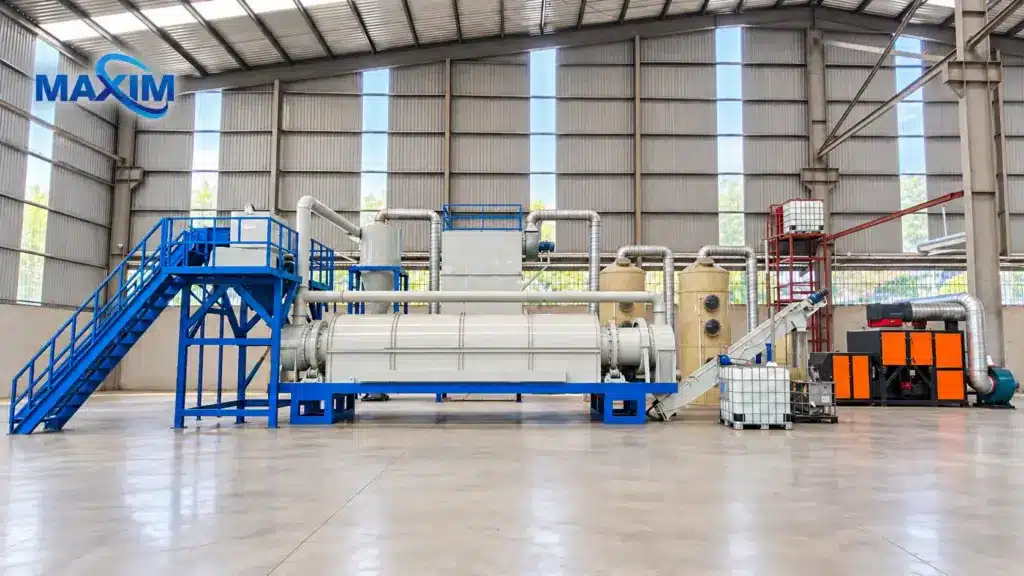
At the Vietnam site, waste lithium batteries are electrically discharged before entering the mechanical process. Shredding reduces the batteries into smaller pieces and creates a more manageable feed for low-temperature treatment.
Our broader lithium battery recycling systems can integrate crushing, sorting, conveying, air purification, automatic control, and centralized dust removal according to project requirements.
| Project Item | Vietnam Customer Site |
| Feed material | Discharged waste lithium batteries |
| Project scope | Lithium battery recycling pretreatment |
| Main process | Shredding → low-temperature drying → material discharge |
| Current status | Installation and commissioning completed; trial operation underway |
| Main focus | Stable pretreatment, drying, electrolyte volatilization, and environmental control |
Trial operation is not only a test of whether individual machines can run. It also checks whether shredding, drying, gas collection, material transfer, and discharge can work as one coordinated process.
During this stage, attention is placed on feed consistency, material movement, the condition of dried material, and environmental system stability. We can customize recycling solutions around material characteristics, production requirements, and site conditions instead of applying one fixed layout to every project.
After electrical discharge, the waste batteries enter the shredder. The purpose is to reduce the feed into smaller, more uniform pieces that can move steadily into the low-temperature dryer.
Mechanical treatment is also an important part of wider lithium battery recycling. Tearing, crushing, screening, air separation, and related processes can be combined to separate electrode materials, copper, aluminum, and other fractions.
For this Vietnam project, the immediate objective is to prepare the shredded material for low-temperature drying and stable discharge before later processing.

The low-temperature dryer performs four main functions.
The emphasis is controlled treatment rather than aggressive heating. The dryer prepares the shredded battery material for more stable downstream processing while directing volatilized components toward the environmental control system.

Battery shredding and drying can generate dust, fine black powder particles, electrolyte vapors, VOCs, and potentially acidic or fluorine-containing gas. Environmental control therefore needs to work together with the process equipment.
Our lithium battery recycling systems can incorporate air purification, centralized dust removal, and negative-pressure operation to reduce dust escape during processing.
For this type of pretreatment line, enclosed negative-pressure collection can capture emissions from shredding, drying, screening, and transfer points and direct them to appropriate treatment equipment.

A typical environmental control package may include a bag filter or dust collector for fine particles and black powder, ducting and an induced-draft fan for negative-pressure collection, and gas treatment equipment for dryer exhaust.
Depending on project requirements, VOC treatment may include equipment such as RCO. An alkaline scrubber can be used for HF and other acidic or fluorine-containing gas, while activated carbon adsorption may serve as an additional purification stage for residual VOCs or odors. Treated gas is then routed through the designed exhaust system.
This arrangement is intended to collect emissions near their source, remove particulate matter, treat volatile or acidic components as required, and support a cleaner working environment.
The Vietnam site shows why lithium battery pretreatment should not be evaluated by the shredder or dryer alone. Material size, moisture, volatile content, gas collection, transfer points, and discharge conditions all affect overall process stability.
Connecting shredding, low-temperature drying, environmental collection, and material discharge into one coordinated line gives the customer a practical basis for evaluating front-end performance before continuous production.
At MAXIM machinery, we can provide preliminary consultation, solution design, equipment production, installation and commissioning, personnel training, and after-sales support.
At the Vietnam customer site, installation and commissioning have been completed and the line is now in trial operation. This stage allows the customer to observe the process with actual waste lithium battery material and make operating adjustments before moving toward regular production.
A: Shredding creates smaller, more uniform pieces for the dryer. This improves material exposure and helps moisture and part of the residual electrolyte volatilize during controlled heating.
A: It reduces free moisture, volatilizes part of the residual electrolyte and VOCs, limits sticking and agglomeration, and creates better material conditions for later screening and separation.
A: Shredding and drying can produce dust, black powder particles, electrolyte vapors, VOCs, and acidic or fluorine-containing gas. Collection and treatment equipment helps capture these emissions and route them through suitable dust and gas purification stages before discharge.
Many recycling facility operators find themselves losing valuable copper and aluminum to the waste stream simply because their sorting systems are incomplete. A common mistake in facility design is relying solely on basic magnets, which only extract iron-based materials. To achieve high purity and maximum financial return, understanding the distinct roles of magnetic vs eddy excerpt …
