
On a lithium battery recycling plant drawing, a dust collector may be listed with other lithium battery recycling equipment even when powder transfer points remain undefined. Buyers then cannot tell what the enclosure covers, where extraction starts, or how capture will be checked. A battery recycling dust collection specification should map each source and assign an enclosure, extraction connection, test location, and maintenance owner. Begin with the actual feed form and equipment arrangement, not a standard package. The schedule below covers particulate capture on a mechanical line. Feed acceptance and gas treatment require separate engineering decisions.
Start with the material path. Each proposed extraction connection needs a location on the process drawing and a defined operating state. The map should follow the feed through the machines and into powder collection.
Prepared feed passes through a shredder and a battery crushing machine before screening separates fine powder from larger fractions. Identify openings, access doors, discharge transitions, and screen outlets where particles could escape. The battery recycling dust collection scope should name enclosed points and extraction connections. Request a source-by-source drawing rather than one line marked “dust collector.”
Screened black powder moves into a collection container or the next handling step. Record transfer interfaces at the screen and battery separation equipment, along with container change points and inspection openings. For enclosed powder handling and black mass dust control, check the boundary during transfer and changeover, as well as while the machine is closed. Assign enclosure supply and joint inspection to named parties in the battery recycling dust collection schedule.
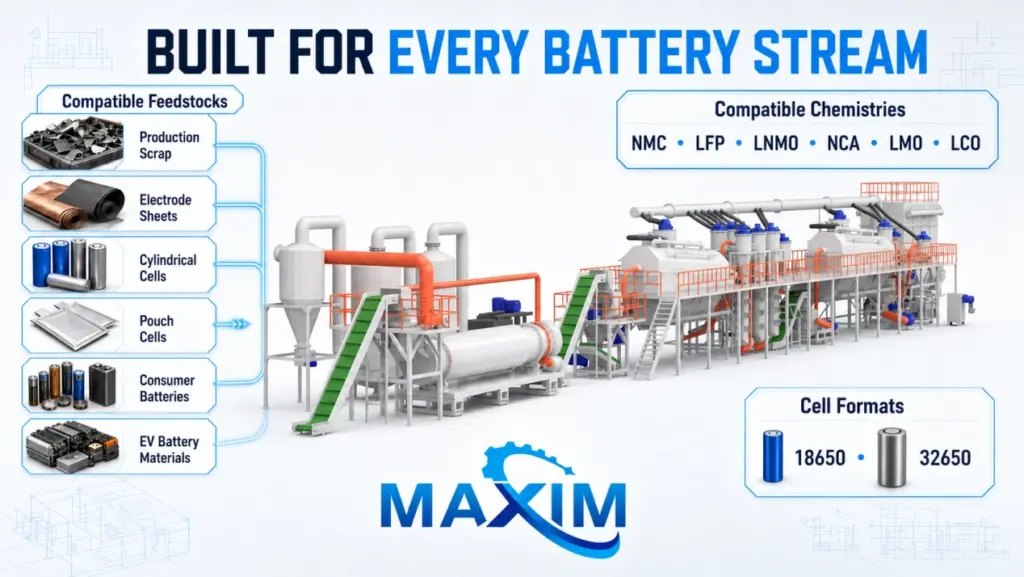
MAXIM machinery offers a lithium battery recycling line with shredding, crushing, screening, conveying, air separation, automatic control, and centralized dust collection. Battery recycling dust collection is described at size-reduction, screening, and conveying stages. The source map turns those line functions into connection and inspection points for a particular installation.
| Source or interface | Boundary to specify | Supplier response | Field check location |
| Shredder and crusher outlets | Enclosure and extraction connection | Connection drawing and access arrangement | Outlet and access door |
| Screen and air-separation transfers | Covered transition and capture point | Airflow path and interface owner | Transfer joint |
| Powder collection or container change | Closed transfer or local capture arrangement | Changeover method and supply boundary | Container connection |
| Collector discharge and filter service | Contained dust removal and service access | Maintenance sequence and responsible party | Collector service point |

Negative pressure means pressure inside a defined enclosure stays below the surrounding area while extraction operates. Verify it at specified openings; do not assume the whole plant is sealed. MAXIM machinery describes negative-pressure operation on the lithium battery line to help limit dust escape. For battery recycling dust collection, request the enclosure boundary, extraction connections, fan duty basis, and operating modes together.
List enclosure doors, panels, transfer gaps, and powder container interfaces. State whether each opening is closed during operation or opened for inspection after isolation. The supplier can then identify the capture zone and test condition. Keep the feed acceptance and safety boundary separate: extraction cannot make an unapproved battery safe to shred.
Battery recycling negative pressure depends on branch flow and duct and filter resistance. Ask for design airflow, connection size, pressure measurement point, and machines served. Figures must fit the actual layout and operating modes. Review how a loaded filter changes the balance and what control response follows. This makes battery recycling dust collection verifiable without assuming a universal flow target.

The battery recycling dust collector is one part of the capture path. Connect the enclosure, duct, collector, fan, discharge point, and powder container in the battery recycling dust collection drawing. Assign supply and sealing of each transition. Name the filter medium, cleaning arrangement, pressure monitoring, and emptying method in the supplier response; check them against the actual powder and project hazard assessment.
Battery recycling filtration concerns particles in extracted air. It does not establish control of gaseous electrolyte constituents or volatile organic compounds; those require a separate treatment scope. A stated collector efficiency also cannot establish worker exposure, outlet emissions, or cleanliness at every transfer point. For battery recycling dust collection, specify each measurement location, test condition, and acceptance criterion separately.
Maintenance matters because filters, bins, and access panels are handled after commissioning. Request service-clearance drawings and a route for removing collected dust. The supplier should state included alarms, shutdown interfaces, and service instructions. The site team should review these against the facility hazard assessment and agree how to recognize a blocked branch or failed extraction.
For each source point, request a marked drawing, enclosure description, branch airflow basis, measuring port, and installation owner. List collector components, filter service, dust discharge, controls, and excluded work separately. This keeps battery recycling dust collection tied to the material path rather than a single equipment price.
Agree on test locations before running the line. Check pressure or airflow at named branches under agreed operating states, inspect transfer joints, and record filter condition and dust discharge handling. Worker-exposure or outlet-emission measurements need defined sampling methods and applicable limits. A clean-looking area is not a measured result.
OSHA advises facilities to assess combustible-dust hazards and consider containment, capture, and housekeeping together. The project assessment should decide whether special protection is needed for the actual powder. MAXIM machinery can discuss centralized collection and negative-pressure interfaces when you contact MAXIM machinery with a process drawing and feed description. We can identify equipment-scope interfaces; acceptance criteria remain project-specific.
A: For battery recycling dust collection, review shredding, crushing, screening, conveying, air separation, and powder discharge across the battery recycling plant. Mark each enclosure opening and transfer connection on a drawing, then state where extraction begins and where capture will be checked. The final point list depends on the actual layout and feed.
A: Request the enclosure and duct connections, branch airflow basis, collector and fan arrangement, filter service method, discharge handling, and measurement points. If battery recycling automation monitors extraction, specify its alarm and shutdown response. Separate supplier scope from site installation and acceptance testing. A collector model by itself does not define capture at every machine or powder transfer.
A: It describes a lower pressure inside a specified enclosure while extraction is running. The specification should name the boundary, openings, operating state, and measurement point. It should also explain what happens when a filter loads or an access point opens. It is not a plant-wide guarantee.
A: Agree on the battery separation equipment interface, container change procedure, and test location before commissioning. Inspect the enclosure fit and record the agreed pressure or airflow reading in the defined operating state. A specialist should select any exposure or emission sampling method and interpret the result against applicable criteria.
A: No. Particle collection and treatment of gaseous electrolyte-related emissions address different streams. Define the particle capture boundary in this specification, then give any gas or VOC stream a separate engineering assessment, equipment scope, and acceptance method. Do not infer gas control from a filter or dust-collector claim.
On a lithium battery recycling plant drawing, a dust collector may be listed with other lithium battery recycling equipment even when powder transfer points remain undefined. Buyers then cannot tell what the enclosure covers, where extraction starts, or how capture will be checked. A battery recycling dust collection specification should map each source and assign excerpt …
