
Before anything ships out, get everything down on paper - that means the feed, runtime, readings, acceptance limits, witnesses, and any remedy needed. A factory acceptance test on some unknown feed just can't provide reliable answers to these questions. It all goes in one signed battery recycling FAT checklist. Both parties can see which record supports the release decision. Installation and site acceptance have their own checks.
Before you get started, agree on the battery recycling FAT checklist - this includes feed, contract scope, test method, and decision rule. Write the battery recycling FAT checklist before startup, not on the morning of the trial. A brochure capacity for a different battery mix does not set the limit for this project.
Describe the feed in operating terms: format, pretreatment, moisture, size, contaminants, blend, supplier, quantity, and preparation method. Whole cells and prepared electrode scrap are not equivalent inputs for lithium-ion battery recycling, even with matching chemistry. Treat charged, damaged, swollen, or unstable batteries as a separate safety case. Warm-up is not stable run time, and no stop disappears from the log.
MAXIM machinery lists crushing, conveying, screening, air separation, controls, and dust collection on the battery recycling line page. The battery recycling FAT checklist should name the configuration and feed before the trial. Our team can review both.
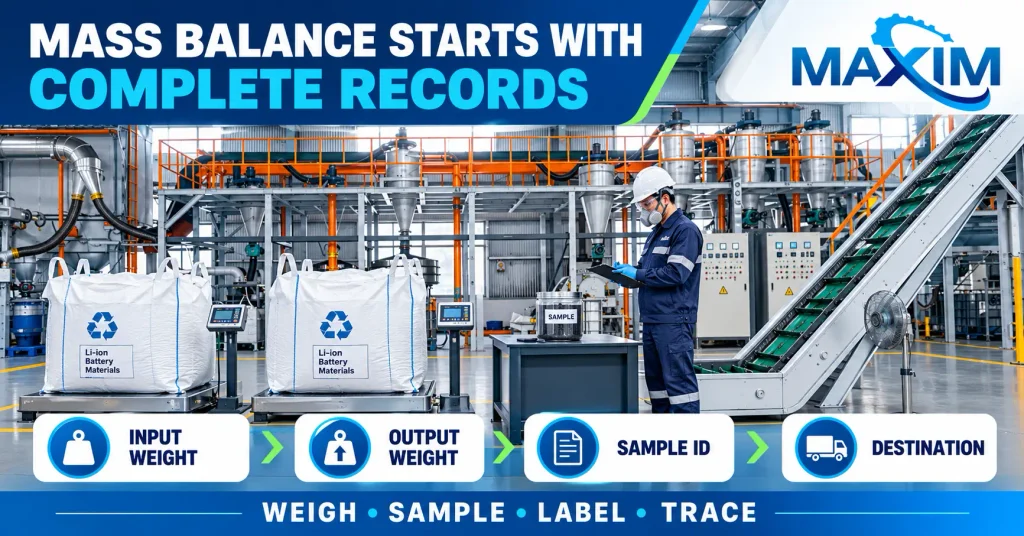
For each result, nail down the unit and calculation. Tolerance matters. So does duration. Which instrument will count? The battery recycling FAT checklist also needs the calibration record, witness, and counting rule. Agree on the laboratory, split samples, seals, storage, and what happens when results conflict. Otherwise, the battery recycling equipment acceptance test may end in a dispute.
First things first, check those tags. And the components, guards, drawings - all of it. Don't forget the control version, and run through the battery recycling FAT checklist too. Now, it's time for no-load checks. After that's done, log everything: feed rate, stops, alarms, any adjustments you made, rejections, and stable data - it's all important.
The battery recycling FAT checklist below is a blank template without universal pass values. Enter contract-specific limits before the test, along with the units, tolerances, and calculation rules that will be used.
| Test item | Record at FAT | Pass basis |
| Feed and runtime | Lot ID, preparation, start and stop times | Signed protocol |
| Throughput | Input mass, active time, interruptions | Contract rate and calculation |
| Output fractions | Mass, sampling point, and sample ID for each stream | Agreed balance and specifications |
| Dust and noise | Location, method, instrument, and readings | Applicable contract requirements |
| Controls and interlocks | Trigger, response, reset, and witness | Approved cause-and-effect list |
| Documents and sign-off | Drawings, raw data, deviations, signatures, and dates | Delivery and release rules |
To get the throughput, calculate it from the input mass and active time, using the contract's downtime rule. Keep setting changes on a separate record. If operators tune the line halfway through, keep the earlier and revised settings beside the readings. The battery recycling performance test should show the full agreed run, including every interruption.
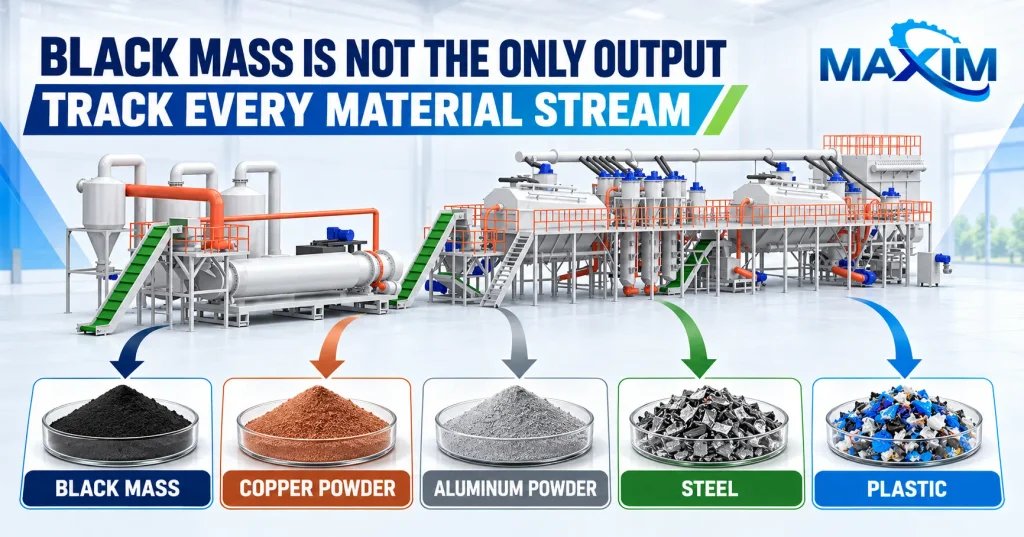
The battery recycling sampling plan is pretty comprehensive - it covers every single input and output sample. Points, intervals, samplers, seals, and chains of custody are all accounted for. Keep the sample ID with its sampler, time, seal, and destination. Now, when it comes to defining key terms, it's essential to separate recovery, yield, and purity - don't lump them together. Use the recovery-rate explanation to clarify things, then keep the actual test method beside the measured result.
Black powder, copper, and aluminum each need a recorded mass beside the related lab result. You'll also need to factor in dust and residual streams when the protocol requires them. Now investigate any gaps in the material balance - what's missing here? Finally, it's essential to outline the rules for re-sampling in the battery recycling FAT checklist, which should include all the required details to ensure accuracy.
In the battery recycling FAT checklist, link stops, guards, overloads, dust faults, and restart steps to their expected responses and resets. Use the signed cause-and-effect list, and record the trigger, response, reset condition, and witness. Site ventilation needs a separate check. So do the electrical installation and operating procedures.
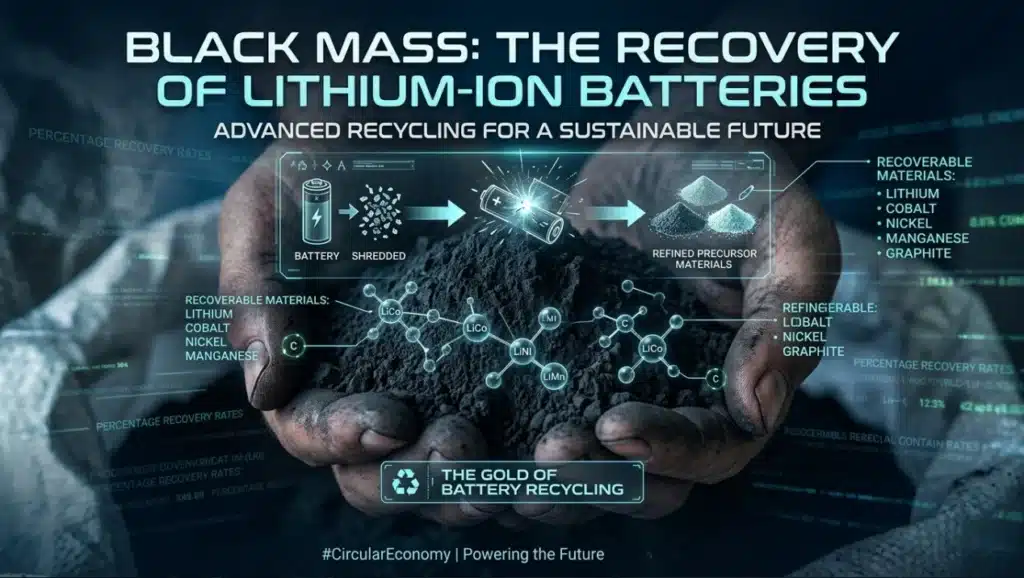
The battery recycling test report needs enough detail for another engineer to reconstruct the decision. File the signed FAT procedure with its readings, calculations, samples, lab reports, photos, alarm log, calibration evidence, and deviations. Each requirement gets one status: pass, fail, or not tested. Keep factory corrections separate from site actions.
Keep every failure, owner, correction, retest method, deadline, first reading, repeated reading, and item of closure evidence. Put the original and repeated readings together so the change can be reviewed. Sign off on the shipment decision and open actions, then put the project or line serial number on the FAT report.
MAXIM machinery offers a lithium battery recycling production line with physical size reduction, classification, and separation stages that buyers can witness and sample. Project acceptance figures come from the actual feed and configuration. Contact MAXIM machinery with the feed and required outputs.
A: Begin with the basics - the purchased line and feed. Runtime is a must, so are sequence, samples, instruments, limits, witnesses, deviations, and raw readings. Then there is the signed shipment decision. A short summary helps with review, but it does not show how each result was reached.
A: Think of these as two separate checkpoints. Factory testing deals with the assembled supplier configuration before shipment. Once installation is complete, site acceptance addresses the installed system, its utilities and interfaces, and local operating conditions. Some contract requirements appear in both plans, but the factory run cannot close work assigned to the site stage.
A: Put the collection point and interval in the protocol first. The same entry should name the sampler, seal arrangement, split-sample handling, laboratory method, and required analytes. Do the recovery and product-purity calculations separately. Each result needs its own denominator and sample basis, or the two figures will be easy to misread.
A: The contract has to adopt that capacity for the stated feed, configuration, duration, and calculation. A figure from a brochure or another lithium battery recycling project does not set acceptance for this line. Put the project limit and its measurement rule in the battery recycling FAT checklist.
A: The original failure and reading stay in the file. Once the correction is agreed, repeat only the affected test under the signed protocol, unless both parties approve a change. Then use the contract's shipment rule. Any item left open must have an owner, due date, and written acceptance.
Before anything ships out, get everything down on paper – that means the feed, runtime, readings, acceptance limits, witnesses, and any remedy needed. A factory acceptance test on some unknown feed just can’t provide reliable answers to these questions. It all goes in one signed battery recycling FAT checklist. Both parties can see which record excerpt …
