
Two lithium battery recycling lines can have the same nominal capacity and still deliver different operating results. The difference often comes from material liberation, screening accuracy, separation stability, dust control, and how well the line matches the incoming batteries.
For plant owners, recycling efficiency should be evaluated as a system rather than as one percentage. A useful assessment considers how much black mass, copper, and aluminum are recovered, how clean those fractions are, and whether throughput remains stable. At MAXIM machinery, we design mechanical recycling systems around these linked objectives.
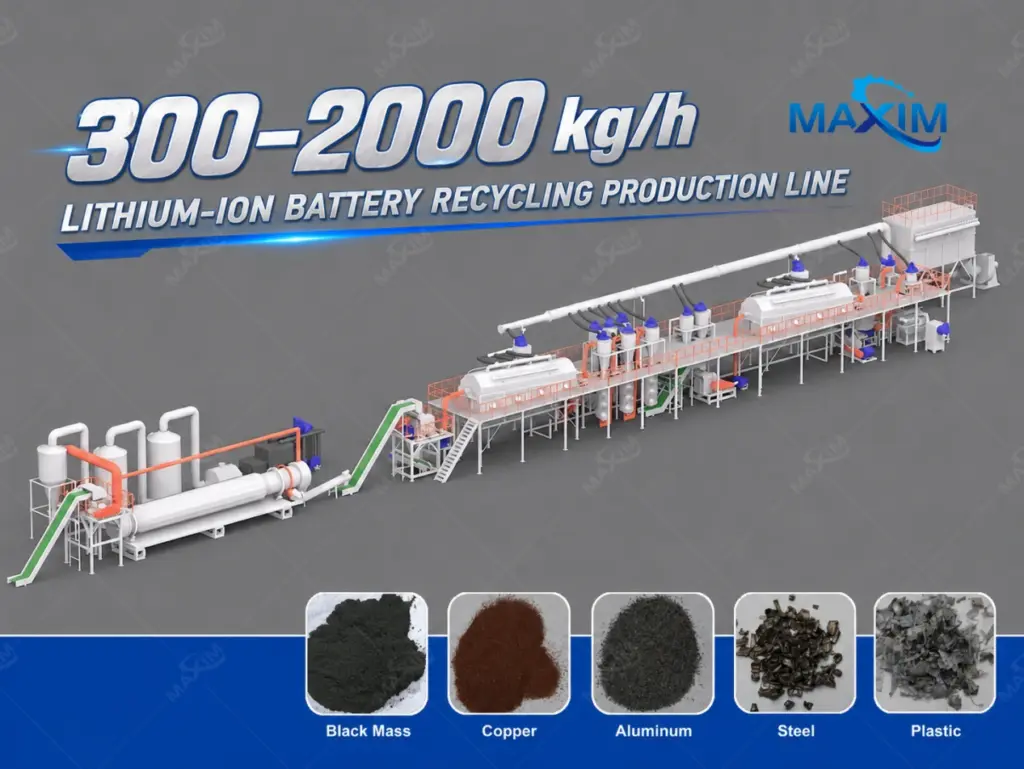
Recovery rate measures how much of a target material is captured from the feed. Purity measures how much of that target material is present in the recovered fraction. High recovery can still produce a contaminated output if separation is poor.
For our lithium battery recycling line, the technical indicators include black powder recovery, aluminum powder recovery, and copper recovery at ≥99%. Copper content in black powder and black powder content in copper are each listed at ≤1%. Recovery and cross-contamination should therefore be reviewed together.
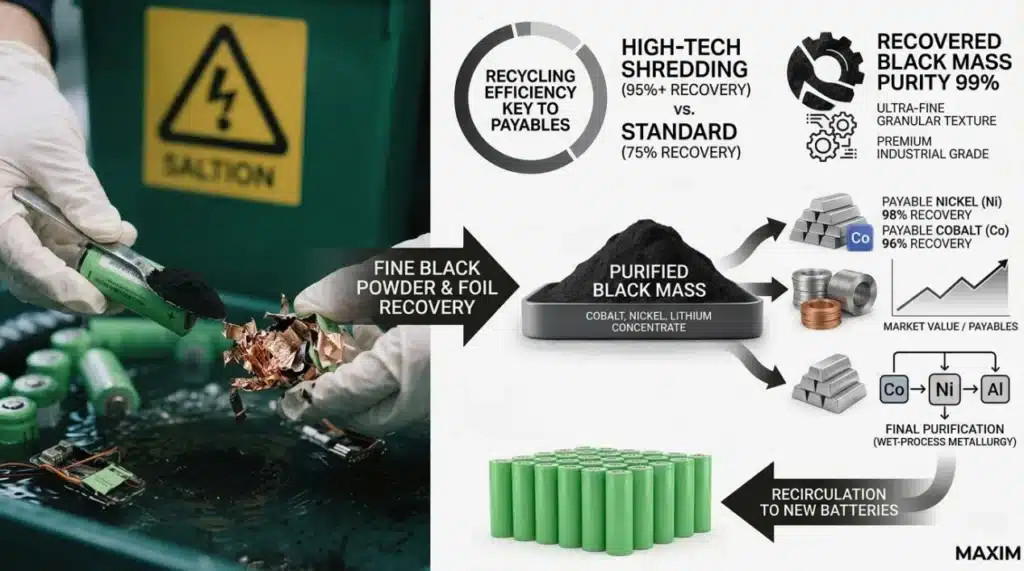
Capacity shows how much feed a line is designed to process per hour, but it does not explain output quality. Our listed models cover 500 to 2,500 kg/h.
| Model | Nominal Capacity |
| MX-500 | 500 kg/h |
| MX-1000 | 1,000 kg/h |
| MX-1500 | 1,500 kg/h |
| MX-2000 | 2,000 kg/h |
| MX-2500 | 2,500 kg/h |
Buyers should compare stable feed rate, recovered yield, fraction cleanliness, and downstream usability together.
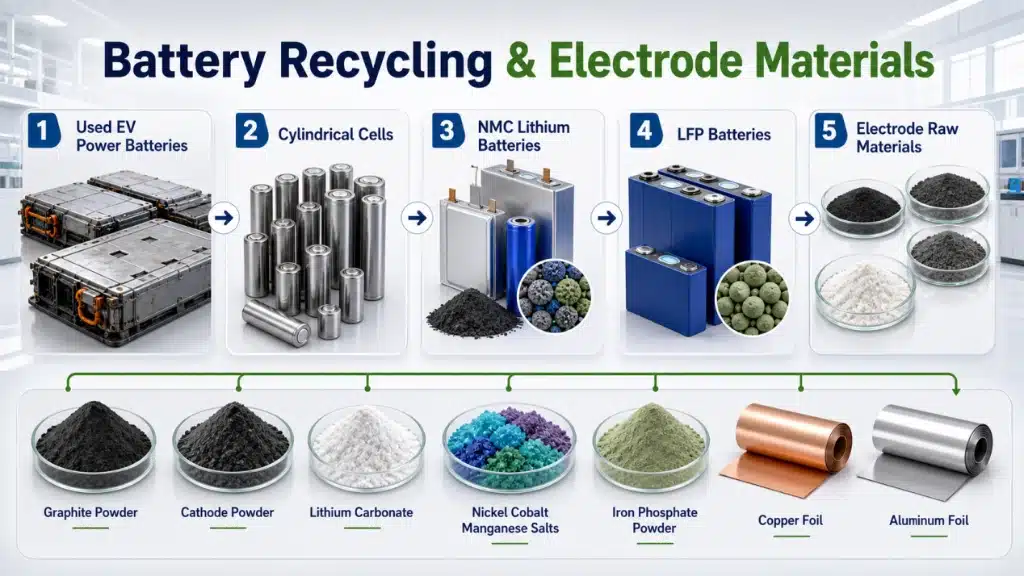
Feedstock strongly affects process design. The applications include NMC, LFP, LNMO, NCA, LMO, and LCO batteries, plus cell-phone, vehicle power, and laptop batteries.
Chemistries and formats differ in casing, electrode structure, foil content, and component proportions. A line configured for one feed stream should not automatically be expected to perform identically with another.
Mechanical liberation is the foundation of separation. Electrode material must be detached sufficiently from copper and aluminum foils before fine classification can work effectively.
Our working principle combines tearing, hammer crushing, vibrating screening, wind separation, and air separation. The goal is not simply smaller particles, but a particle condition that supports efficient downstream separation.
After crushing, particle size and density differences become useful. Screening separates fine powder from larger metallic fractions, while airflow-based separation helps classify materials with different physical characteristics.
A well-matched sequence reduces black mass remaining with metals and metal particles entering the powder stream. This improves both recovery and material quality.
Fine electrode powder is valuable and easy to disperse, so dust management affects workplace conditions and material retention.
Our line uses centralized dust removal and negative-pressure operation to limit dust overflow. The listed technical standard gives a dust-content target of ≤5 mg/m³.
A typical mechanical route can be summarized in six steps:
1.Feed and pretreat suitable battery material.
2.Tear or shred the batteries.
3.Crush to improve liberation.
4.Screen by particle size.
5.Separate fractions through airflow.
6.Collect black powder, copper, aluminum, and other outputs.
Our final products mainly include copper, aluminum, lithium cobalt oxide material, and graphite powder.
Black mass is the fine material obtained from end-of-life lithium-ion batteries or production scrap and mainly contains cathode and anode materials. It can contain lithium, cobalt, nickel, manganese, graphite, and other battery-related constituents.
A cleaner black-mass fraction is important because downstream hydrometallurgical or other refining processes depend on feed composition. Mechanical recycling equipment should therefore be judged by how effectively it separates black mass from copper, aluminum, plastics, and other fractions, not by claims about final purified metal recovery.
One customer project in India was planned around spent lithium batteries with a target capacity of 1 ton per hour. The engineering focus was to match the line to the feed material while maintaining a practical crushing, classification, and recovery sequence. Capacity is only one input; battery type, feed condition, desired fractions, site layout, and operating requirements also matter.
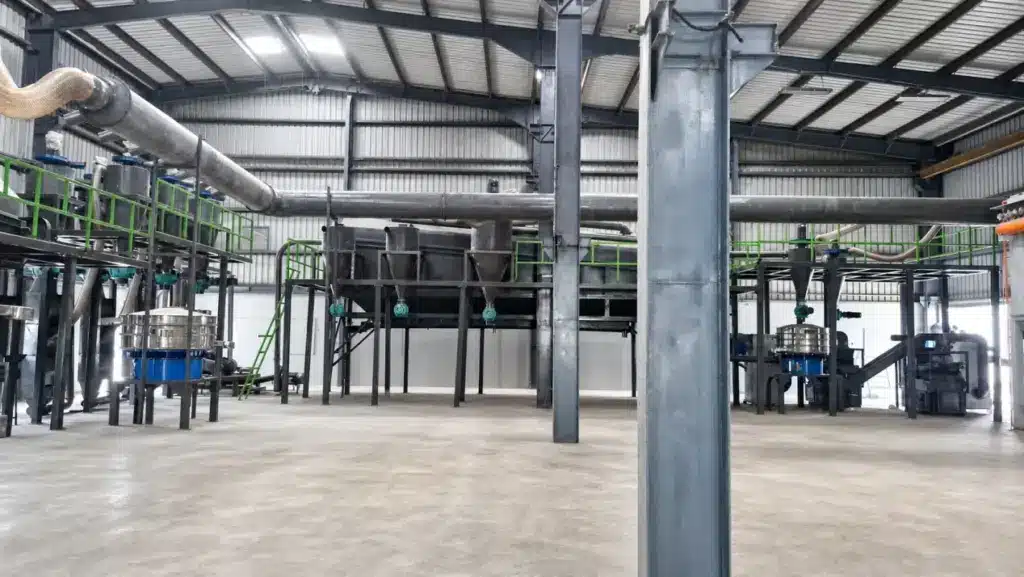
For this project type, the process logic follows the functions used in our lithium battery recycling system: tearing or shredding, crushing, screening, airflow separation, conveying, dust collection, and automatic control. Our line includes crushing, sorting, conveying, air purification, automatic control, and centralized dust removal systems.
The case illustrates a broader purchasing principle: a 1 t/h project should be engineered around actual feedstock and output targets, not selected only from a capacity label.
Before selecting equipment, ask the supplier to define each performance figure:
1.Which battery types were used for the stated performance?
2.Does recovery refer to black mass, copper, aluminum, or another fraction?
3.What contamination level is expected in each stream?
4.Under what feed conditions is nominal capacity achieved?
5.How is fine powder collected?
These questions make comparisons more meaningful than a single recovery percentage.
Positive and negative electrode sheets, cylindrical cells, LFP batteries, ternary batteries, and vehicle battery materials do not present identical processing conditions. Our application scope includes positive and negative chip processing, 18650 and 32650 batteries, LFP batteries, cylindrical batteries, and scrap vehicle lithium batteries.
The combination of shredding, crushing, screening, and separation should therefore follow the actual feed and desired outputs.
At MAXIM machinery, we focus on resource-recycling equipment and customized processing solutions for lithium batteries, metals, and solid waste. Our service scope covers preliminary consultation, solution design, equipment production, installation and commissioning, personnel training, and after-sales maintenance.
For a new project, we recommend providing battery type, hourly capacity, feed condition, target fractions, plant space, and utility requirements. These inputs help us configure the line around real production objectives instead of a one-size-fits-all specification.
A: Actual recovery depends heavily on the specific battery chemistry and the raw feed condition. It also relies on the process design and the exact material being measured. High-quality mechanical equipment must specify recovery separately for black mass, copper, aluminum, or other mixed fractions. Achieving final lithium, nickel, or cobalt recovery usually requires complex additional downstream refining.
A: Key factors include battery composition, crushing and liberation quality, particle-size control, screening efficiency, airflow separation, dust collection, and operating stability. Poor liberation can leave electrode material attached to metal foils.
A: Black mass is a fine, dark mixture mainly derived from cathode and anode materials after lithium-ion batteries are mechanically processed and larger fractions are separated. It is an important intermediate feedstock for further material recovery.
A: Match the equipment to the feedstock, then control feeding, shredding, crushing, screening, airflow separation, and powder collection as one coordinated process. Stable operation and clean separation are as important as nominal capacity.
A: Confirm battery chemistry, battery format, feed condition, target outputs, available space, and utilities before selecting the line. For a nominal 1 t/h requirement, MAXIM machinery lists the MX-1000 at 1,000 kg/h, while final configuration should still be based on actual project conditions.
A request such as “quote a scrap metal recycling line” leaves many technical questions open. Similar scrap can still require different feeding, shredding, conveying, sorting, and discharge arrangements. A better RFQ defines the job before asking for a machine. Material, capacity, sorting goals, final product, and site conditions should all be clear. What Information Should a excerpt …
