
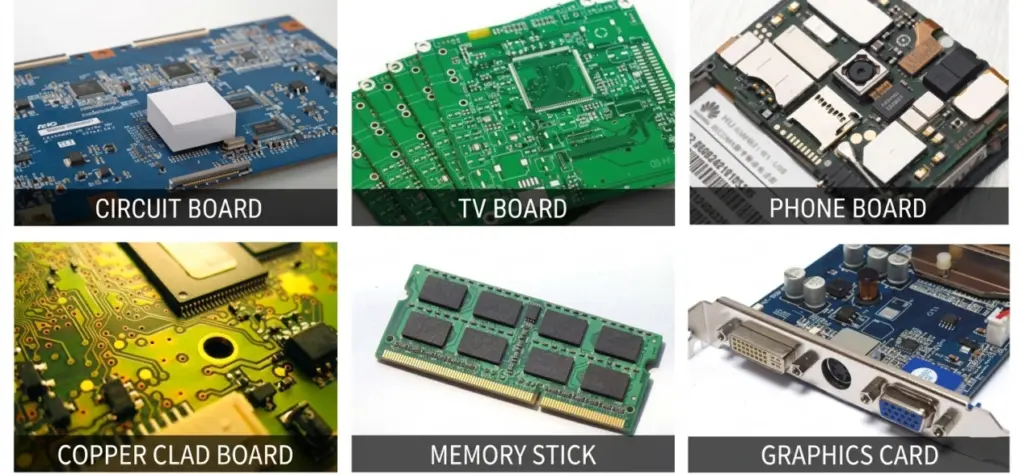
Investing in printed circuit board recycling serves as more than just an environmental duty. The activity stands as a truly profitable industrial opportunity when operators handle the work properly. The main goal of any electronic waste processing facility remains to pull out the greatest possible value from discarded materials. At the same time, the facility must keep operational costs low and limit environmental impact. Facilities that pick suitable processing technology can reach high purity levels in recovered materials. These high purity levels lead directly to stronger market prices and improved profit margins.
To see the real profitability in this industry, people need to look closely at the material makeup of standard printed circuit boards. Research indicates that electronic components account for 58% of their composition, the substrate for 37%, and solder for 5%. For every tonne of substrate processed, approximately 40% consists of metallic materials and 60% of non-metallic materials. These materials hold nearly every common element from the periodic table. As a result, the materials become very valuable.
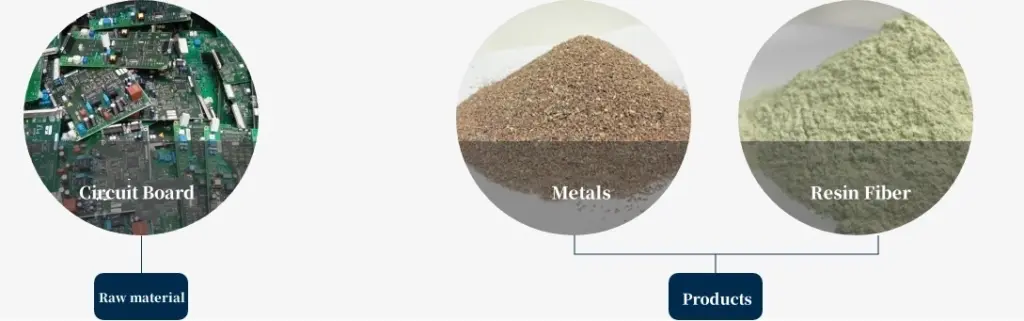
The economic promise grows even clearer when analysts examine exact metal yields. Experts estimate that one tonne of computer circuit boards holds 130 kg of copper, 0.5 kg of gold, 60 kg of lead, 40 kg of tin, 36 kg of nickel, 40 kg of antimony, 10 kg of iron, and additional rare and precious metals such as platinum and palladium. Because these metals, fibres, and resins carry high value, the use of professional electronic waste recycling equipment helps turn waste into useful resources. The same equipment also creates important economic gains for the plant operator.
In the past, the task of pulling out these valuable elements created real operational problems. Processing electronic waste from used mobile phones, computers, televisions, circuit boards, and home appliances required solutions for hard disassembly, loss of precious metals, and toxic contamination. Traditional methods often depended on manual dismantling or simple burning and chemical washing. These approaches always caused large losses of precious metals.
In addition, the old techniques could not stop environmental contamination from dangerous substances such as lead, mercury, and cadmium. Modern facilities need a closed-loop and automated method. This method must support exact recovery of precious metals like gold, silver, copper, and palladium. The approach must also allow recycling of materials such as plastics and resins. To overcome these problems, facilities require advanced machinery that focuses on dry physical separation instead of dangerous chemical treatments.
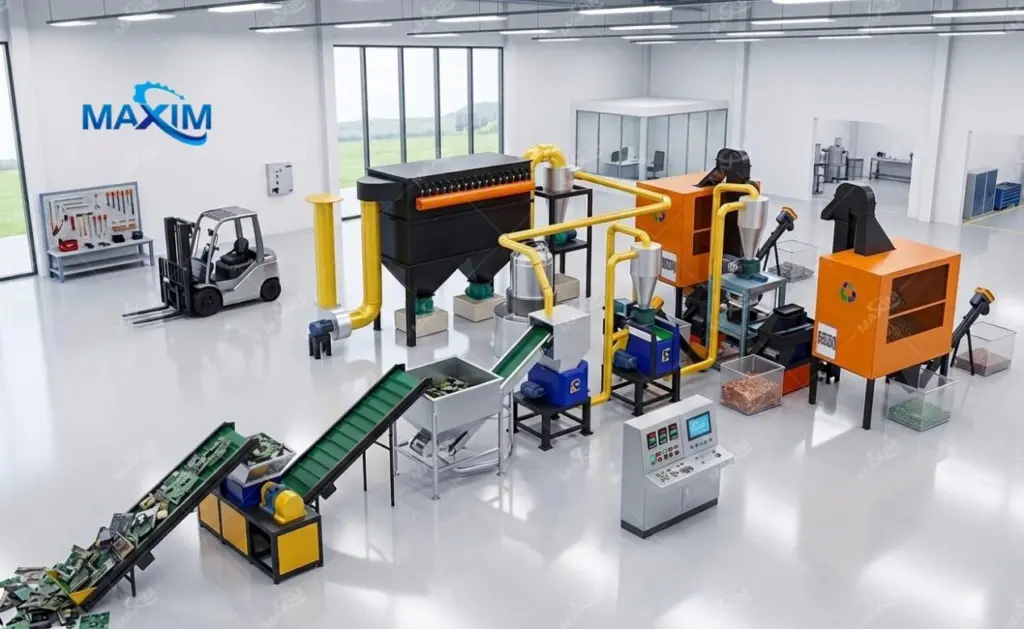
The modern PCB recycling production line works to process many kinds of waste circuit boards. Examples include computer boards, mobile phone boards, television boards, and copper-clad laminates. The line separates mixed metals from non-metals in the end. This dry physical separation method proves very efficient and runs completely without water or harmful chemicals.
The opening phase centers on preparing the raw materials. Electronic waste recycling equipment recovers circuit boards from inside electrical appliances such as televisions and computers. Before the main shredding starts, operators must remove large components, batteries, and hazardous elements. This early preparation protects the downstream crushing equipment from items that cannot be processed. The step also keeps the final sorted materials at high purity. After recycling and processing, the electronic waste separates into metallic and non-metallic materials. These materials then move into different downstream supply chains for reuse.
After preparation, the circuit boards move into the mechanical size-reduction phase. A three-stage crushing process is typically employed, which enables a processing capacity of up to 800 kg per hour depending on the equipment model. The boards first break down into smaller chunks. Workers then grind the material further into a fine mixture of metal and resin powders. During this phase, the recirculation system improves crushing efficiency because the system sends oversized particles back into the crusher. In addition, the system includes a magnetic separation function. This function removes iron from the material flow without trouble and prevents contamination of the non-ferrous metals.
The last and most important step separates the fine powder mixture according to material density and electrical conductivity. The air density separator utilizes controlled aerodynamic stratification to segregate lighter non-metallic fractions (resin and fiberglass) from the heavier metallic concentrates. This primary classification stage achieves a separation efficiency exceeding 97 percent. For the remaining mixed powder, the high-voltage electrostatic separator delivers finer and more effective sorting. The separator controls the loss of non-ferrous metals like copper in a successful way. This combined separation technique ensures that the recovered copper powder reaches an outstanding commercial grade.
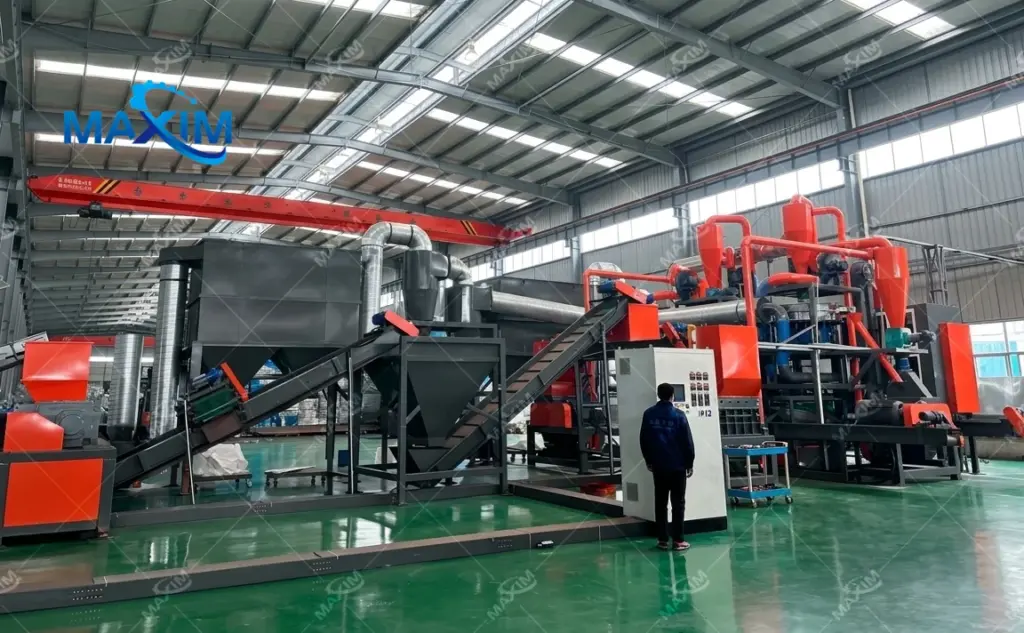
To create a dependable and profitable facility, investors must learn about the specific machinery that powers the process. MAXIM machinery focuses on the research, development, and manufacturing of environmentally friendly recycling machinery. We supply customized processing solutions.
The mechanical foundation of the facility depends on strong crushers. These machines offer a compact structure, sensible layout, stable performance, and low noise levels. Because printed circuit boards contain tough fiberglass and different metals, the shredder blades must show exceptional durability. Core components such as shredder blades and sorting systems come from independent development by MAXIM machinery. The wear and impact resistance of these components goes beyond industry standards. Furthermore, a programmable logic controller makes feeding uniform and coordinates operation across the entire production line.
Electrostatic separation technology serves as the key element in reaching maximum copper recovery. After air gravity sorting removes most of the non-metallic powders, the electrostatic separator creates a high-voltage electrical field. This field pushes conductive copper particles away from the non-conductive resin and glass fibers. The equipment stands as essential for facilities that want to produce the highest purity copper suitable for direct sale to metal smelting plants.
Processing dry circuit boards creates a large volume of fine and possibly hazardous dust. To address this issue, the entire production and conveying line operates under a continuous negative pressure environment. This design effectively encapsulates the system, preventing fugitive dust emissions at critical transition points. The pulse dust collector works at an efficiency of over 99 percent. The collector suppresses dust emissions effectively and meets national environmental protection requirements in full. No secondary pollution occurs.
Choosing suitable equipment calls for a thoughtful balance among expected processing volume, available budget, and long-term operational goals. MAXIM machinery creates customized layouts based on customer production capacity requirements, material characteristics, and site conditions. This approach avoids one-size-fits-all solutions.
The target throughput determines the size and power of the plant that operators need. Electronic waste recycling equipment works well for recycling many types of circuit boards, including standard PCBs and flexible printed circuit boards. The table below compares standard technical parameters for different plant capacities and helps guide selection.
| Equipment Model | Capacity (kg/h) | Power (kw) | Dimension (M) | Weight (T) |
| MX-PCB 300 | 200-300 | 102 | 2055 | 15 |
| MX-PCB 500 | 400-500 | 134 | 2565 | 20 |
| MX-PCB 800 | 600-800 | 194 | 3065 | 30 |
| MX-PCB 1000 | 800-1000 | 238 | 3585 | 40 |
A lower initial purchase price sometimes hides high long-term maintenance costs. Modern investors should seek intelligent control systems that cut down on manual work. The equipment includes a PLC control system that supports remote monitoring and fault warnings. These features lower operation and maintenance costs in a meaningful way. For daily upkeep, the entire production line comes with walkways and guardrails at elevated positions. The additions make real-time monitoring and maintenance easier for service personnel. MAXIM machinery also offers a full-life cycle service. The service covers preliminary consultation, solution design, equipment production, installation, personnel training, and after-sales maintenance. Responses arrive within 24 hours to keep operations stable.
We are excited to announce that MAXIM machinery will be participating in the upcoming Metal, E-Waste & Battery Recycling Expo 2026 in Germany. If you are looking to optimize your precious metal and copper recovery, visit our booth to discuss custom solutions for your plant.
A: The most efficient and environmentally responsible method today is the dry physical separation process. The method avoids toxic chemicals and water usage completely. Instead, the process depends on a multi-stage mechanical crushing system followed by precision air classification and high-voltage electrostatic separation. This automated approach reaches a separation efficiency of over 97 percent for air sorting alone. The method ensures maximum recovery of valuable copper and precious metals. At the same time, the process consistently complies with stringent modern environmental emission standards through advanced particulate filtration.
A: The separation happens through differences in physical properties such as specific gravity and electrical conductivity. After operators pulverize the circuit boards into a fine powder mixture, air flow separators lift the lighter non-metallic materials like resin and fiberglass away from the heavier metals. The remaining mixture then enters a high-voltage electrostatic separator. Metals conduct electricity while plastics do not. Because of this difference, the electrostatic field moves the metal particles into a separate collection bin. The result is an exceptionally high purity rate.
A: Dry physical separation stands far superior for modern e-waste copper extraction. Wet chemical processing creates highly toxic wastewater. The process also leads to secondary pollution and demands costly environmental permits. In contrast, the dry method uses a fully closed-loop system that includes a pulse dust collector. The collector operates at over 99 percent efficiency. This setup produces zero hazardous wastewater. No secondary pollution takes place, and the plant meets national environmental protection laws with ease.
A: The technology that operators choose controls both the initial capital expenditure and the ongoing operational costs. A complete system that features three-stage crushing, PLC-automated controls, and electrostatic separation needs a higher initial investment than basic shredders. Even so, this advanced configuration reduces manual labor costs, decreases energy consumption, and raises the purity and yield of the recovered copper in a dramatic way. In the end, the higher quality of the final product creates a much quicker return on investment and stronger long-term profitability.
A request such as “quote a scrap metal recycling line” leaves many technical questions open. Similar scrap can still require different feeding, shredding, conveying, sorting, and discharge arrangements. A better RFQ defines the job before asking for a machine. Material, capacity, sorting goals, final product, and site conditions should all be clear. What Information Should a excerpt …
