
The rapid expansion of the electric vehicle market has generated a complex waste stream for recycling facilities. Investors and process engineers face the daily reality of receiving highly varied materials, ranging from cell phone batteries and laptop batteries to large car power batteries. Within these categories, the physical formats differ drastically, encompassing cylindrical structures like 18650 and 32650 cells, as well as flexible pouch designs. Sorting these discarded power units into perfectly uniform batches before processing is economically inefficient and technically impractical. Therefore, a modern EV battery recycling machine must possess the mechanical versatility to accept a mixed input of different cell structures without jamming, losing efficiency, or compromising the purity of the final extracted resources. This adaptability directly influences the operational uptime and overall profitability of the recycling plant.
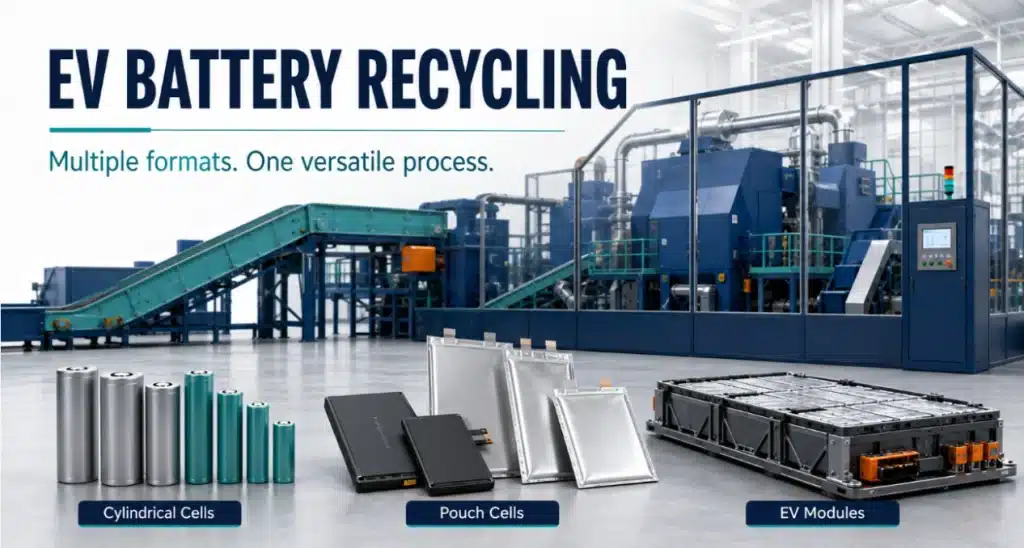
Beyond physical shapes, the internal chemical makeup of end-of-life power units varies significantly. Facilities commonly process a mixture of chemistries, including Lithium Nickel Cobalt Manganese Oxide, Lithium Iron Phosphate, Lithium Nickel Manganese Spinel, Lithium Nickel Cobalt Aluminium Oxide, Lithium Manganese Oxide, and Lithium Cobalt Oxide. An optimized lithium battery recycling production line must handle the distinct material densities and binder properties of these different formulations. For instance, ternary materials containing valuable metals like cobalt and nickel require precise separation to maximize their market value. Simultaneously, the system must efficiently process iron phosphate inputs, which are dominating the current energy storage landscape. A versatile setup ensures that regardless of the incoming chemistry, the facility can maintain continuous throughput and extract high-value commodities without requiring constant manual reconfiguration.
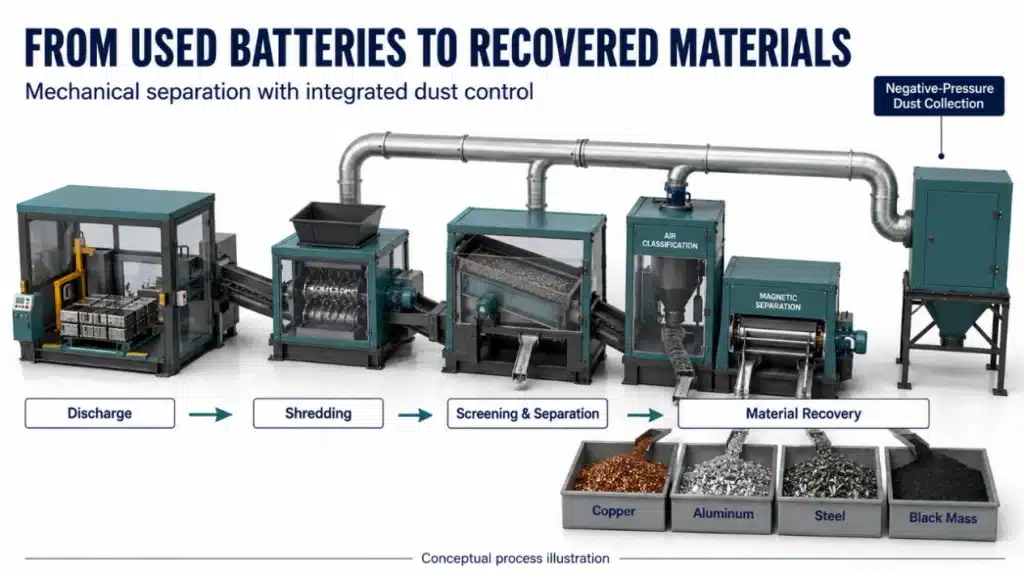
The initial size reduction phase is critical for safe and effective material liberation. MAXIM machinery’s systems utilize a combined process starting with a tearing machine and followed by hammer crushing mechanisms. This robust mechanical approach is engineered to forcefully break open rigid steel shells, aluminum casings, and flexible polymer pouches alike. Before entering the shredding phase, materials undergo discharge treatment to eliminate potential safety hazards and prevent thermal runaway during the mechanical breakdown. By reducing the mixed waste into uniform fractions, the shredding modules prepare the complex internal components, such as the coated foils and separators, for the subsequent dry separation stages.
Once the materials are crushed, they enter a sophisticated sorting system designed to separate materials based on density and physical properties. Our technology integrates vibrating screens and air separation units to systematically divide the shredded fractions. The wind separator specifically targets lightweight materials, efficiently lifting and removing the plastic diaphragms from the heavier metallic and carbon components. This multi-stage screening process ensures that the aluminum, copper, and positive and negative electrode materials are thoroughly isolated. The precision of the air classification directly impacts the quality of the output, preventing cross-contamination between the valuable conductive foils and the active electrode powders.
Achieving battery-grade purity requires the strict removal of ferrous contaminants. Following the initial crushing and screening, the material stream passes through a high-intensity magnetic separator. This module captures and extracts the steel shells and other iron-based fragments from the flow. Removing the steel early in the process prevents damage to downstream grinding equipment and ensures the high purity of the non-ferrous metals and active powders. Our equipment achieves exceptional separation metrics, maintaining an aluminum content in the black powder of less than or equal to one percent, and a copper content in the black powder of less than or equal to one percent. Furthermore, the overall recovery rate for copper and aluminum powder reaches greater than or equal to ninety-nine percent.
Processing dry battery materials inherently generates significant amounts of fine, potentially hazardous particulates. To address this, we equip our processing facilities with a centralized black powder collection system that operates entirely under negative pressure. This design ensures that there is no dust overflow during the production process, keeping the working environment clean and protecting operator health. The exhaust air passes through advanced filtration systems, including a cartridge dust remover and a spray tower associated with an RCO catalytic combustion furnace, to neutralize emissions. Through these rigorous environmental controls, the dust content is restricted to less than or equal to five milligrams per cubic meter, and operational noise is kept below ninety decibels.
Every commercial recycling venture has unique volume requirements and space constraints. We customize the production line layout and equipment parameters according to specific customer production capacity requirements to avoid inefficient, one-size-fits-all setups. To accommodate varying scales of operation, MAXIM machinery offers multiple equipment models with distinct processing capacities:
Model MX-500 features a capacity of 500 Kg/H.
Model MX-1000 features a capacity of 1000 Kg/H.
Model MX-1500 features a capacity of 1500 Kg/H.
Model MX-2000 features a capacity of 2000 Kg/H.
Model MX-2500 features a capacity of 2500 Kg/H.
This scalable approach allows plant managers to select the exact machinery required for their current feedstock supply while maintaining the option to upgrade specific modules as their recycling volume expands.
Efficient management of varied inputs relies on intelligent control systems that reduce the need for manual intervention. Our automated recycling processes are designed to seamlessly transition between different batches of waste without halting production. When processing a combination of cylindrical cells and soft packs, the integrated PLC systems adjust the feeding rates to prevent overloading the tearing and crushing modules. The final outputs generated from this streamlined, mixed-feedstock process are highly refined commodities. These mainly include separated copper, aluminum, lithium cobalt oxide, graphite powder, and steel. By achieving a black powder recovery rate of greater than or equal to ninety-nine percent, facilities can maximize their return on investment from every ton of mixed waste processed.
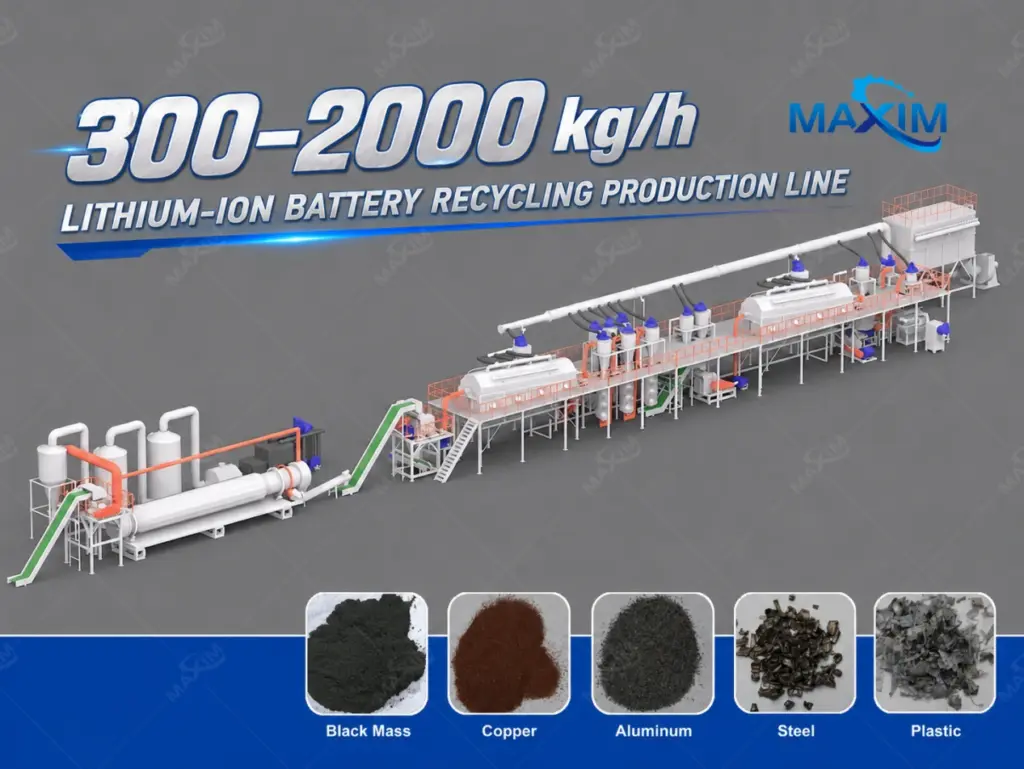
Building a profitable and environmentally compliant facility requires more than just standalone machinery; it demands a comprehensive, fully closed-loop processing architecture. We are a team of experienced, professional application engineers, designers, and technicians dedicated to providing continuous value throughout the lifecycle of your project. Our full closed-loop processing method, encompassing pre-shredding, crushing, and sorting, meets strict environmental emission standards while maximizing resource reuse. We provide a one-stop service program covering preliminary consultation, solution design, equipment production, installation and commissioning, personnel training, and after-sales maintenance. By choosing our advanced sorting technologies, investors can confidently process diverse feedstocks, reduce operational costs, and secure a strong position in the rapidly growing circular economy of energy storage materials.
A: Capacity configurations are highly flexible and can be tailored to match your specific plant requirements. We offer a range of standard models to suit different operational scales, starting from the MX-500 at 500 kilograms per hour up to the MX-2500, which processes 2500 kilograms per hour.
A: Yes, our equipment is specifically designed to adapt to various battery types, including ternary lithium and lithium iron phosphate. The combination of wind separators, vibrating screens, and air separation technologies allows the system to effectively process mixed chemistries and isolate the valuable positive and negative electrode materials.
A: The system handles diverse formats by utilizing a robust preliminary size reduction stage. A heavy-duty tearing machine combined with hammer crushing is used to break down rigid structures like 18650 and 32650 cylindrical cells, as well as flexible pouch designs, ensuring uniform material sizing for the subsequent sorting stages.
A: The environmental control system is highly effective because the entire production line operates under negative pressure, ensuring zero dust overflow during production. Utilizing a centralized black powder collection system and cartridge dust removers, the final dust emission concentration is strictly maintained at less than or equal to five milligrams per cubic meter.
A: By utilizing advanced sorting modules, the separation process yields exceptional purity. The final black powder recovery rate reaches greater than or equal to ninety-nine percent. Furthermore, the aluminum content within the extracted black powder is kept to less than or equal to one percent, and the copper content is also restricted to less than or equal to one percent.
Why Mixed Feedstock Compatibility Drives Recycling Profitability The Challenge of Processing Diverse Retired EV Batteries The rapid expansion of the electric vehicle market has generated a complex waste stream for recycling facilities. Investors and process engineers face the daily reality of receiving highly varied materials, ranging from cell phone batteries and laptop batteries to large excerpt …
