
Choosing an industrial metal shredder is not simply about motor power or advertised capacity. The machine must match the feed material, output size, operating schedule, and downstream recovery process. Equipment suitable for steel drums may not be ideal for car bodies, aluminum profiles, mixed demolition scrap, or light-gauge sheet.
For scrap yards, dismantling plants, foundries, and recycling facilities, the buying process should start with a clear material profile and production target.
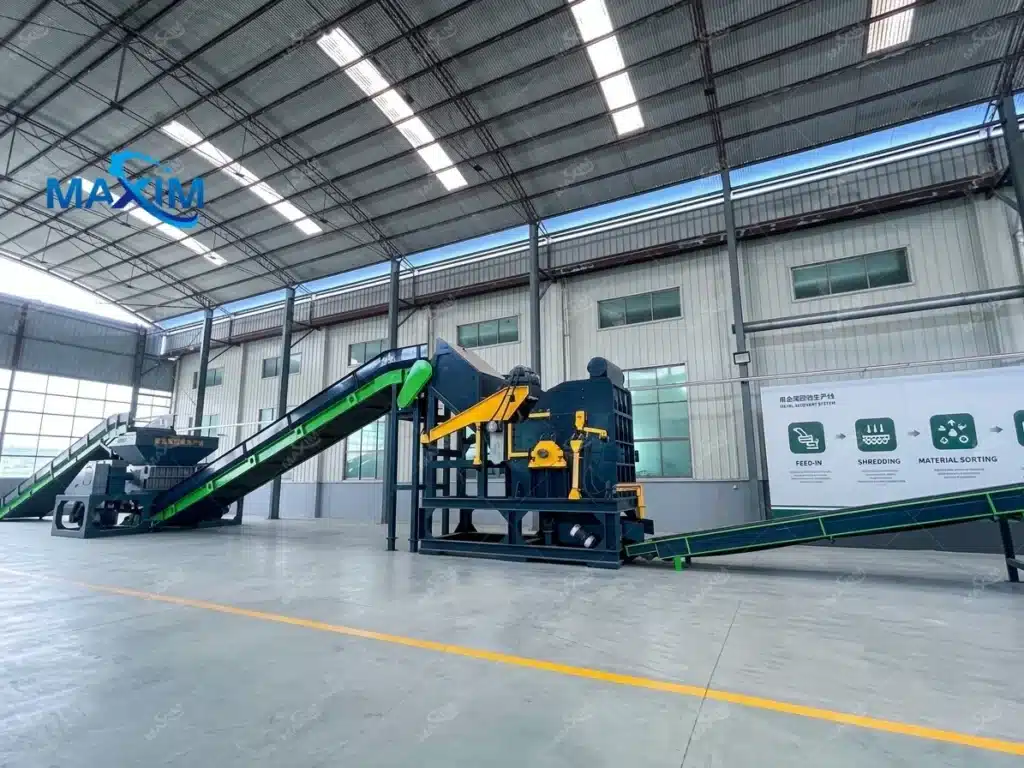
Start by recording the scrap composition, maximum dimensions, wall thickness, bulk density, and contamination level. Clean factory offcuts behave differently from mixed scrap containing rubber, plastic, soil, wood, or fabric.
Bulky items such as car shells, drums, and appliances normally need strong primary reduction. Light ferrous scrap may require impact crushing to release impurities and create a denser fraction. Non-ferrous metals need controlled processing because excessive fines may reduce sorting efficiency.
Before requesting a quotation, identify:
MAXIM machinery develops customized recycling solutions according to material properties, capacity requirements, and site conditions rather than applying one standard configuration to every project.
Output size should be determined by the next stage. Coarse pieces may be acceptable for volume reduction or secondary crushing. Smaller, uniform fragments are usually preferred for material liberation, separation, or smelting preparation.
| Reduce bulky scrap volume | Coarse, manageable pieces | Storage, transport, or secondary crushing |
| Prepare light steel scrap | Smaller, denser material | Magnetic separation or smelting |
| Recover mixed metals | Liberated, controlled-size material | Magnetic and eddy current separation |
| Stabilize line feeding | More uniform pieces | Conveying, screening, or sorting |
Instead of asking only how small a machine can shred, buyers should ask which output range gives the best result in the next process.
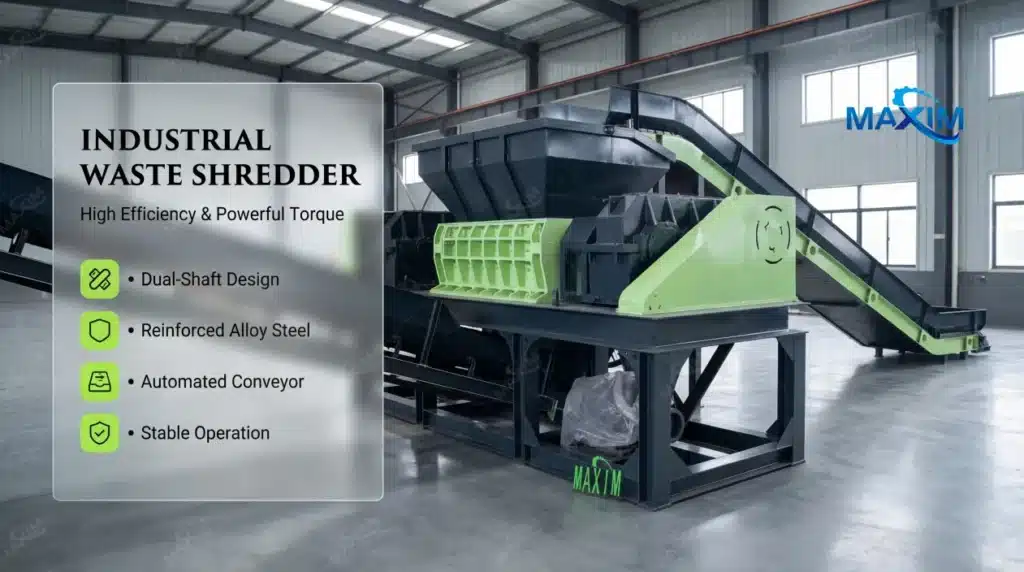
A pre-shredder reduces oversized material before secondary processing. It can stabilize feeding and reduce sudden loads on downstream conveyors, hammer shredders, screens, and separators.
Consider a scrap yard receiving vehicle shells and light steel. Direct feeding into a high-speed crusher may create uneven loading. A practical arrangement could use primary shredding, followed by hammer crushing and separation. Material testing should confirm the final configuration.
In this type of system, the pre-shredder is not expected to produce the final saleable fraction. Its role is to create a manageable and consistent intermediate feed for the following processing stages.
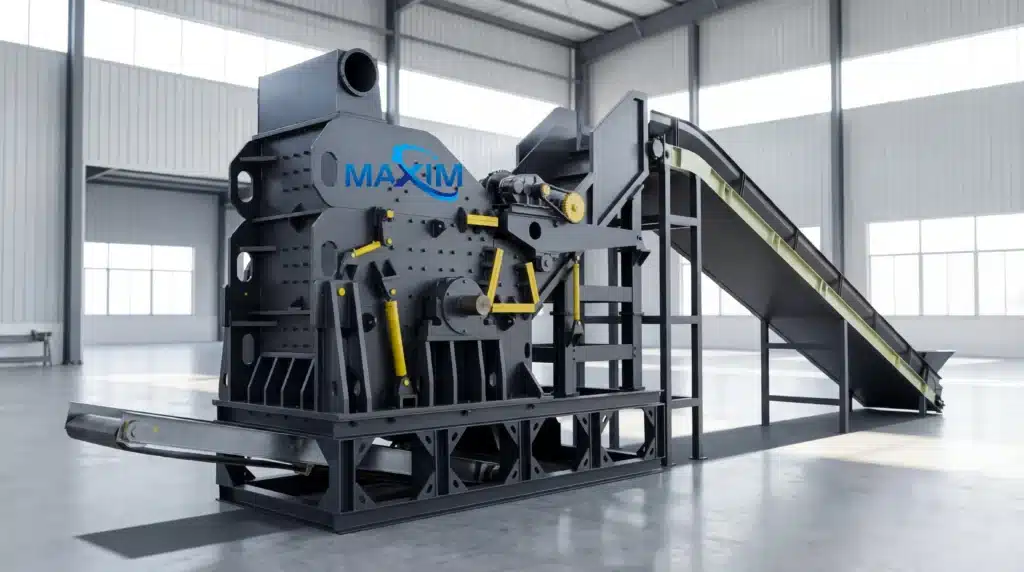
Hammer shredders use repeated impact to break and deform scrap. They are generally suitable for light ferrous material, discarded appliances, thin sheet, and pre-reduced feed that requires further liberation.
Impact crushing can separate metal from attached materials and create a denser fraction for magnetic separation. Oversized or irregular scrap may still require pre-shredding.
MAXIM machinery’s scrap metal recycling production line can combine crushing with magnetic and eddy current separation. This arrangement supports the recovery of ferrous and non-ferrous metals from non-metallic impurities.
A hammer shredder should therefore be evaluated according to more than the final particle size. Buyers must also consider whether the machine produces material that can be evenly transported, screened, and separated by the following equipment.
Required throughput should come from the plant’s actual schedule:
Required hourly capacity = daily scrap volume ÷ effective operating hours
Processing 80 tons during eight effective hours requires an average of 10 tons per hour. Effective hours should exclude maintenance, shift changes, feeding delays, and stoppages. Some spare capacity is needed for peaks.
MAXIM machinery configures scrap metal recycling lines according to project conditions. Available integrated line capacities range from 10 to 50 tons per hour, depending on material characteristics and equipment configuration.
Buyers should avoid selecting a line only according to annual processing volume. Hourly feed peaks, storage limitations, delivery schedules, and the operating time available for each shift may have a greater effect on the required machine size.
Published throughput is meaningful only when test conditions are known. Loose sheets, compacted bundles, cast components, and aluminum profiles have different loading behavior.
Ask the supplier to define:
Power must be considered together with torque, shaft speed, chamber design, and cutter geometry. A larger motor alone does not guarantee stable production.
For example, a lightweight but bulky scrap stream may fill the chamber quickly without reaching the machine’s weight-based capacity. Dense metal components may create the opposite problem by placing heavy loads on the shafts and blades. A realistic material test helps prevent both under-sizing and unnecessary investment.
The cutting system affects capacity, output, and maintenance. Compare blade material, shape, spacing, shaft construction, replacement access, wear points, inspection intervals, and spare-parts supply.
MAXIM machinery independently develops core components such as shredder blades and sorting systems. Our equipment can also use PLC control with remote monitoring and fault warnings, helping operators coordinate production and identify problems.
A technical quotation should state exactly what is included. Measurable maintenance information is more useful than general claims about long service life. Buyers should request a list of recommended spare parts and confirm which components are considered normal wear items.
The cutting chamber must also suit the incoming scrap. A machine with strong cutters may still perform poorly if long materials bridge over the chamber or bulky pieces cannot enter the feed opening.
An industrial metal processing shredder should be assessed as part of a system. Automated feeding, overload protection, coordinated conveyors, maintenance access, and fault alerts can improve stability.
Before choosing a supplier, ask:
MAXIM machinery provides consultation, solution design, equipment production, installation, commissioning, personnel training, and after-sales maintenance for complete projects.
This approach is especially important when several machines must operate together. A powerful shredder provides limited value if the conveyor, separator, or discharge system cannot handle its output.
A complete line may include conveyors, primary shredding, hammer crushing, screening, magnetic separation, eddy current separation, dust control, and final handling.
Magnetic separators recover ferrous fractions. Eddy current separators help separate conductive non-ferrous metals from non-metallic material. Both depend on suitable particle size, adequate material liberation, and even feeding.
MAXIM machinery’s scrap metal recycling line follows a crushing, impurity-removal, sorting, and forming sequence. Integrated magnetic and eddy current separation can improve metal purity and prepare recovered materials for the downstream supply chain.
Dust collection should also be planned as part of the complete layout. Shredding painted, coated, or contaminated scrap may generate dust and light fractions that must be controlled before they reach the sorting area.
Send every supplier the same project information so that quotations can be compared fairly:
The best proposal is the one that clearly explains how the system will process the real material, connect with downstream sorting, and maintain stable operation.
Buyers should also confirm how performance will be accepted after installation. The test should define the material, operating period, throughput measurement, output requirements, and acceptable interruption conditions. This turns broad supplier promises into measurable project criteria.
A: The best machine depends on feed type, incoming size, contamination, throughput, target output, and downstream separation. Bulky mixed scrap normally requires a different configuration from light ferrous sheet.
A: Throughput varies with material density, feed consistency, chamber size, cutter configuration, power, and output requirements. Capacity should be verified using comparable scrap. MAXIM machinery configures integrated metal recycling lines in the 10 to 50 tons per hour range, depending on the project.
A: A double-shaft shredder is generally used for coarse reduction of bulky or mixed scrap. A hammer shredder is more suitable for further crushing light ferrous material and preparing it for magnetic separation. Some lines use both.
A: Ask about material testing, guaranteed capacity conditions, output size, blade supply, maintenance access, power requirements, automation, installation, operator training, and after-sales support.
A: One machine may process both categories, but its cutter configuration, feeding method, output requirement, and downstream sorting system must match the mixture. Magnetic and eddy current separation may be needed to recover different fractions.
A request such as “quote a scrap metal recycling line” leaves many technical questions open. Similar scrap can still require different feeding, shredding, conveying, sorting, and discharge arrangements. A better RFQ defines the job before asking for a machine. Material, capacity, sorting goals, final product, and site conditions should all be clear. What Information Should a excerpt …
