
Construction and demolition waste is usually a mixed load. A load of waste may consist of timber, plastics, metal profiles, cables, insulation, concrete, and packaging of all shapes and sizes.
The right choice depends on feed composition, required particle size, and the next separation step. A shredder usually performs coarse reduction at the front of the line, while a grinder is used later when smaller, more consistent particles are needed.
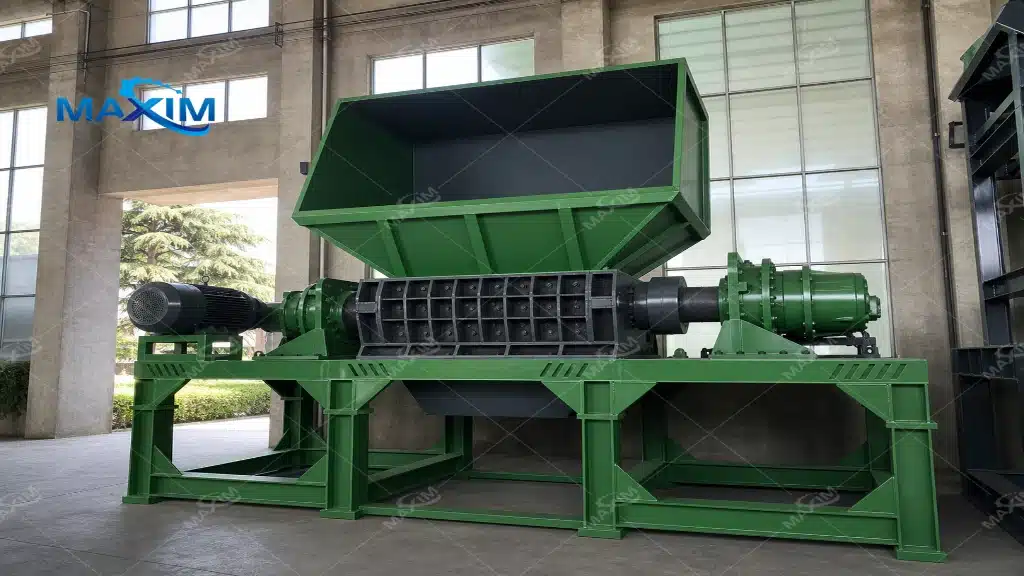
Industrial shredders are used to cut large pieces of waste down to size. The machines take large, irregular, or mixed material feedstocks and cut them down to a manageable size. The machines have low-speed, high-torque shafts that pull the material down into the cutting chamber, where the blades then cut and tear the waste into smaller pieces.
A double-shaft shredder is suitable for items like wooden pallets, timber offcuts, plastic pipes, film, packaging materials, cables, and other light metal items. As the two shafts wind around each other within the shredding unit, difficult-shaped and irregularly weighted items can be gripped without the need for precise pre-shredding or stockpiling in advance.
The purpose is usually not to create a fine final product. Shredding reduces volume, opens bundled material, improves conveyor handling, and prepares waste for screening, magnetic separation, air classification, or secondary reduction.
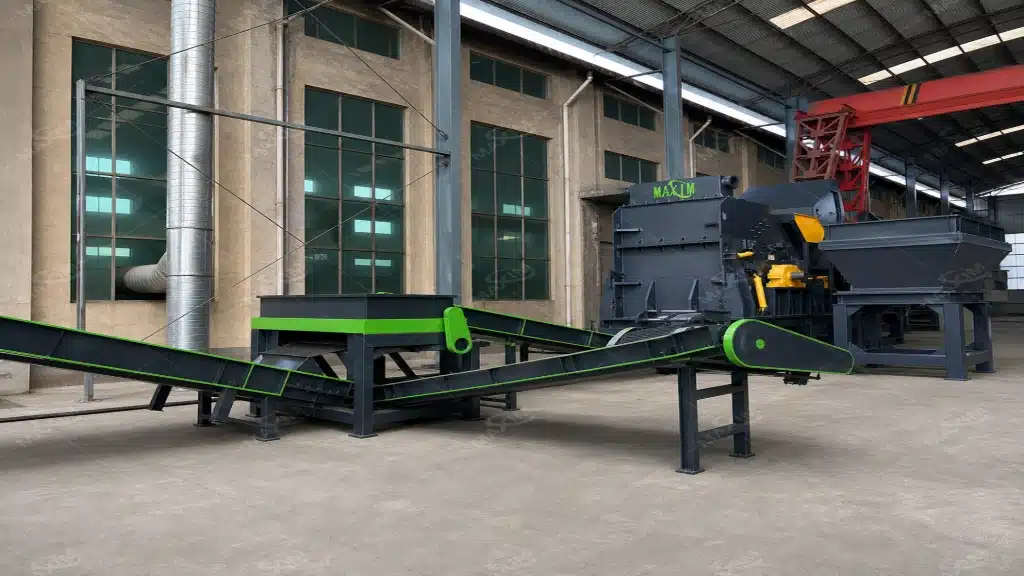
An industrial grinder is designed to handle smaller amounts of material and to be more precisely fed. In an industrial grinder, material is either impacted, cut, or abraded to create finer and more uniform particles.
Grinders are used to cut materials to a constant size, generally to go through a screen or another process. They can cut up clean wood for burning, cut up separated plastics to reduce size, or break up materials to release other materials within them. However, grinders are generally less tolerant of random contaminants. Thick steel, stones, reinforced concrete, and even large-sized waste can rapidly wear down grinders or even block them up.
Grinders are typically used as finishing machines and thus are not the first machine to process mixed demolition waste.
The biggest differences between shredders and grinders are noticed at the inlet. Shredders can take in bigger pieces and even mixed-up shapes, whereas grinders perform better after the feed has been reduced in size by means of screening or separating.
| Selection factor | Industrial shredder | Industrial grinder |
| Main role | Primary reduction | Secondary or fine reduction |
| Typical feed | Bulky, irregular, mixed | Smaller, more consistent |
| Main action | Tearing and shearing | Impact, cutting, abrasion |
| Contamination tolerance | Generally higher | Generally lower |
| Typical output | Coarse pieces | Finer, uniform particles |
| Best line position | Front end | After pre-treatment |
The size of the output from a process should be suitable for the next process in the line. Therefore, coarse shredding may be suitable for magnetic separation because the steel has been exposed, and then manual or air separation of the remaining pieces if large enough.
A grinder is useful if screening downstream needs to be done within a narrow particle size range. However, finer is not always better, as excessive grinding creates more dust, uses more energy, and can mix materials that were easier to sort at coarser sizes.
A primary shredder is generally the best first stage of size reduction for Timber, Pallets, Plastic Pipes & Film, Insulation & Packaging materials. These materials are initially supplied in long & hollow or flexible form or in other irregular shapes unsuitable for direct input to a high-speed grinder.
After shredding, the material can be sieved to separate individual parts. Clean wood can then be ground down to a consistent size where required. Sorted plastics can also be reduced in size before being further processed. This is to stop oversized parts as well as contaminants from entering the finer part of the machine and being damaged.
Dismantled demolition waste often contains a mixture of sheet metal, wire, iron fasteners, wood, plastics, and even large amounts of mineral waste. The primary goal when processing this type of waste is to open it up and reduce it down to a size that can move freely through the various processing units in the demolition waste plant.
A practical configuration may include:
By processing in stages, most valuable materials can be recovered prior to fine processing, which is unnecessary.
Concrete, brick, masonry, and stone break mainly through compression and impact rather than tearing. They are therefore better suited to jaw crushers, impact crushers, or other aggregate equipment.
Shredding can still be used to process bulky wood, plastic, or metal before the mineral-bearing fraction is crushed. A grinder must not be used as a general-purpose substitute for shredding and crushing. Use shredding for bulky mixed non-mineral waste, grinding for controlled secondary size reduction, and crushing for hard mineral material.
A shredder can discharge directly to a separation line if the following four criteria are met.
A buffer hopper is not necessarily required; however, it is beneficial where there are fluctuating output levels. A metering conveyor can aid in preventing sudden surges in feed to items such as screens, magnetic separators, and air classifiers, preventing overloading.
MAXIM machinery designs recycling solutions for the specific type of material, required capacity, and site conditions.
The Two-stage system is best used to turn bulky raw material into a small, uniform end product. The shredder reduces the raw material volume, exposing all the combined material within. The material is then screened and metal removed, and then the Grinder reduces just the fraction of material left that requires further reduction.
Consider a renovation waste stream containing wood, plastics, wire, and light metal. Sending everything directly to a grinder would create uneven loading and expose it to long pieces and metal contamination. A shredder-first layout opens the material, after which magnetic separation removes ferrous metal, and the remaining fractions can be processed separately.
Add the second stage only if it improves the separation, final product quality, or downstream processing.
A reliable selection process should review seven points:
A material test is usually the best way to verify a number of crucial factors such as potential for ‘hopper bridging’, generation of dust, wear characteristics and suitability for post-discharge separation. Rather than specifying products based solely on nameplate power, material tests provide more reliable results.
MAXIM machinery designs and manufactures bespoke recycling facilities for the recycling of lithium batteries, metals, and solid waste. Our services span from initial consultation and detailed system design through to installation, training, and after-sales service maintenance.
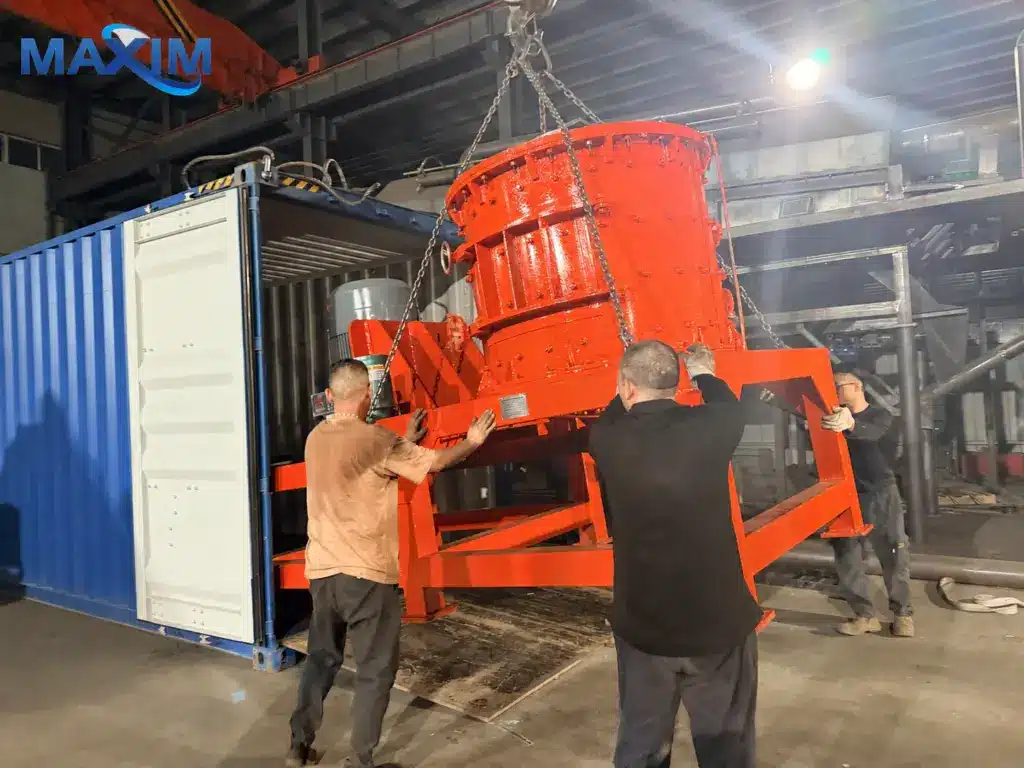
An Indian customer needed to recover steel wire from waste tires while removing the rubber still attached to the metal. MAXIM machinery configured a two-stage processing line using a Metal Shredder Machine and a Metal Hammer Crusher. First, the Metal Shredder Machine tears the tire-derived steel wire into smaller, more manageable pieces, opening compacted bundles and creating a stable feed for the next stage. The shredded material then enters the Metal Hammer Crusher, where repeated impact strips away the residual rubber from the wire surface. This staged process helps produce cleaner steel wire for downstream separation, collection, and recycling while reducing rubber contamination in the recovered metal.
A: The function of a shredder is to perform primary reduction of the waste by tearing and shearing into larger pieces. A grinder performs secondary reduction of prepared waste to smaller, more uniform-sized pieces.
A: Yes. Direct connection is practical for most applications, provided that the final product size, production rate, and method for feeding the material into the conveyor are suitable for the air separator. In cases where the material flow to the conveyor is not uniform, a buffer hopper or a metering conveyor can be added.
A: Some treatment facilities may process specific fractions of the waste stream; however, the very heavily contaminated material should be shredded and separated prior to processing. Large metal objects, such as pipes and broken steel, as well as stones and reinforced concrete items, have the potential to cause excessive wear and/or damage in a treatment facility.
A: Use both when bulky feed must first be reduced and sorted, but the final product still needs a smaller, more consistent size. The shredder protects the secondary machine, while the grinder controls particle size.
A: The size of the material that leaves a process is determined by the size of the material that is needed for the next process. For example, very coarse material may be required for magnetic separation or for manual sorting. Smaller-sized material will be needed for screening or for possible reuse. It may also be suitable for further processing.
A request such as “quote a scrap metal recycling line” leaves many technical questions open. Similar scrap can still require different feeding, shredding, conveying, sorting, and discharge arrangements. A better RFQ defines the job before asking for a machine. Material, capacity, sorting goals, final product, and site conditions should all be clear. What Information Should a excerpt …
