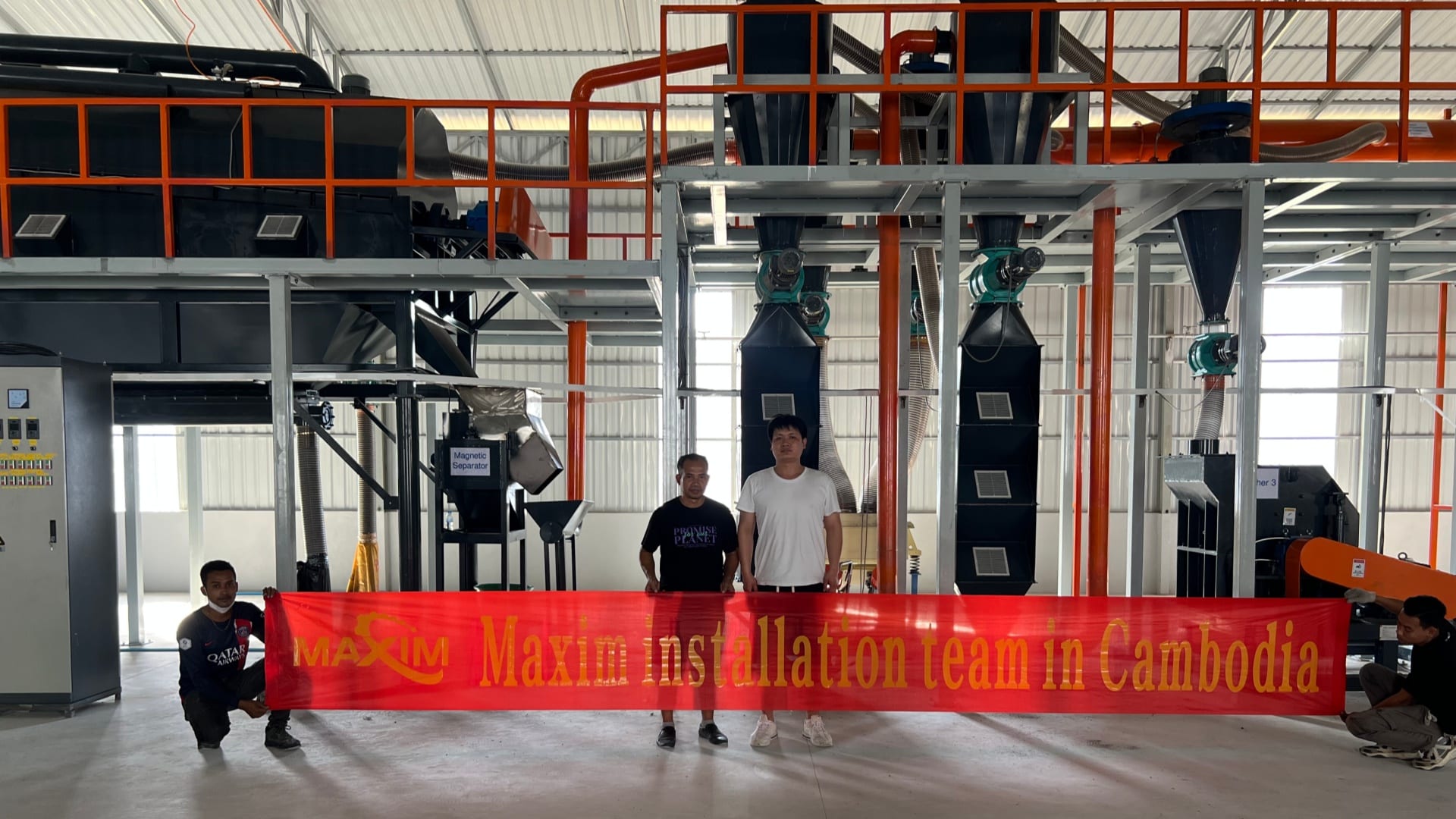
Lithium battery recycling in Asia is moving from waste management to material recovery. The growing number of Electric Vehicles, as well as the increasing volume of spent consumer electronics, energy storage systems, and battery production waste, such as spent cells, modules, electrodes, and production scrap, is turning into a serious challenge for waste management that needs to be transformed into a valuable source of materials.
However, building a successful recycling facility requires more than installing a battery shredder. Project developers must evaluate battery chemistry, feedstock condition, operating capacity, safety controls, output purity, factory layout, and downstream material demand. A production line that works efficiently with uniform electrode scrap may require a different configuration when processing mixed cylindrical batteries or complete automotive battery packs.
This guide explains how recycling companies, battery manufacturers, and environmental service providers can plan an appropriate processing line for Asian operating conditions.

Battery recycling conditions vary significantly across Asia. Some markets generate large volumes of manufacturing scrap, while others depend mainly on discarded mobile phone batteries, laptop batteries, electric two-wheeler cells, or retired EV battery packs.
These differences affect plant design in several ways:
For this reason, a lithium battery recycling plant in Asia should be configured around its actual local supply chain rather than copied from a standard project in another market.
The most common feedstocks include production waste from battery factories, positive and negative electrode sheets, cylindrical cells, mobile phone batteries, laptop batteries, energy storage cells, and retired automotive power batteries.
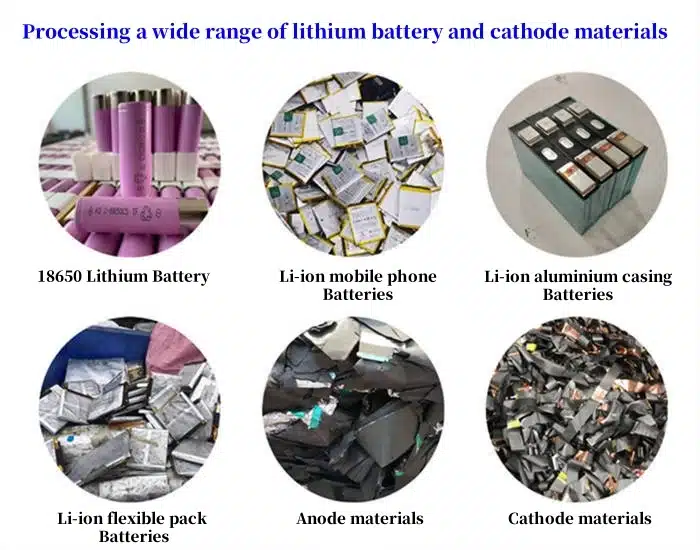
The processing requirements differ by material.
| Battery feedstock | Main characteristic | Important planning issue |
| Electrode sheets | Relatively uniform composition | Stable feeding and powder recovery |
| Cylindrical cells | Metal casing and compact structure | Controlled shredding and metal separation |
| Consumer batteries | Mixed sizes and conditions | Sorting and feed consistency |
| EV battery cells | Larger volume and higher stored energy | Discharge and upstream dismantling |
| Battery production scrap | Suitable for continuous processing | Automation and capacity matching |
The first stage determines whether the remaining process can operate safely and consistently. Incoming batteries should be classified according to chemistry, format, physical condition, and source.
Damaged, swollen, leaking, or unidentified batteries should not be mixed directly with normal feedstock. Complete battery packs may also contain housings, wiring, cooling components, structural frames, and electronic control units that must be removed before mechanical processing.
A typical preparation workflow includes:
A plant processing electrode sheets may require limited dismantling, while an EV battery recycling project may need a more extensive upstream preparation area.
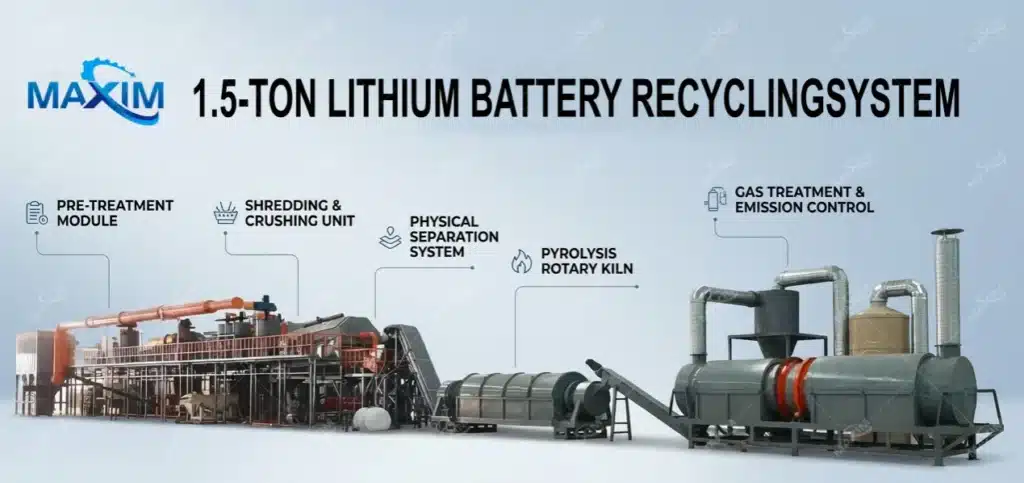
After preparation, the batteries enter a coordinated mechanical recycling process. The purpose is to release electrode material and separate it from copper, aluminum, steel, plastic, and other fractions.
A typical process includes:
These stages must operate as one connected system. If the upstream shredder produces inconsistent pieces, downstream screens and air separators may not achieve stable separation. Similarly, an undersized conveying system can restrict the throughput of a larger crusher.
Mechanical processing can produce several reusable material fractions:
Black mass contains cathode and anode materials, including graphite and compounds containing lithium, nickel, cobalt, manganese, or other elements depending on battery chemistry. It is normally transferred to downstream hydrometallurgical, pyrometallurgical, or material regeneration processes for further refining.
Mechanical recycling equipment should therefore not be evaluated only by hourly capacity. Buyers must also examine powder recovery, metal purity, cross-contamination, dust control, and the consistency of the final fractions.
MAXIM machinery lithium battery recycling line is designed to recover black powder, aluminum powder, and copper at rates of up to 99% or higher.
The upstream section may include conveyors, feeding units, dismantling equipment, tearing machines, and primary crushers. The correct configuration depends on whether the plant receives complete packs, modules, individual cells, or electrode production scrap.
Feeding equipment must deliver material at a stable rate. Irregular feeding can overload the crusher, reduce separation efficiency, and create unnecessary wear. Shredder selection should also consider battery casing strength, material dimensions, residual energy risks, and required particle size.
For mixed projects, modular preparation areas can help operators handle different feedstocks before they enter a common downstream separation line.
After crushing, the production line requires equipment that separates materials by particle size, density, magnetic properties, and aerodynamic behavior.
A complete system may include:
Environmental equipment is not an optional accessory. Fine black mass particles can spread easily if transfer points, screens, and collection areas are not enclosed. Negative-pressure operation helps direct airborne particles toward the dust collection system rather than into the workshop.
With centralized dust collection and controlled operation, the MAXIM machinery production line can maintain dust concentration at no more than 5 mg/m³ and operating noise at no more than 90 dB, although buyers should also verify the environmental regulations applicable to their project location.
A suitably designed line can process several battery categories, but different materials should not automatically be mixed without evaluation.
The supported battery chemistries can include:
Battery format is equally important. Cylindrical, pouch, and prismatic cells have different casing structures and material distributions. Complete EV packs also require different preparation from loose cells or electrode sheets.
Before finalizing the production line, buyers should provide representative samples, material photographs, chemistry information, expected proportions, and required output products. Testing helps determine whether changes are needed in shredding, screening, airflow, or conveying settings.
Capacity should be selected according to reliable feedstock supply rather than maximum theoretical demand. MAXIM machinery offers configurations ranging from 500 kg/h to 2,500 kg/h.
| Model | Nominal capacity |
| MX-500 | 500 kg/h |
| MX-1000 | 1,000 kg/h |
| MX-1500 | 1,500 kg/h |
| MX-2000 | 2,000 kg/h |
| MX-2500 | 2,500 kg/h |
A project with limited monthly battery collection may operate more efficiently with a smaller line running consistently than with an oversized system operating intermittently.
For example, a facility receiving uniform factory scrap may prioritize automatic feeding and continuous operation. A plant receiving mixed batteries from several collection channels may need more space for sorting, storage, and preparation, even if its hourly crushing capacity is lower.
Buyers should evaluate:
A supplier comparison should extend beyond equipment price and motor power. Important criteria include:
Buyers should also ask whether quoted capacity applies to their specific battery material. A line processing loose electrode sheets may achieve a different practical throughput from one handling heavily cased cylindrical cells.
Recovery figures should be reviewed together with contamination levels. High powder output is less valuable when excessive copper or aluminum remains in the black mass.
MAXIM machinery focuses on resource recycling equipment for lithium batteries, metals, and solid waste. Our lithium battery processing solutions can combine shredding, crushing, screening, air separation, conveying, centralized dust collection, air purification, and automatic control.
Project support can cover the full equipment lifecycle:
Instead of applying one configuration to every project, the production line can be adjusted according to battery type, site conditions, capacity requirements, and target outputs.
To prepare a more accurate proposal, buyers should provide battery chemistry, material photographs, sample details, required hourly throughput, available factory dimensions, electrical conditions, environmental requirements, and expected final products.
A: A typical line includes feeding equipment, shredders, crushers, vibrating screens, air separators, conveyors, powder collection, automatic controls, and dust treatment systems. Complete battery packs may also require discharge and dismantling equipment.
A: The cost depends on capacity, battery format, automation level, factory layout, environmental controls, and required output purity. A reliable quotation requires actual feedstock and project information.
A: Yes, a properly configured line can process LFP and NMC materials. However, batteries should be identified and sorted because their chemistry, recycling value, and downstream treatment requirements differ.
A: Batteries are shredded and crushed before screening and air separation removes copper, aluminum, steel, plastics, and other fractions. The remaining fine electrode powder is collected as black mass.
A: Compare suppliers based on sample testing, process design, recovery indicators, dust control, automation, installation, training, spare parts, and after-sales support. The proposed line should match your actual battery feedstock and operating conditions.
A request such as “quote a scrap metal recycling line” leaves many technical questions open. Similar scrap can still require different feeding, shredding, conveying, sorting, and discharge arrangements. A better RFQ defines the job before asking for a machine. Material, capacity, sorting goals, final product, and site conditions should all be clear. What Information Should a excerpt …