
The global push for electronic waste management has transformed scrap circuit boards from an environmental liability into a highly lucrative resource. Investors and procurement personnel understand that the profitability of an e-waste processing facility is directly tied to the mechanical efficiency and recovery rates of the chosen equipment. Research into standard printed circuit boards indicates that electronic components account for 58% of their composition, the substrate for 37%, and solder for 5%. For every tonne of substrate processed, approximately 40% consists of metallic materials and 60% of non-metallic materials.
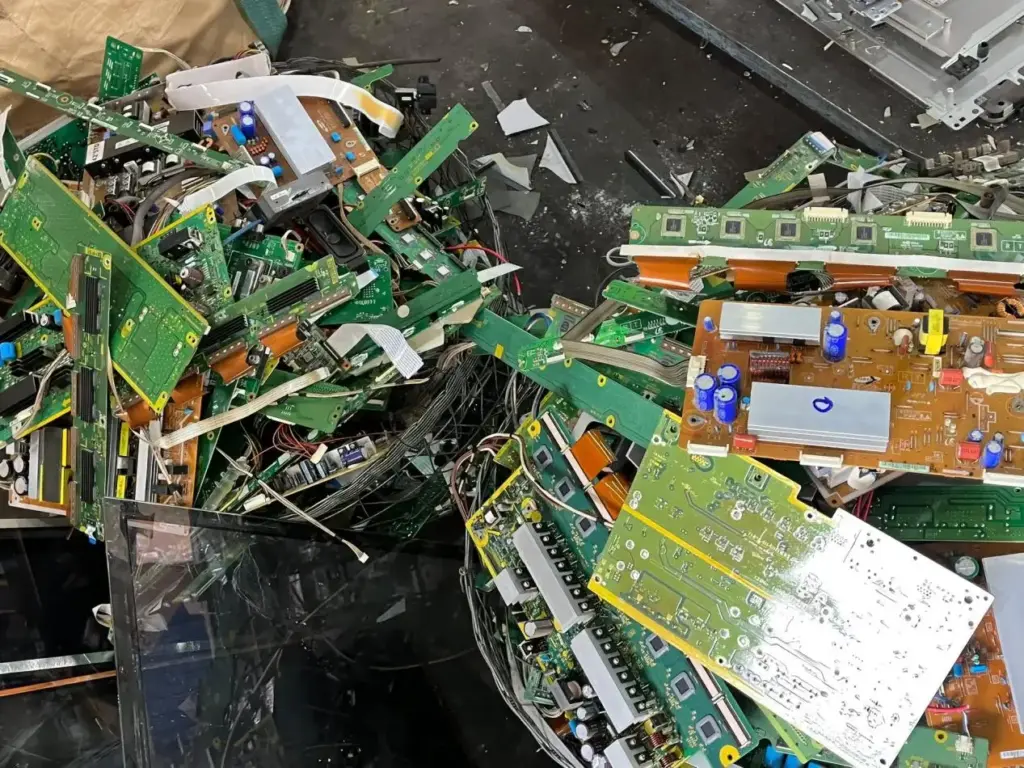
The intrinsic value locked within these components is substantial. It is estimated that one tonne of computer circuit boards contains 130 kg of copper, 0.5 kg of gold, 60 kg of lead, 40 kg of tin, 36 kg of nickel, 10 kg of iron, and 40 kg of antimony, alongside trace amounts of platinum and palladium. Extracting these materials profitably requires a sophisticated dry physical separation process. Traditional chemical leaching or incineration methods are being phased out due to strict environmental regulations and the high cost of secondary pollution treatment. Modern mechanical PCB recycling lines, such as those engineered by MAXIM machinery, provide a comprehensive solution that turns these complex waste streams into high-purity, market-ready commodities while maintaining strict ecological compliance.
A complete e-waste processing line relies on a sequential mechanical journey to liberate and isolate different materials. The process is entirely physical, utilizing the distinct physical properties of metals and resins to achieve separation without the introduction of water or hazardous chemicals.
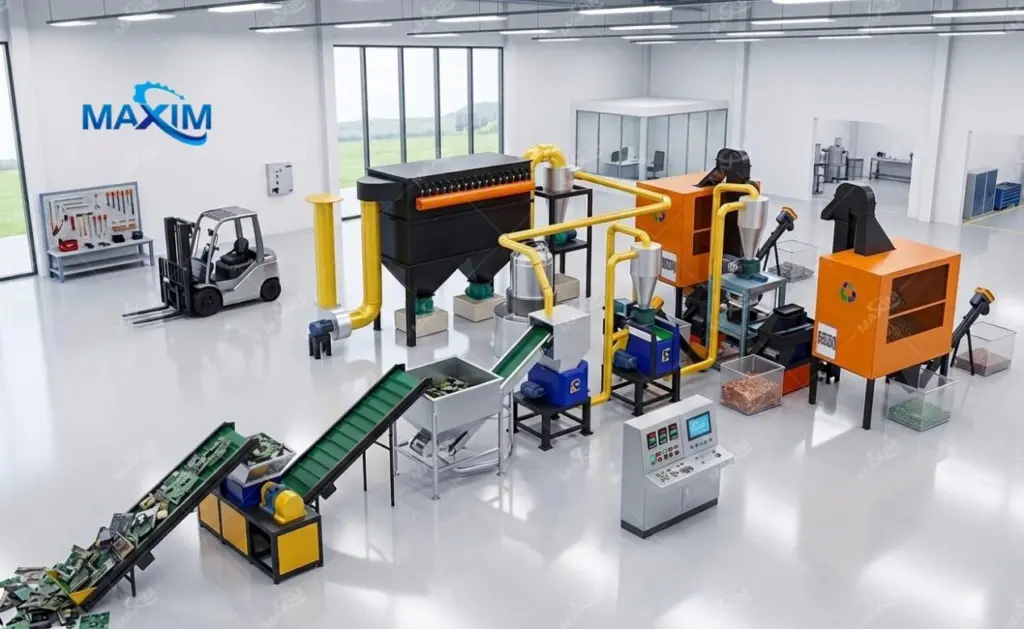
The initial phase involves size reduction to break the physical bonds between the metallic traces and the fiberglass substrate. Raw boards are first fed into a heavy-duty twin-shaft shredder, which shears the rigid material into smaller, manageable strips. Following this primary reduction, the material enters a secondary granulator or pulverizer. While typical configurations rely on a two-stage method, an advanced three-stage crushing process enables a processing capacity of 800 kg per hour, ensuring the material is reduced to a uniform powder. The recirculation system enhances this crushing efficiency, automatically returning oversized particles to the pulverizer until they reach the optimal micron size for separation.
Once the circuit boards are reduced to a mixed powder, the material passes through an automated magnetic separation function to remove iron from the material. This step is critical because iron components can cause unnecessary wear on downstream fine-sorting equipment and contaminate the final non-ferrous metal yield. The magnetic sorter efficiently captures the ferrous particles, isolating them for separate industrial recycling.
The demagnetized powder then enters the air classification stage. This equipment utilizes a combination of wind flow and gravity to separate particles based on their aerodynamic properties and specific gravity. The heavier metallic particles fall through the upward air current, while the lighter non-metallic resin and fiberglass particles are carried forward. The air classification equipment achieves a separation efficiency of over 97%, acting as the primary sorting mechanism to handle the bulk of the material volume.
The final and most crucial step for maximizing revenue is the high-voltage electrostatic separator. The metallic fraction recovered from the air classifier still contains trace amounts of dense non-metals, while the non-metallic fraction may carry fine copper dust. The electrostatic separator utilizes a high-voltage corona field. Conductive metals lose their induced charge rapidly and fall off the rotating drum, while non-conductive resins retain their charge and are pinned to the drum until brushed off. This ensures finer and more efficient sorting, effectively controlling the loss of non-ferrous metals and guaranteeing a highly pure end product.
Process engineers must evaluate equipment based on how effectively it addresses the complex composite nature of printed circuit boards. The interlocking of copper foils, fiberglass woven cloth, and epoxy resins requires multiple distinct separation mechanisms acting in concert.
Copper is the primary economic driver in circuit board recycling. Because copper is highly conductive and relatively dense, the dual approach of air and electrostatic separation is perfectly suited to capture it. The air classifier handles the heavy lifting, removing the vast majority of the bulk resin, while the electrostatic separator acts as a precision finishing tool. This combined logic prevents copper loss in the exhaust streams and ensures the recovered metal powder meets the high-purity standards required by downstream metallurgical smelters and refineries.
Effective separation logic also dictates that the non-metallic byproduct must be clean and usable. The resin and fiberglass powder generated from the process holds significant volume. When effectively stripped of all metal contaminants, this non-metallic fraction can be sold as an additive for manufacturing construction materials, epoxy paints, building boards, and plastic composites. This turns a potential waste disposal cost into a secondary revenue stream, closing the loop on the recycling process.
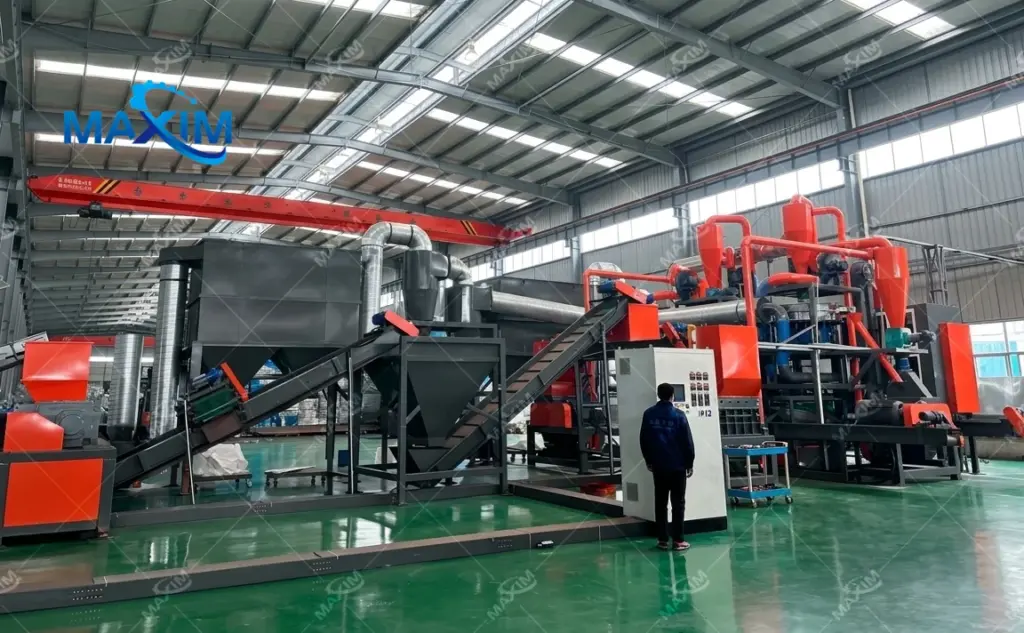
Handling pulverized fiberglass and heavy metal dust presents serious occupational health and environmental risks. Modern recycling plants cannot operate without robust atmospheric controls. Facility investors must carefully review the dust extraction parameters before finalizing any equipment procurement.
During the high-speed crushing and separating stages, significant amounts of micro-dust are generated. To manage this, the pulse dust collector operates at an efficiency of over 99%, effectively suppressing dust emissions. This ensures that the facility fully complies with strict environmental protection requirements, generating no secondary pollution. Advanced systems guarantee a clean working environment by maintaining a dust content of less than 5mg/m3.
A standalone dust collector is insufficient if dust escapes from the transfer pipes. To prevent this, the entire production line utilizes negative pressure feeding to effectively reduce dust spillage. This means that the internal pressure of the crushing and sorting chambers is kept lower than the atmospheric pressure of the workshop. Any potential leaks draw ambient air into the machine rather than allowing hazardous dust to escape. Additionally, acoustic insulation ensures that operational noise levels are kept at or below 90dB.
Choosing the right processing line requires matching the equipment capacity to the projected raw material intake and ensuring intelligent control systems are in place for stable operation. MAXIM machinery integrates advanced automation and safety features, such as PLC control, which ensures uniform feeding and coordinated operation across the entire production line. Furthermore, the entire production line is fitted with walkways and guardrails at elevated positions, facilitating real-time monitoring and maintenance by service personnel.
Procurement personnel should evaluate processing capacities based on current supply chain volumes while leaving room for future expansion. The equipment models scale according to throughput needs, electrical power requirements, and spatial footprints. Selecting a model with an integrated recirculation system and intelligent load monitoring will prevent bottlenecks during periods of variable material quality.
To assist in the decision-making process, the following technical parameters outline the available configurations for facility planning.
| Model | Capacity | Power | Dimension | Weight |
| MX-PCB 300 | 200 to 300 kg per hour | 102 kw | 2055 m | 15 Ton |
| MX-PCB 500 | 400 to 500 kg per hour | 134 kw | 2565 m | 20 Ton |
| MX-PCB 800 | 600 to 800 kg per hour | 194 kw | 3065 m | 30 Ton |
| MX-PCB 1000 | 800 to 1000 kg per hour | 238 kw | 3585 m | 40 Ton |
Our configurations utilize compact structures and rational layouts to deliver stable performance and low noise levels for continuous industrial operation.
A: Advanced dry-process lines utilizing precision airflow and electrostatic separation can typically achieve a copper and precious metal recovery rate exceeding 99%. The exact yield depends on the initial grade of the scrap circuit boards, but the electrostatic stage ensures that nearly all conductive non-ferrous metals are successfully separated from the non-conductive resin.
A: Modern commercial configurations rely entirely on a dry physical separation process involving mechanical crushing, air classification, and high-voltage electrostatic sorting. This completely eliminates the need for water, thereby preventing secondary wastewater pollution and eliminating the high costs associated with chemical liquid treatment.
A: While heavy-duty shredders are physically capable of processing fully populated motherboards, process engineers highly recommend passing the boards through a dedicated electronic component dismantling machine first. Removing aluminum heat sinks, large capacitors, and batteries beforehand maximizes the lifespan of the crusher blades and ensures the highest possible purity of the final copper output.
A: The dust control framework relies on keeping the entire closed-loop system under negative pressure. Air is constantly drawn inward through the material pipelines and directed into a high-efficiency pulse jet dust collector. The collector forces the airborne particulates through fine filter bags, catching 99% of the micro-dust and allowing only clean air to exit the exhaust stack.
A: The primary ongoing operational expenses are industrial electricity consumption and the replacement of wear-and-tear parts. The blades inside the primary shredder and secondary granulator experience the highest friction. Procurement personnel should prioritize machines equipped with high-durability alloy steel blades and ensure that the system includes an automated magnetic separator to remove stray iron, which drastically reduces internal wear.
Why Process Efficiency Determines E-Waste Profitability The global push for electronic waste management has transformed scrap circuit boards from an environmental liability into a highly lucrative resource. Investors and procurement personnel understand that the profitability of an e-waste processing facility is directly tied to the mechanical efficiency and recovery rates of the chosen equipment. Research excerpt …
