
A successful PCB recycling project starts before equipment selection. First define what enters the line, what output fractions are required, how much material must be processed, and what the site can support. Without those inputs, two quotations that look similar may describe very different systems.
At MAXIM machinery, we design PCB recycling solutions around project conditions. Our PCB recycling production line is intended for computer boards, mobile phone boards, television boards, copper-clad laminates, PCBs and FPCBs, with the process separating mixed metallic material from non-metallic fractions.
“Waste PCB” covers many materials. A clean copper-clad laminate behaves differently from populated computer boards containing components, solder, steel parts and mixed resins. Before requesting a proposal, prepare representative photos, sample weights and a short description of the board mix.
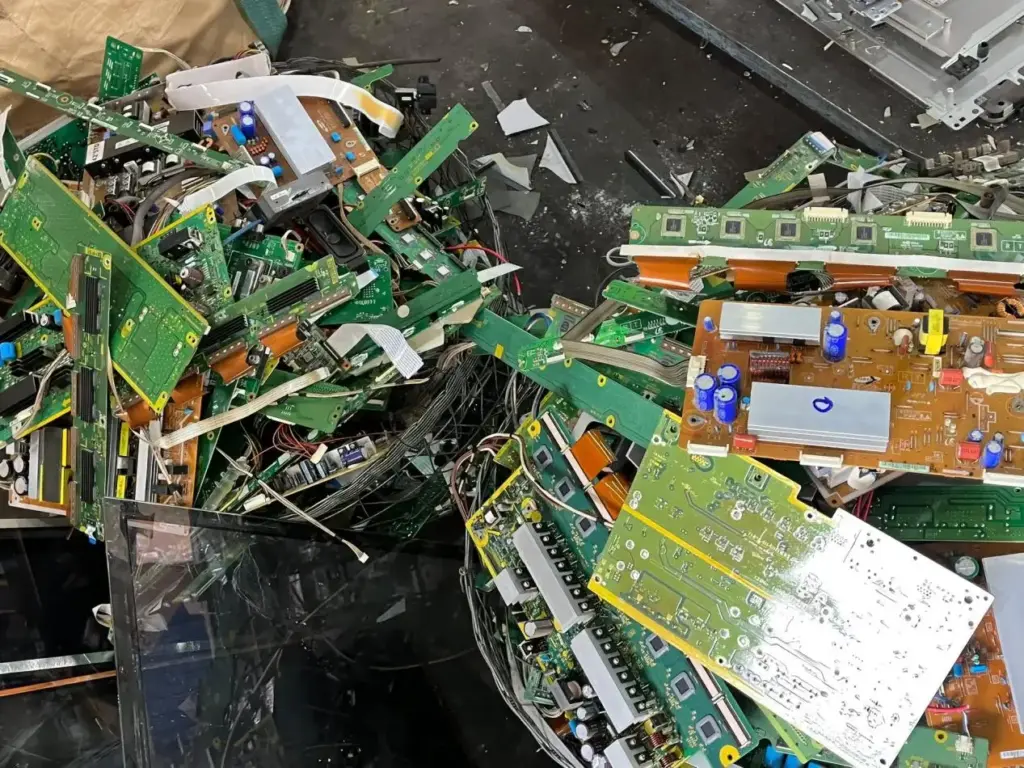
Useful feedstock information includes:
These details help determine whether dismantling, iron removal or extra size reduction is needed.
Capacity should reflect real material availability, not simply the largest machine a site can afford. Define tonnes per month, planned hours per day, working days per month and expected peak feed rate. Then specify the desired outputs, such as a metal-rich fraction and a resin/fiber-rich fraction.
For reference, MAXIM machinery PCB line configurations cover 200–300, 400–500, 600–800 and 800–1,000 kg/h, with installed power from 102 to 238 kW. Final performance depends on feed condition and line configuration.
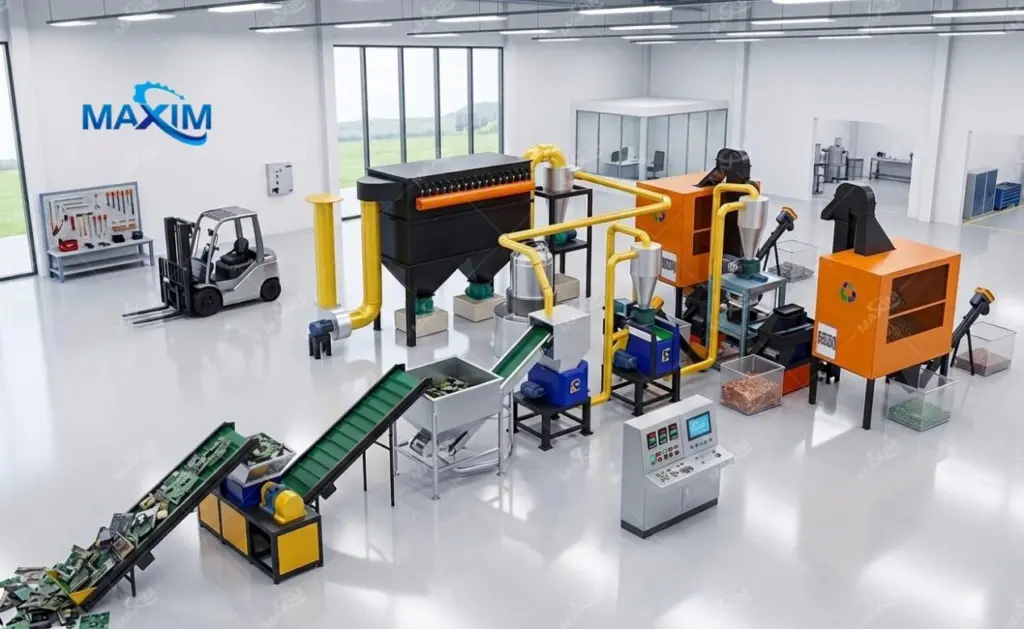
PCB recycling is not simply “shred once and separate.” Size reduction prepares composite boards for downstream classification by liberating metals from resin and fiber while keeping particle size suitable for later stages.
A typical line therefore combines controlled feeding with staged crushing. MAXIM machinery uses PLC-coordinated feeding, a three-stage crushing arrangement and material recirculation to support stable processing.
When discussing a PCB shredder machine, ask about allowable feed size, discharge range, wear parts and maintenance access rather than judging it by motor power alone.
After size reduction, separation should match material properties.
| Stage | Main function | Project question |
| Magnetic separation | Removes ferrous material | How much iron is present? |
| Air classification | Separates by aerodynamic behavior | Is particle size controlled? |
| Electrostatic separation | Refines conductive and non-conductive fractions | What output quality is required? |
MAXIM machinery integrates magnetic separation, air classification and high-voltage electrostatic separation in the PCB line.
These stages work as one process chain. A capable separator cannot fully compensate for poorly prepared feed.
A complete plant also needs material transfer, product collection, dust handling and coordinated controls. Our PCB line uses negative-pressure feeding, pulse dust collection and PLC control to reduce uncontrolled dust escape and keep equipment operating in sequence.
Elevated areas are also equipped with walkways and guardrails for inspection and servicing.
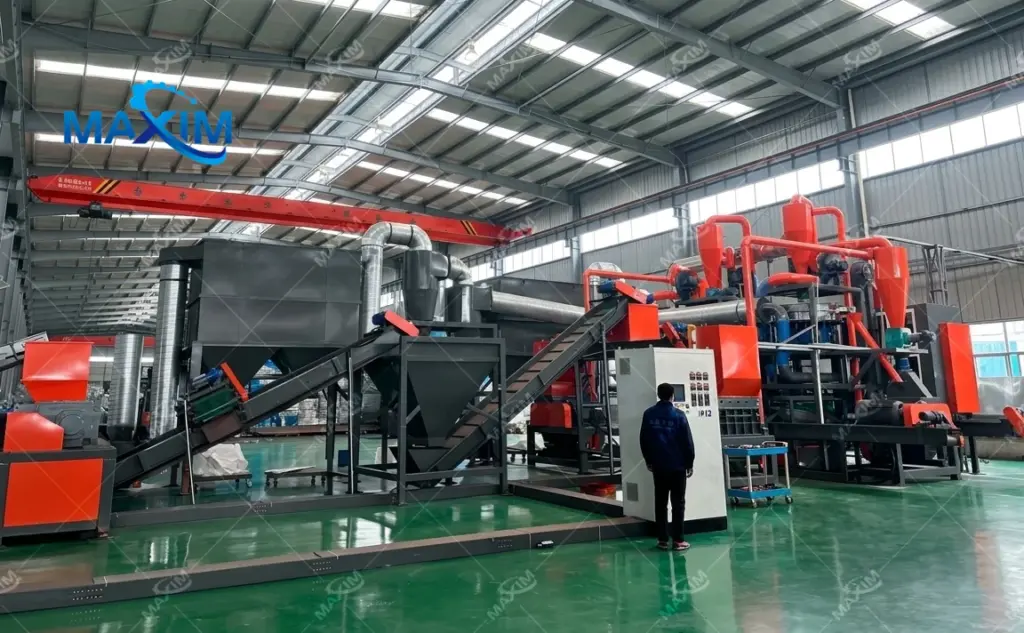
An RFQ should state site voltage, frequency, available transformer capacity and expected shift pattern. Installed power is not the same as actual operating consumption, but it is essential for cable sizing, switchgear planning and site electrical design.
Utility limits should be checked before the line configuration is finalized.
Layout planning must cover more than machine footprint. Allow room for incoming-board storage, feeding, separated product collection, dust ducting, electrical cabinets, operator access and maintenance.
A practical material path is:
Receiving → pretreatment → size reduction → separation → product collection → storage
Illustrative case: a buyer requests a 600–800 kg/h line for a narrow workshop with one loading door. The capacity may be suitable, but the layout can still create problems if forklifts, product bags and maintenance routes share the same aisle. In that case, logistics should be solved before the quotation is finalized.
PCB crushing generates fine particulate material, so dust-control interfaces should be planned with the process. The RFQ should describe exhaust routing, indoor or outdoor installation, collection points and local site requirements.
Permitting, emissions limits and occupational requirements vary by jurisdiction. They should be confirmed with local authorities and the responsible engineering team rather than assumed from a standard equipment package.
A useful RFQ gives every supplier the same technical basis.
| RFQ input | What to provide |
| Feedstock | Board types, photos, sample quantity, contamination |
| Capacity | kg/h and monthly volume |
| Operation | Hours/day and shifts |
| Output | Required metal and non-metal fractions |
| Utilities | Voltage, frequency, available power |
| Site | Building dimensions and access |
| Scope | Installation, commissioning, training, spare parts |
This makes competing proposals easier to compare because differences in scope become visible.
Ask what is included for conveying, dust collection, electrical control, product collection, spare and wear parts, installation supervision, commissioning, operator training and technical documentation.
Also confirm exclusions. Freight, civil foundations, external power distribution, local ductwork and site labor may be handled differently between projects.
If feedstock varies widely, send representative samples before final configuration. Testing can reveal unexpected steel content, difficult-to-liberate composites or particle behavior that changes separation settings.
At MAXIM machinery, we support PCB Recycling solution design according to capacity, material characteristics and site conditions, and our service process covers consultation, equipment production, installation and commissioning, training and after-sales support.
MAXIM machinery focuses on recycling equipment and customized processing solutions for lithium batteries, metals and solid waste. For PCB projects, we can discuss feedstock, target capacity, process configuration, utilities and site conditions before preparing a proposal.
Project-specific verification is still required for throughput on a particular board mix, local compliance, installation scope, logistics, downstream refining and total investment. A practical first step is to send photos or samples with capacity and site data, then use the RFQ checklist above to define the project clearly. You can also learn more about our capabilities through the MAXIM machinery production line section.
A: A PCB recycling plant can process suitable waste circuit boards such as computer boards, mobile phone boards, television boards, copper-clad laminates, PCBs and FPCBs. Feed condition and pretreatment requirements should be confirmed before equipment selection.
A: A complete line may include feeding, staged crushing, magnetic separation, air classification, electrostatic separation, recirculation, dust collection, conveying and PLC control. The final configuration depends on feedstock and output requirements.
A: Power depends on capacity and configuration. MAXIM machinery PCB configurations from 200–300 to 800–1,000 kg/h use installed power values from 102 to 238 kW. Site voltage and available electrical capacity should be provided during the RFQ stage.
A: Include board type, sample photos, throughput, operating schedule, target outputs, site voltage, available space, dust-control interfaces and the required installation or commissioning scope.
A: There is no single reliable price for every project. Capacity, feedstock, automation, utility conditions, site preparation, installation, freight and local requirements all affect the budget. A project-specific quotation should be prepared after the technical inputs are confirmed.
A successful PCB recycling project starts before equipment selection. First define what enters the line, what output fractions are required, how much material must be processed, and what the site can support. Without those inputs, two quotations that look similar may describe very different systems. At MAXIM machinery, we design PCB recycling solutions around project excerpt …
