
Copper and aluminum are important fractions in mechanical lithium-ion battery recycling, but separating them is not a one-machine task. Results depend on feed preparation, liberation, particle-size control, and stable flow through screening and airflow classification.
Foil, electrode coating, separator film, casing fragments, and fine powder arrive attached or mixed. The process must first create a feed condition that makes physical separation possible.
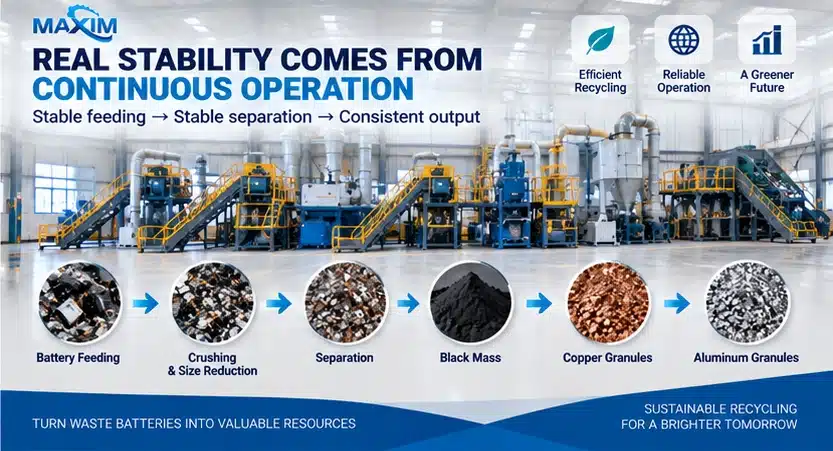
In common lithium-ion cells, copper foil is used as the anode current collector, while aluminum foil is used on the cathode side. Before either metal becomes a useful recovered fraction, coating and attached components must be released from the foil.
Primary shredding opens the structure. Secondary hammer crushing breaks attached material and releases electrode powder. The goal is not simply smaller particles. Under-crushing can leave foil, coating, and separator material locked together, while excessive crushing can create too many mixed fines.
Changing screen mesh cannot solve poor liberation, and excessive fine metal makes downstream classification harder.
After liberation, particle size becomes a process variable. Vibrating screens separate fine electrode powder from larger metal-rich and separator-rich fractions. Air separation can then use differences in particle weight and aerodynamic behavior to classify the remaining mixture. These stages form part of the mechanical flow used in MAXIM machinery’s lithium battery recycling production line.
A practical rule is simple: separation equipment performs more consistently when the incoming fraction is reasonably controlled. Wide, unstable size distributions make light and heavy particles behave less predictably.
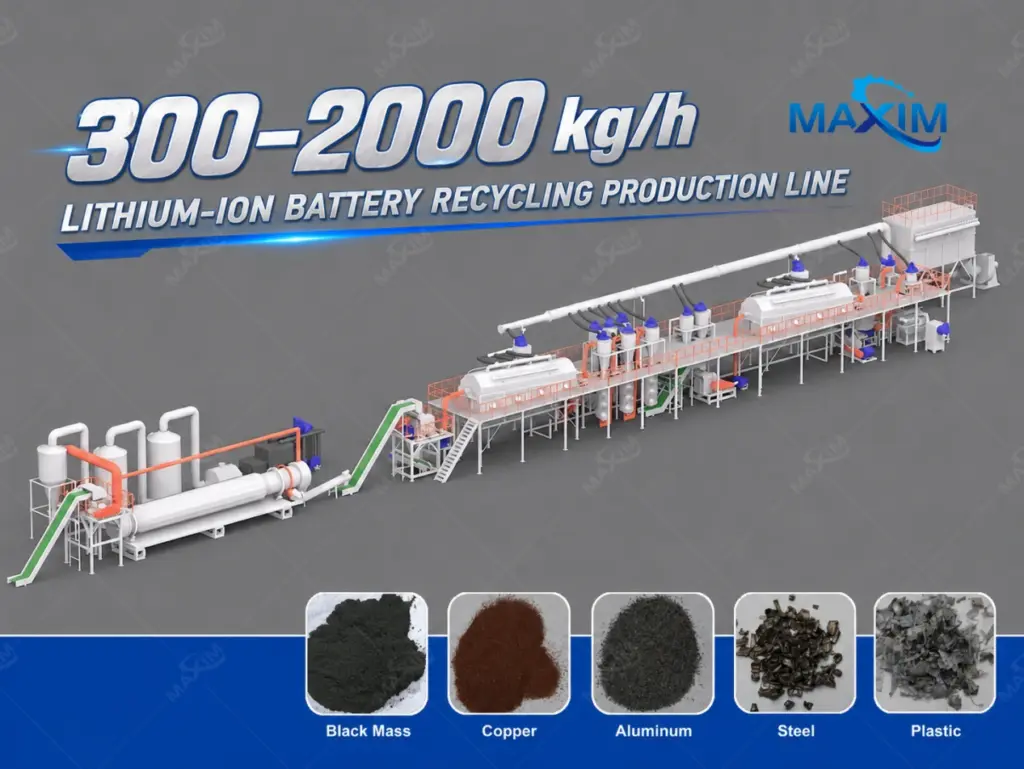
Shredding and crushing create the conditions for separation. In our lithium battery recycling equipment, primary size reduction exposes internal components, while secondary crushing helps detach coating material from copper and aluminum fractions. The required intensity depends on feed type because clean electrode sheets do not behave like complete cells or mixed end-of-life battery material.
Screening removes fine powder from larger pieces and narrows the size range entering later stages. This is important for black mass recovery because excessive metal carryover into the fine fraction can lower material quality.
Feed rate, screen loading, particle shape, and partially liberated material in the coarse fraction all matter.
Air separation works best after the material has been sufficiently prepared. It uses physical differences in particles to help divide lighter and heavier fractions. Collection points then keep powder, copper-rich, aluminum-rich, and other outputs separated for downstream handling.
At MAXIM machinery, our waste lithium battery recycling production line combines crushing, conveying, screening and sorting, air separation, automatic control, and centralized dust collection. The line recovers copper, aluminum, and electrode powder through coordinated mechanical stages rather than relying on one isolated separator.
| Process stage | Main role | Typical problem from poor feed |
| Primary shredding | Open structures and reduce size | Large attached pieces |
| Hammer crushing | Improve coating and foil liberation | Under-liberation or excessive fines |
| Screening | Classify by particle size | Powder contamination or overloaded coarse fraction |
| Air separation | Classify prepared particles | Unstable split from wide size variation |
| Collection | Keep recovered fractions separate | Cross-contamination during discharge |
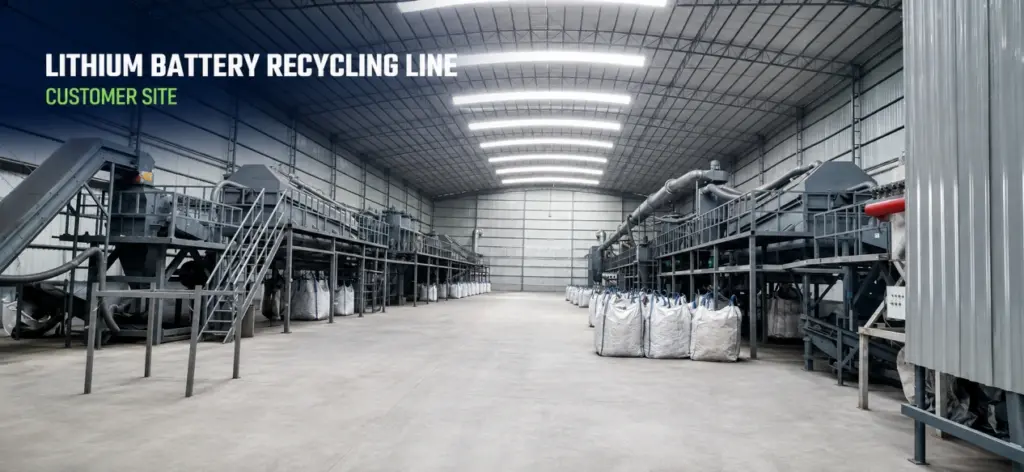
Feed identification should come before equipment selection. Electrode production scrap may be relatively uniform, while whole cells can introduce casings, separator film, terminals, plastics, and other components. Mixed battery formats add further variation.
Complete, charged, damaged, or swollen batteries may require discharge, dismantling, drying, or other pretreatment before crushing. The front-end arrangement should be confirmed for the actual material rather than copied from a generic battery recycling machine flow.
One of our 2 t/h cathode and anode sheet projects illustrates the difference. Because the feed was electrode sheet scrap, the process emphasis was on mechanical liberation and separation of coating material, copper, and aluminum rather than treating it exactly like mixed whole batteries.
Several feed characteristics directly affect separation:
This is why a lithium-ion battery recycling machine should be configured around actual samples and target outputs.
Correctly selected machines can still produce unstable fractions if feeding is irregular. Surges change crusher loading, screen bed depth, and airflow conditions.
The target is controlled material flow. Feed rate, crusher condition, screen performance, conveying, and air settings should be checked as one system. If copper or aluminum quality changes, troubleshooting should begin upstream before assuming the final separator is the only problem.
A useful evaluation sequence is:
This prevents a common procurement mistake: asking for a universal purity number without defined feed conditions. We do not treat purity or recovery values as universal across different battery materials.
When you discuss a project with us, useful inputs include battery chemistry, format, feed condition, residual charge status, material photos or samples, required throughput, target recovered fractions, available plant space, and local electrical conditions. These details help us evaluate crushing, screening, air separation, conveying, and dust control as a connected system.
Our lithium battery recycling production line can be configured for electrode sheets, battery production waste, cylindrical batteries, power batteries, consumer batteries, and selected mixed lithium-ion materials. We can also support process planning, equipment selection, installation, training, and after-sales service.
For buyers comparing lithium battery recycling equipment, the better question is not “Which separator is best?” It is “What feed condition will reach the separator, and which upstream stages create it?” That leads to a more realistic process design and supplier discussion.
A: Copper and aluminum separation normally depends on several mechanical stages. Shredding and crushing liberate foil and coating material, screening removes fine powder and classifies particle size, and airflow-based separation helps divide prepared fractions by physical behavior. Final collection keeps recovered streams from mixing again.
A: The best feed is stable, sufficiently liberated, and within a controlled particle-size range. Battery type, remaining charge, moisture, separator content, casing material, and attached electrode coating should be checked before selecting settings or equipment.
A: Yes. A properly configured mechanical line can recover both metal fractions. However, cathode and anode materials have different foil, coating, and physical characteristics, so process settings should match the actual incoming mixture.
A: There is no universal mill choice. The correct crushing stage depends on feed form, coating adhesion, required liberation, downstream screen size, and the target metal fraction. A material test is more useful than choosing a crusher or mill by name alone.
A: Not necessarily. Powder recovery and clean metal fractions are related but different measurements. A line should be evaluated for powder recovery, metal carryover, copper and aluminum cross-contamination, and consistency under defined feed and operating conditions.
Copper and aluminum are important fractions in mechanical lithium-ion battery recycling, but separating them is not a one-machine task. Results depend on feed preparation, liberation, particle-size control, and stable flow through screening and airflow classification. Foil, electrode coating, separator film, casing fragments, and fine powder arrive attached or mixed. The process must first create a excerpt …
