
Waste circuit boards are small, but they are one of the most value-dense streams in electronic waste. For recyclers, the question is no longer whether printed circuit boards should be recovered. The real question is how to recover metals efficiently, control dust, reduce manual handling, and produce cleaner separated fractions that can move into downstream reuse.
A complete PCB Recycling strategy should look at three things at the same time: material value, environmental risk, and production stability. When these three points are aligned, a recycling plant can turn mixed e-waste into a more predictable resource stream.
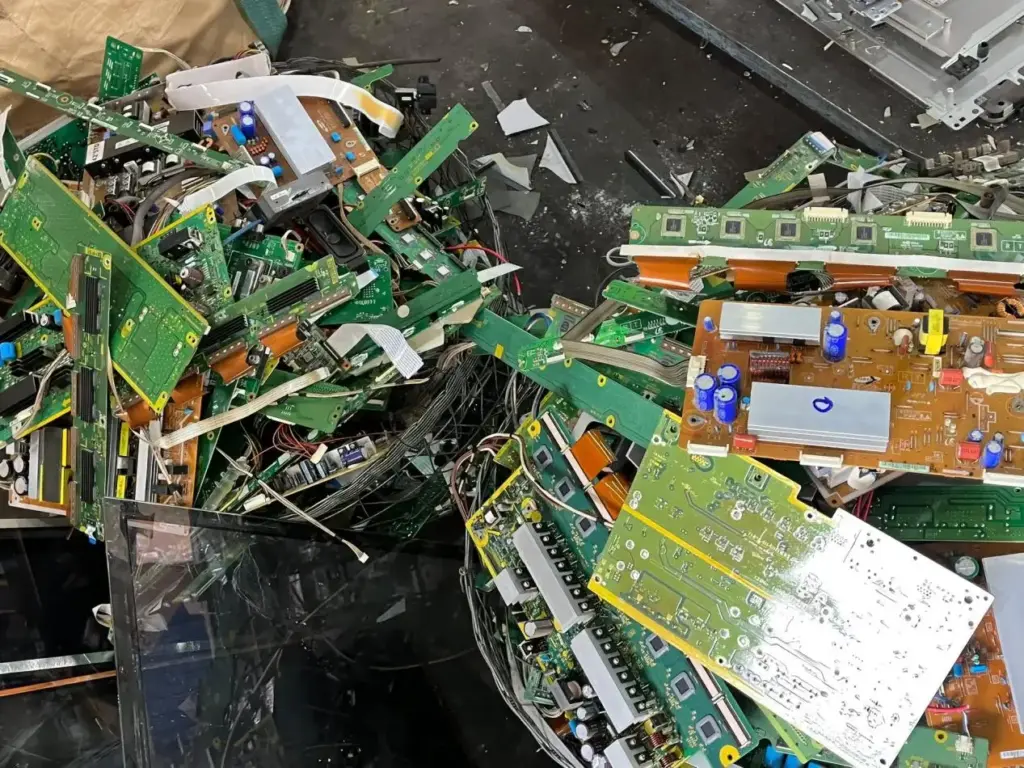
Printed circuit boards contain a mix of metals, solder, resin, fiberglass, and electronic components. Standard printed circuit boards include electronic components, substrate, and solder; for every tonne of substrate, about 40% is metallic material and 60% is non-metallic material. One tonne of computer circuit boards may contain copper, gold, iron, lead, tin, nickel, antimony, and other rare or precious metals.
This is why waste circuit board recycling is not only an environmental task. It is also a resource recovery opportunity. The metallic fraction can be further processed for copper and other metal recovery, while the non-metallic fraction may be considered for resin, fiber, or filler-related reuse depending on local downstream channels.
A useful way to understand the value is to separate the board into three recovery targets:
| Material group | Typical source in PCBs | Recovery focus |
| Non-ferrous metals | Copper traces, connectors, solder areas | Copper-rich powder and mixed metal recovery |
| Ferrous metals | Screws, shields, attached iron parts | Magnetic separation before fine sorting |
| Non-metallic material | Resin, fiberglass, substrate | Clean separation from metal fractions |
The higher the separation accuracy, the easier it becomes to increase material value and reduce losses.
Low-tech treatment methods often focus only on quick metal extraction. Open burning, rough crushing, or poorly sealed processing can create dust, fumes, and mixed residues that are difficult to control. PCBs may also come from televisions, computers, mobile phones, household appliances, and FPCBs, which means raw material composition is not always consistent.
The main risks include metal loss, dust leakage, incomplete sorting, and secondary pollution. For an industrial recycling plant, these issues directly affect profit and compliance. A stable line needs enclosed conveying, coordinated feeding, efficient separation, and reliable dust collection instead of relying on manual selection alone.
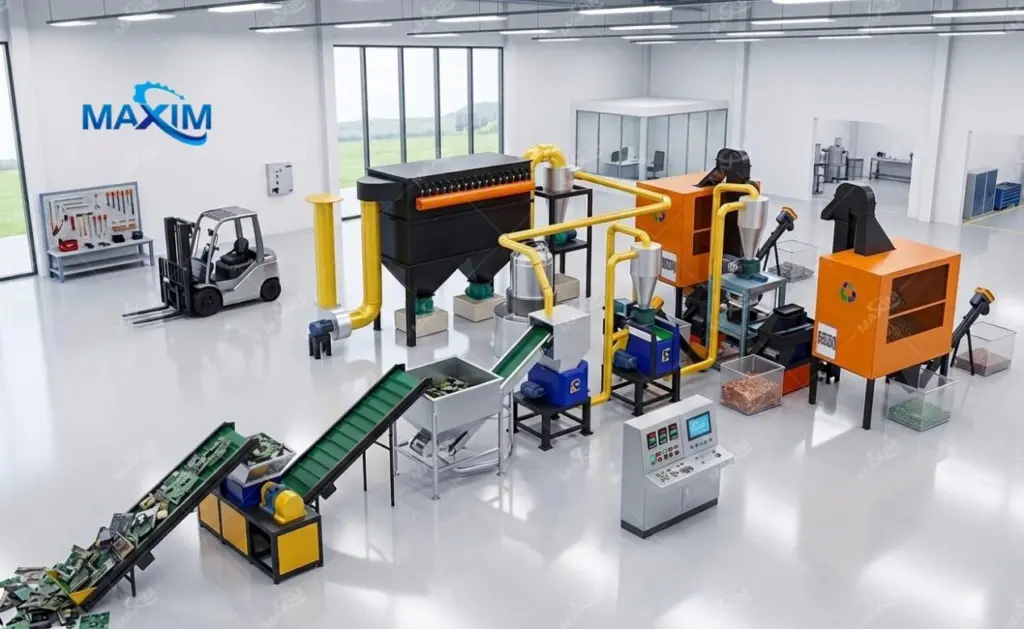
A modern PCB recycling production line usually follows a dry mechanical route. The goal is to reduce board size step by step, remove iron impurities, separate material by density and conductivity, and collect dust during the process.
The first step is to prepare the feedstock. Large components, batteries, oversized metal parts, and unsuitable materials should be removed before continuous feeding. This reduces wear on blades and helps the downstream sorting equipment work more consistently.
For mixed e-waste plants, feed preparation is especially important because different board types behave differently during crushing. A graphics card, memory stick, mobile phone board, and copper-clad laminate may not have the same thickness, metal content, or component density.
After feeding, the boards move through size reduction. The purpose is not simply to crush the material as fast as possible. The particles must reach a suitable size range so that air classification and electrostatic separation can perform effectively.
A practical PCB recycling machine should use staged crushing rather than one aggressive crushing step. MAXIM machinery’s PCB recycling line includes a three-stage crushing process and a recirculation system that improves crushing efficiency.
The recirculation system matters because oversized particles can reduce separation accuracy. When partially crushed material returns to the right process stage, the line can produce a more uniform feed for downstream separation.
A simplified process logic is:
1. Boards are fed into the crushing system.
2. Material is reduced into smaller particles.
3. Oversized particles are returned for further crushing.
4. Iron impurities are removed by magnetic separation.
5. Fine material moves into classification and electrostatic sorting.
Once the material reaches the target particle size, the line separates lighter and heavier fractions. Air classification uses airflow and density differences to separate non-metallic powder from heavier metal-rich particles. MAXIM machinery’s air classification equipment is listed with a separation efficiency of over 97%.
After air classification, electrostatic separation further improves the separation between conductive and non-conductive particles. This is especially important for copper recovery because copper particles can be lost if the separation system is not accurate. Our high-voltage electrostatic separator is designed for finer sorting and for controlling the loss of non-ferrous metals.
Different plants may use different recycling routes depending on budget, feedstock, environmental requirements, and downstream buyers. However, for many industrial processors, dry physical separation is often the most practical front-end method because it avoids wastewater and keeps the process easier to operate continuously.
| Method | Main purpose | Advantages | Limitations |
| Dry physical separation | Separate metals and non-metals by crushing, air classification, magnetic separation, and electrostatic sorting | No process wastewater, suitable for continuous production, easier dust control when enclosed | Requires good particle size control and reliable dust collection |
| Burning | Remove non-metallic material quickly | Simple in concept | High pollution risk, poor compliance, metal loss risk |
| Chemical recovery | Extract specific metals through chemical reaction | Useful for deeper precious metal recovery | Requires chemical handling, wastewater treatment, and stricter process control |
For a waste circuit board recycling plant, dry mechanical separation is often the best first stage. It prepares a cleaner copper-rich or mixed metal fraction for further refining, while reducing the volume of non-metallic residue.
A hybrid approach may be useful when a plant wants to recover more than copper. For example, dry processing can first separate metals from resin and fiberglass. Then, downstream refining or chemical processes may recover specific metals from the concentrated metal fraction.
This approach is more controlled than treating complete boards directly with high-impact or chemical methods. It also gives the operator more flexibility. If feedstock quality changes, the plant can adjust the front-end crushing and sorting settings before sending material to downstream recovery.

A complete PCB recycling production line is not a single crusher. It is an integrated system. Each machine must support the next stage; otherwise, the whole line becomes unstable.
The size reduction section usually includes feeding, shredding or crushing, pulverizing, conveying, and recirculation. For large or mixed boards, the front-end machine must be strong enough to handle uneven material without frequent blockage.
The most important selection points are blade wear resistance, particle size control, feeding uniformity, and coordination between stages. PLC control supports uniform feeding and coordinated operation across the whole line.
For plant managers, this matters because unstable feeding can cause three problems: low throughput, overloaded motors, and poor separation quality.
PCB crushing creates fine particles. These particles may include resin dust, fiberglass powder, and metal fines. A safe production line must control dust at the source instead of cleaning it after it spreads into the workshop.
MAXIM machinery’s PCB recycling equipment uses negative pressure feeding to reduce dust spillage, and its pulse dust collector is listed with over 99% efficiency for suppressing dust emissions.
The line also includes elevated walkways and guardrails, which support real-time monitoring and maintenance. This is a practical detail because operators need safe access for inspection, cleaning, and adjustment.
Choosing a circuit board recycling machine should start with the actual material stream. A plant processing mostly computer motherboards may need different settings from a plant processing mixed phone boards, TV boards, and copper-clad laminates.
Capacity should match daily collection volume, working hours, and storage conditions. Oversizing equipment can increase investment pressure. Undersizing it can create feedstock backlogs.
MAXIM machinery lists several PCB recycling models:
| Model | Capacity | Power | Weight |
| MX-PCB 300 | 200–300 kg/h | 102 kW | 15 Ton |
| MX-PCB 500 | 400–500 kg/h | 134 kW | 20 Ton |
| MX-PCB 800 | 600–800 kg/h | 194 kW | 30 Ton |
| MX-PCB 1000 | 800–1000 kg/h | 238 kW | 40 Ton |
These model ranges give processors a way to match equipment scale with expected throughput.
A PCB recycling plant is affected by site size, local environmental rules, feeding method, raw material storage, and downstream sales channels. A copied layout may not fit every workshop.
MAXIM machinery focuses on resource recycling and provides customized recycling and processing solutions for lithium batteries, metals, and solid waste. Our equipment supports companies in reducing costs and improving efficiency through efficient, intelligent, and environmentally friendly systems.
For buyers, customized layout support should cover:
1. Raw material testing and process matching.
2. Equipment layout based on workshop space.
3. Capacity selection by hourly and daily output.
4. Dust collection and noise control planning.
5. Installation, commissioning, training, and after-sales support.
MAXIM machinery provides service from early consultation and solution design to equipment production, installation, commissioning, personnel training, and after-sales maintenance, with after-sales response within 24 hours.
A: A PCB recycling machine reduces waste boards into fine particles, removes iron by magnetic separation, separates lighter non-metallic material through air classification, and then uses electrostatic separation to sort conductive copper-rich particles from non-conductive resin and fiberglass.
A: A PCB recycling production line can process computer boards, mobile phone boards, television boards, copper-clad laminates, and other waste circuit boards. MAXIM machinery’s PCB line is designed to separate mixed metals from non-metallic materials in these feedstocks.
A: The right capacity depends on feed volume, operating hours, board type, and target output quality. MAXIM machinery provides PCB recycling line models from MX-PCB 300 at 200–300 kg/h to MX-PCB 1000 at 800–1000 kg/h.
A: Dust control is important because crushing and pulverizing waste circuit boards can release fine resin, fiberglass, and metal particles. Negative pressure feeding and pulse dust collection help reduce dust spillage, improve workshop cleanliness, and support safer long-term operation.
A request such as “quote a scrap metal recycling line” leaves many technical questions open. Similar scrap can still require different feeding, shredding, conveying, sorting, and discharge arrangements. A better RFQ defines the job before asking for a machine. Material, capacity, sorting goals, final product, and site conditions should all be clear. What Information Should a excerpt …
