
When evaluating investments in the renewable energy sector, facility owners and engineering procurement contractors often ask for a standard throughput number. However, determining true lithium battery recycling plant capacity is not as simple as reading a single specification on a sales brochure. Actual operational volume is a dynamic calculation driven by three main variables, which include feedstock conditions, pretreatment efficiency, and separation bottlenecks. A poorly balanced mechanical line will inevitably clog, reducing actual throughput far below the theoretical maximum. Sizing a facility correctly requires a deep understanding of how material flows from the initial shredder down to the final black mass collection point. Accurate planning ensures financial viability and steady supply chain integration for secondary raw materials.
The physical condition of incoming materials dramatically alters the effective processing speed of any facility. Operators handling whole electric vehicle battery packs face entirely different sizing requirements compared to those processing uniform production scrap.
Comparison of Feedstock Forms:
Whole Packs require extensive manual discharging and dismantling before entering the mechanical line. This labor-intensive phase acts as an absolute ceiling on total daily volume, regardless of how fast the downstream machines operate.
Modules still require some preparation but can be fed into heavy-duty primary shredders at a more consistent rate.
Shredded Cells and Production Scrap materials, such as cathode and anode sheets or bare cylindrical cells, can be fed directly into an EV battery recycling machine continuously, allowing operators to hit maximum theoretical throughput targets without manual delays.
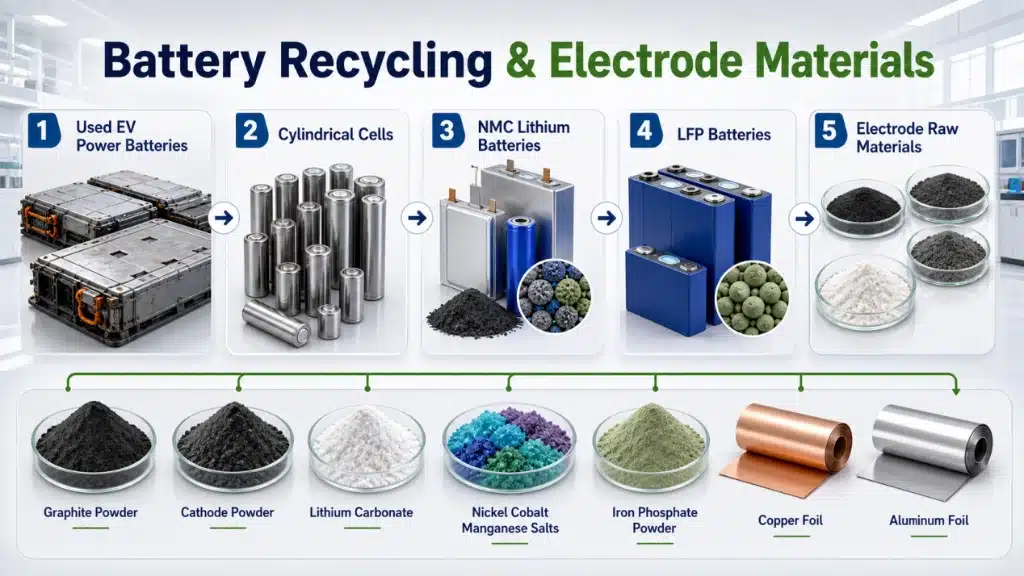
Chemistry also plays a hidden role in volume planning. An integrated lithium battery recycling plant must be capable of processing varying combinations of Lithium Nickel Cobalt Manganese Oxide and Lithium Iron Phosphate. Because different chemistries exhibit unique physical behaviors when crushed and dried, the internal mechanisms of the sorting equipment must adapt. For instance, the moisture content and electrolyte variations between ternary lithium and lithium iron phosphate batteries mean that screen sizes and airflow velocities must be adjustable. If the equipment cannot dynamically respond to these chemical variations, materials will bridge and block the transfer chutes, instantly lowering the hourly capacity.
The primary shredding phase is where most volume calculations fail. If the front-end shredder is undersized, the rest of the facility will sit idle waiting for material. Conversely, if the shredder overfeeds the line, downstream equipment will choke. High-efficiency systems utilize intelligent programmable logic controllers to monitor the torque and feed rate. When the system detects a potential overload from tough materials like steel casings, it automatically reverses or slows the feeding conveyor. While this prevents catastrophic jams, it also means that your average hourly processing rate will fluctuate based on the toughness of the incoming scrap.
After the material is pulverized, it moves into the most sensitive phase of the operation. The crushed mixture of copper, aluminum, plastics, and black powder must be separated accurately. Equipment like vibrating screens, magnetic separators, and air classifiers have strict volumetric limits. Pushing too much material through a gravity separator will drastically reduce the purity of the final product. Industry specifications outline that black powder recovery, aluminum powder recovery, and copper recovery should all reach or exceed 99 percent. Maintaining this level of extraction requires careful calibration of material flow. The capacity of your plant is ultimately limited by the maximum speed at which your air classifiers can operate while still maintaining less than 1 percent cross-contamination between metals and black mass.
Environmental compliance is an operational variable that directly impacts how much material a facility can process per shift. The mechanical destruction of battery cells generates significant amounts of ultra-fine particulate matter. A properly designed facility operates under complete negative pressure to prevent any leakage into the workspace. If the volume of crushed material exceeds the rating of the pulse dust collection system, the entire line must be slowed down to prevent environmental hazards. A properly scaled system ensures dust content remains below 5mg/m³ and noise stays under 90dB, allowing for continuous operation without triggering safety shutdowns.
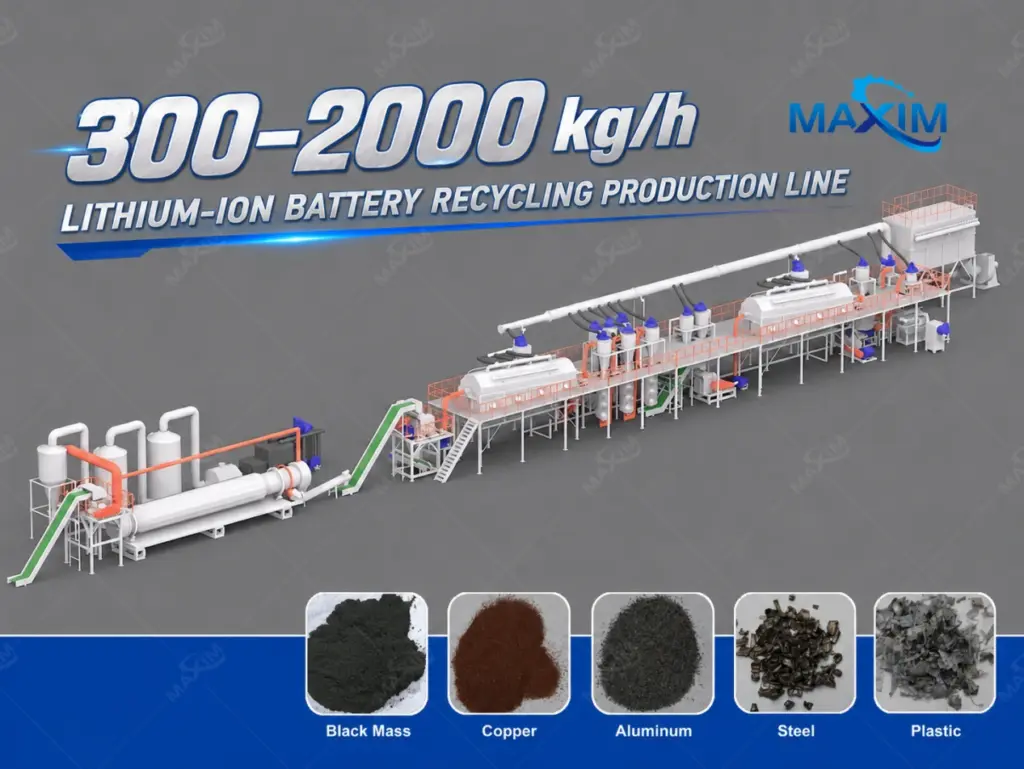
To ensure seamless operation, every stage of the machinery must be mathematically matched. Purchasing a massive primary shredder is useless if the secondary hammer crushers and electrostatic separators have a lower capacity threshold. Buyers must align their target volumes with specific equipment models.
Standard Equipment Capacity Tiers:
*Model MX-500 processes 500 kilograms per hour, ideal for pilot plants or specialized production scrap processing.
*Model MX-1000 processes 1000 kilograms per hour, suitable for mid-sized operations handling a mix of electronics and small cells.
*Model MX-1500 processes 1500 kilograms per hour, built for continuous regional recycling hubs.
*Model MX-2000 processes 2000 kilograms per hour, designed for high-volume continuous industrial output.
*Model MX-2500 processes 2500 kilograms per hour, engineered for massive commercial-scale operations dealing with heavy electric vehicle modules.
Physical floor space is another invisible limit on throughput. A high-capacity line requires adequate buffer zones between machines to allow for maintenance access, forklift traffic, and the safe storage of incoming raw materials and outgoing big bags of sorted powder. Cramping a high-volume system into an undersized building will result in logistical traffic jams, forcing operators to halt the mechanical line simply because they cannot move the finished products out of the way fast enough.
To avoid purchasing an unbalanced setup, engineering teams should follow a strict evaluation checklist before finalizing facility designs.
1. Define the exact ratio of input materials, including the expected split between cylindrical cells, soft packs, and hard-cased modules.
2. Identify the target purity requirements for the final copper, aluminum, and graphite powder fractions, as higher purity demands slower processing speeds.
3. Calculate the required operating hours per day to determine if a smaller line running multiple shifts is more capital efficient than a massive line running a single shift.
4. Plan for inevitable downtime by incorporating maintenance intervals for screen replacements and blade sharpening into the weekly capacity models.
A scalable plant requires scalable utilities. Before committing to a specific volume target, engineers must verify that the local grid can support the total connected kilowatt power requirements of the shredders, blowers, and separation motors. Heavy machinery requires stable voltage to prevent sorting equipment from losing calibration during peak loads. Additionally, adequate compressed air supplies are mandatory for the continuous cleaning of the pulse dust collector cartridges. Failing to secure enough utility capacity will permanently throttle the daily output of the entire mechanical recycling circuit.
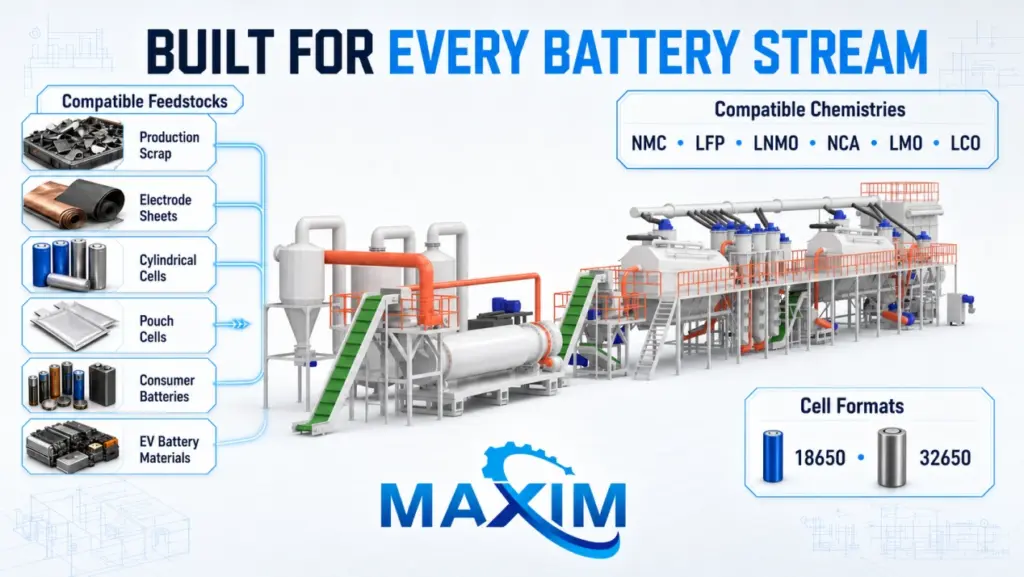
MAXIM machinery specializes in the research, development, and manufacturing of environmentally friendly processing solutions tailored to exact buyer specifications. Because no two waste streams are identical, standard equipment sizing rarely delivers the highest return on investment. By utilizing full closed-loop processing and independent intelligent controls, these customized systems adapt to your specific daily volume targets.
If you are moving from the planning phase into procurement, it is highly recommended to engage with engineers who understand how to balance pre-shredding torque with air classification sensitivities. You can explore our project design and technical support to map out your exact floor plan. Once your variables are defined, you can easily request a lithium battery recycling line quotation to receive an accurate bottleneck calculation and equipment blueprint.
A: Capacity is determined by analyzing your specific feedstock type, such as whole electric vehicle batteries versus clean production scrap, your target output purity, and the sequential processing limits of your mechanical crushing and separation stages. Every project requires a tailored bottleneck calculation rather than relying on generic estimates.
A: Throughput varies significantly based on custom configurations. Standard mechanical processing systems generally range from 500 kilograms per hour up to 2500 kilograms per hour. A well-designed facility scales its sorting equipment to match your specific daily volume targets.
A: Different chemistries and physical forms dictate specific pretreatment requirements and shredding torques. For example, processing dense modules wrapped in steel casings will yield a different hourly processing rate through the primary crusher compared to uniform electrode cell scrap or laptop batteries.
A: Bottlenecks frequently occur during the fine crushing and air separation stages. If primary shredders feed material faster than classifiers and screens can effectively liberate the copper and aluminum from the black powder, the entire system must be slowed down to prevent cross-contamination.
A: Yes. Working with an integrated manufacturer allows you to establish a modular plant layout. This ensures you can seamlessly upgrade specific areas, such as adding parallel screening lines or larger negative pressure dust control units, as your input volume grows over time.
When evaluating investments in the renewable energy sector, facility owners and engineering procurement contractors often ask for a standard throughput number. However, determining true lithium battery recycling plant capacity is not as simple as reading a single specification on a sales brochure. Actual operational volume is a dynamic calculation driven by three main variables, which excerpt …
