
An industrial shredder machine converts irregular, bulky waste into a controlled feed for conveying, separation, secondary crushing, or baling. This improves material flow, reduces handling pressure, and helps operators recover more usable value.
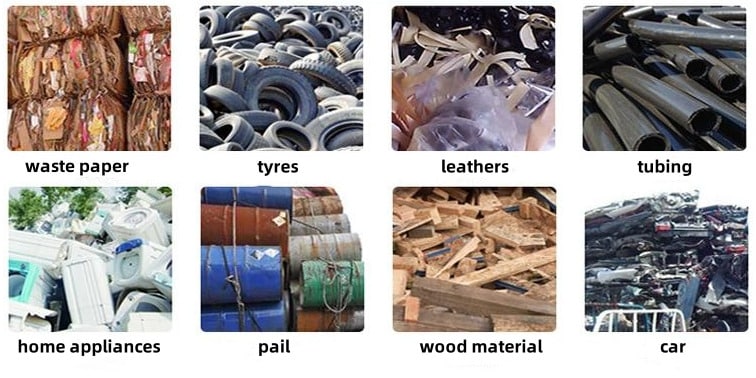
Bulky waste creates problems before separation begins. Large metal sheets, drums, tires, pallets, and hollow plastics occupy space, feed unevenly, and may bridge inside hoppers. A pre-shredder reduces these items into manageable pieces without trying to produce a fine final product in one step.
| Before shredding | After controlled shredding | Operational effect |
| Irregular, oversized feed | More consistent pieces | Easier conveying and metering |
| Attached materials | More exposed interfaces | Better liberation for sorting |
| Low bulk density | More compact material | Better storage and transport use |
| Unstable manual feeding | Controlled mechanical feed | Safer, steadier workflow |
The correct output is not always the smallest possible size. Excessive fines can increase dust, wear, and separation losses. The target should match the next machine.
Shredding normally works as front-end preparation before conveying, separation, screening, secondary crushing, or baling.
Each unit has a different purpose. Magnets remove ferrous metals, eddy current separators recover conductive non-ferrous fractions, screens classify by size, and hammer mills or grinders provide further reduction.
At MAXIM machinery, we develop integrated scrap-metal processes around crushing, impurity removal, sorting, and forming. Our documented line combines magnetic and eddy current separation and is designed for 10 to 50 tons per hour.
The value of a recycling shredder should be tied to measurable plant results:
1.Reduced waste volume and storage pressure
2.More efficient loading and transportation
3.Controlled feeding to downstream equipment
4.Better exposure of joined materials
5.Improved separation of recoverable fractions
6.Less manual handling
7.Greater flexibility for changing feed materials
Volume reduction helps a plant use containers, floor space, and transport capacity more effectively, especially for hollow products, light-gauge metal, tires, and plastic containers.
Operators should compare incoming and outgoing bulk density, truck utilization, storage time, disposal charges, and recovered-material value. Shredding creates the strongest benefit when it replaces repeated handling and prepares waste for profitable recovery.
A recycling line runs steadily only when the feed matches each machine’s opening, torque, and capacity. Oversized pieces may block conveyors or overload secondary crushers.
A slow-speed, high-torque pre-shredder helps regulate flow. We evaluate:
1.Maximum feed size and wall thickness
2.Hardness, contamination, and bulk density
3.Required tons per hour
4.Target output range
5.Downstream equipment limits
6.Operating hours and maintenance needs
This is more reliable than selecting equipment by motor power alone.
Material liberation means opening or tearing connected materials so that sorting equipment can recover them. Examples include metal attached to plastic, steel fasteners inside wood, or aluminum and copper mixed with non-metallic residue.
Shredding does not perform final separation. It creates conditions for magnets, air classifiers, screens, and eddy current separators to work effectively. Our integrated approach uses screening, air separation, and magnetic separation for mixed waste, while metal lines add eddy current separation for non-ferrous recovery.
Mechanized feeding and size reduction can reduce direct contact with sharp, unstable, or heavy items. PLC-based coordination can support uniform feeding and synchronized line operation.
Ferrous scrap responds to magnetic separation, while aluminum, copper, and other non-ferrous metals require different recovery methods. Mixed scrap therefore needs both liberation and sorting.
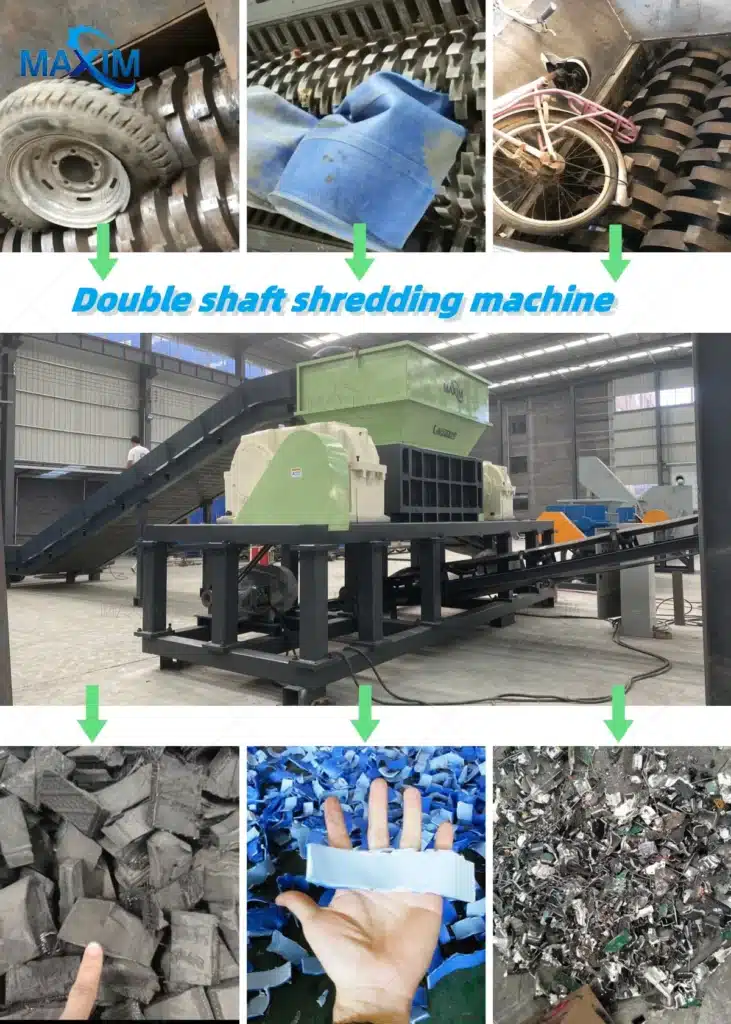
Industrial shredders can handle paint drums, thin metal sheets, car bodies, metal offcuts, and mixed light scrap. Cutter geometry, shaft speed, torque, and output size should match the feed. Dense or high-strength material may require a different configuration from hollow containers or light sheet metal.
One layout does not suit every waste stream. Plastic film may wrap around shafts, tires contain steel reinforcement, wood may carry nails, and electronic waste combines valuable metals with resins and potentially hazardous components.
For circuit-board recycling, size reduction is followed by magnetic separation, air classification, dust collection, and electrostatic separation. This shows why a shredder should be selected as part of a process, not as an isolated purchase. MAXIM machinery configurations use coordinated PLC feeding and negative-pressure conveying to control material movement and dust.
Nameplate capacity is only a starting point. Actual throughput changes with feed density, dimensions, moisture, contamination, cutter condition, feeding consistency, and target output.
| Metric | What to verify |
| Sustained throughput | Tons processed during normal operation |
| Output distribution | Percentage within the required size range |
| Downstream stability | Blockages, recirculation, and idle time |
| Recovery performance | Purity and yield of saleable fractions |
Material trials should use representative feed rather than unusually clean samples.
Total operating value includes energy, cutter wear, replacement parts, labor, planned service, downtime, and disposal of unrecovered residue.
Cost per ton can be estimated as:
Total operating cost during the period ÷ tons of acceptable material processed
A configuration that runs steadily, protects downstream equipment, and allows practical cutter maintenance may cost less over its working life than a cheaper machine with frequent stoppages.
Customization is appropriate when standard equipment cannot match the feed, site, or output requirement. At MAXIM machinery, we adapt line layouts and equipment parameters according to capacity, material characteristics, and site conditions. Solutions can include PLC control, monitoring, fault warnings, installation, commissioning, training, and lifecycle service.
Before proposing a configuration, we need the waste composition, feed size, hourly volume, contaminants, desired output, downstream process, utilities, and available footprint.
A: It reduces bulky waste, creates a consistent feed, improves material liberation, supports downstream sorting, and limits unnecessary manual handling. Its value should be measured through throughput, transport efficiency, recovery performance, downtime, and cost per ton.
A: Depending on the cutter and drive configuration, it can process metal, plastics, tires, wood, paper, electronic waste, appliances, vehicle parts, and mixed bulky waste. Feed dimensions and the required output must be reviewed before selection.
A: Yes. The shredder prepares and liberates the material, while magnets and eddy current separators recover ferrous and non-ferrous fractions. A complete line must match the material composition and desired purity.
A: Yes. Cutter arrangement, hopper size, drive power, output range, conveyors, separation equipment, control system, and layout can be adapted to the material, required capacity, downstream process, and available space.
A request such as “quote a scrap metal recycling line” leaves many technical questions open. Similar scrap can still require different feeding, shredding, conveying, sorting, and discharge arrangements. A better RFQ defines the job before asking for a machine. Material, capacity, sorting goals, final product, and site conditions should all be clear. What Information Should a excerpt …
