
A lithium battery recycling project often begins with one practical question. What equipment turns spent batteries or production scrap into recoverable materials in a safe and steady way? The answer varies with battery chemistry, format, remaining charge, target output, capacity, and local environmental rules. A well-designed line manages material flow. It separates valuable fractions. It limits dust. It also prepares black mass for later refining steps.
Industrial recycling combines pre-treatment, size reduction, physical separation, and, where required, downstream metallurgical refining. Mechanical processing normally produces separated metal fractions and black mass. Hydrometallurgical or pyrometallurgical plants may then recover individual metals from that material.
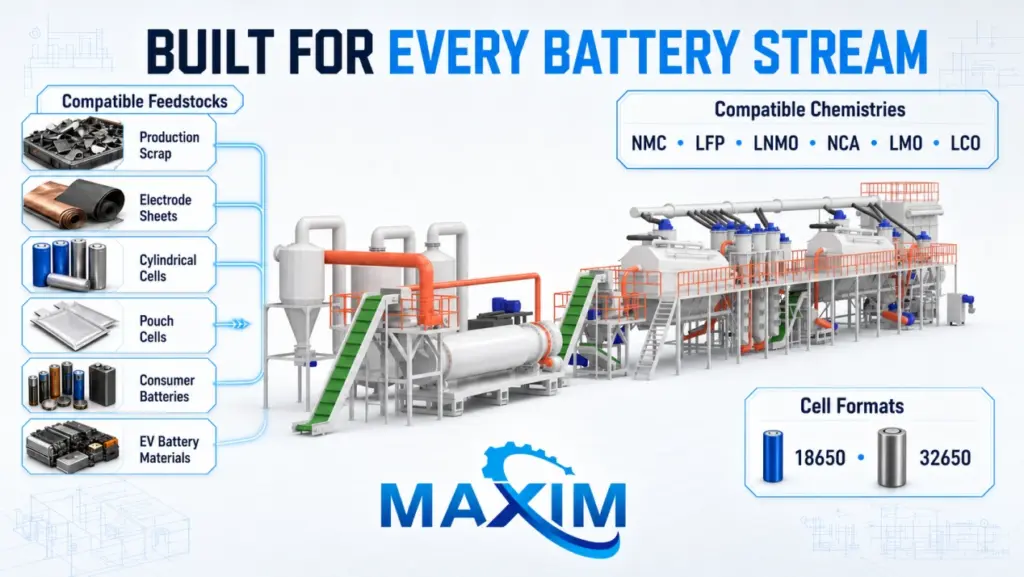
A line can be configured for battery manufacturing scrap, electrode sheets, cylindrical cells, pouch cells, consumer batteries, and electric-vehicle battery material. MAXIM machinery equipment can be designed for NMC, LFP, LNMO, NCA, LMO, and LCO chemistries. The equipment also handles 18650 and 32650 cells.
These materials should not receive automatic mixing. Cell casing, electrolyte condition, chemistry, state of charge, and feed size affect pre-treatment and separation settings. Stable and classified feedstock usually supports more consistent output.
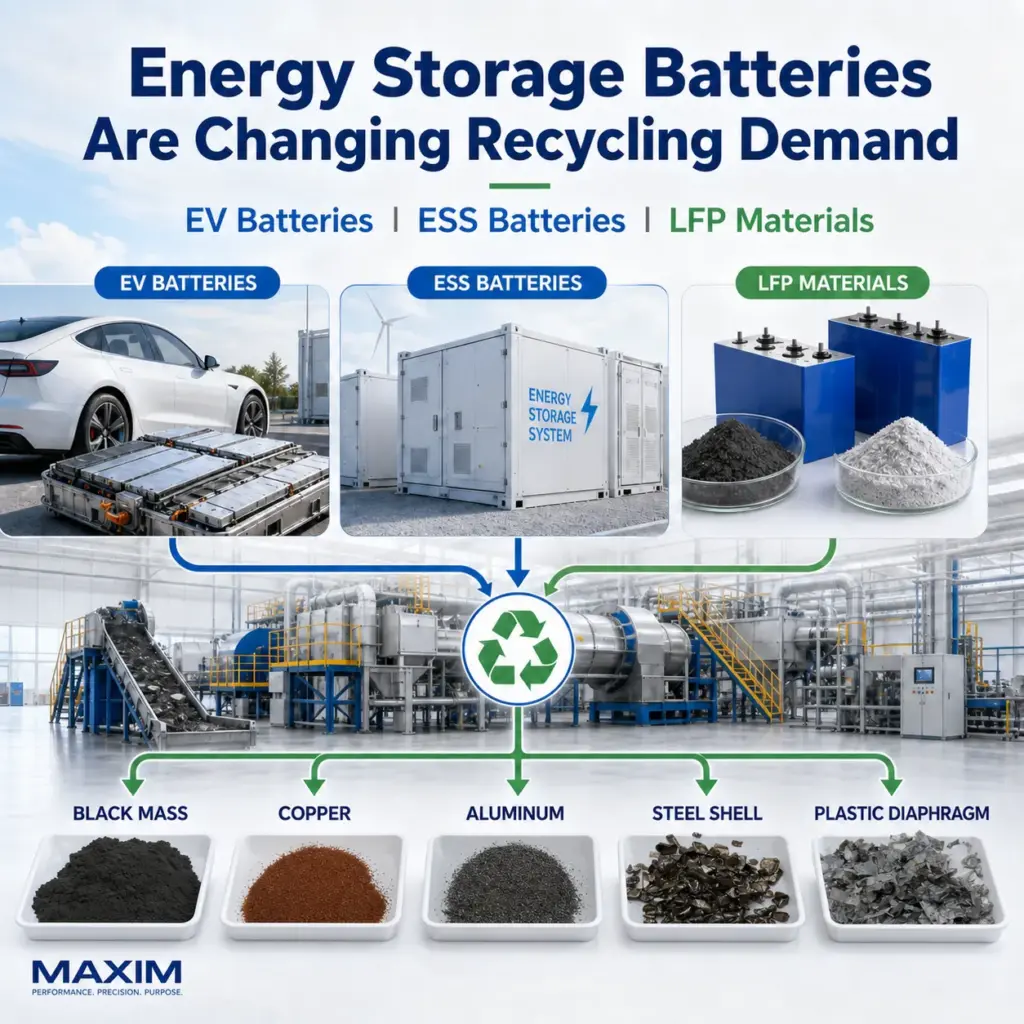
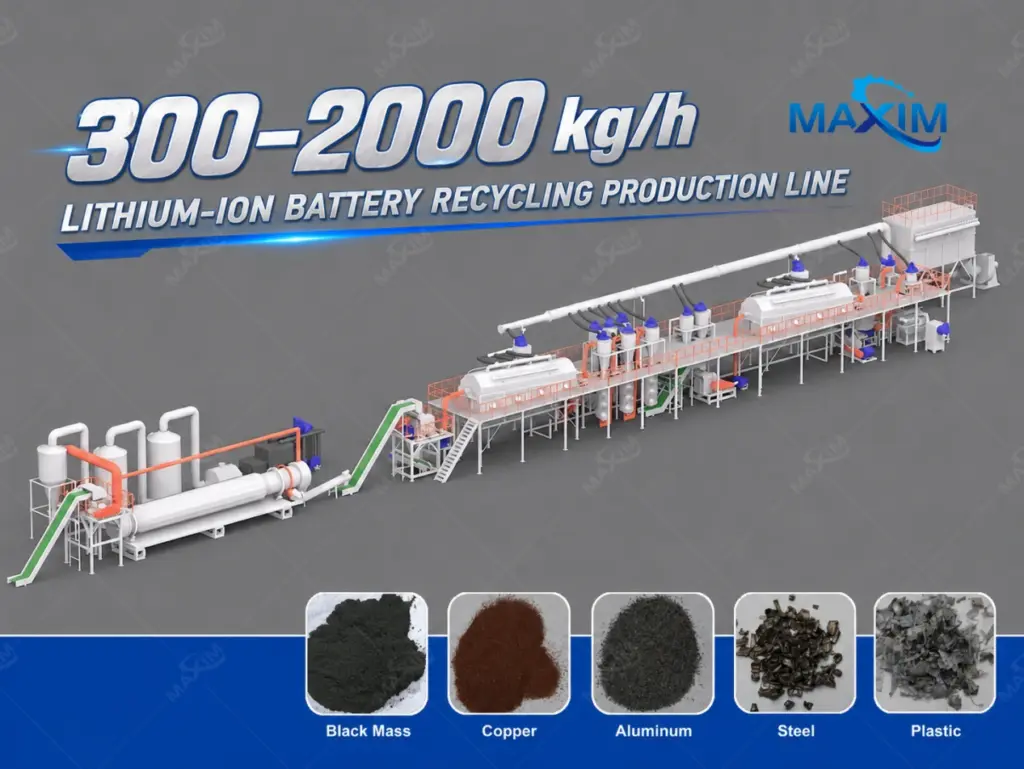
Mechanical separation can recover black mass containing cathode and anode materials. It also recovers copper and aluminum fractions. Steel and other casing metals come out as well. Plastics and separator materials appear in the output too.
Black mass does not count as a finished battery-grade product. The material serves as an intermediate that may contain lithium, nickel, cobalt, manganese, graphite, and residual metallic impurities. Further chemical processing usually becomes necessary to produce purified salts or precursor materials.
A practical production line receives arrangement as a controlled sequence. Each stage prepares material for the next stage. Final product quality depends on the stability of the entire system.
Before shredding, operators should identify battery chemistry, format, physical damage, and state of charge. Packs and modules may require dismantling to remove housings, busbars, cables, cooling parts, and electronic controls.
Clean electrode scrap needs a different front-end arrangement from mixed end-of-life cells. Damaged or swollen batteries also require specific safety procedures before processing.
Shredding opens the battery structure and reduces bulky material. Secondary crushing releases electrode powder from copper and aluminum foils. In the MAXIM machinery process, tearing, hammer crushing, and staged size reduction can be combined according to the feedstock.
Particle size must be controlled. Material that stays too coarse may retain attached powder. Excessive grinding can create metal contamination. It can increase the dust load. It can also complicate separation.
Vibrating screens classify particles by size. Air separation uses differences in density and aerodynamic behavior to divide light and heavy fractions. Conveyors maintain a stable flow between stages.
A complete MAXIM machinery line can include crushing, sorting, conveying, air purification, automatic control, and centralized dust collection. Negative-pressure operation helps reduce dust escape. The operation also maintains a cleaner processing area.
The right technology depends on whether the project will sell separated fractions, produce black mass, or refine metals internally.
Mechanical pre-treatment reduces volume and separates valuable fractions before refining. Hydrometallurgy becomes suitable when individual metal products receive requirement. Pyrometallurgy accepts complex feed but uses high-temperature equipment.
A mechanical line becomes suitable when a business wants to process manufacturing scrap or spent cells at an industrial scale. The line also recovers copper and aluminum as separate fractions. It produces black mass for an external refinery. The line can build a regional pre-processing hub. It can add preparation capacity to an existing refining facility.
The commercial model should receive confirmation before equipment selection. Black mass composition varies by chemistry. Operators and buyers should agree on impurity limits, moisture, packaging, and sampling.
Equipment selection should begin with material testing and output requirements. The process should not begin with capacity alone.
LFP and NMC batteries have different valuable-material profiles. Production scrap usually stays cleaner and more uniform than mixed end-of-life batteries. Cylindrical cells, pouch cells, modules, and electrode sheets also behave differently during feeding and crushing.
Provide representative samples, average dimensions, chemistry proportions, expected contaminants, and daily volume. These details influence the shredder, screens, air-separation settings, and dust-collection load.
MAXIM machinery offers line models from 500 to 2,500 kg/h. Capacity planning should also consider operating hours, maintenance, feedstock supply, storage, utilities, and expansion.
A serious comparison should examine more than the purchase price.
1.Recovery and separation targets
2.Black mass impurity limits
3.Copper and aluminum grade
4.Dust, noise, and fire-risk controls
5.Energy use and wear parts
6.PLC control and maintenance access
7.Installation, training, and after-sales support
MAXIM machinery’s machine can reach recovery rates of at least 99% for black powder, aluminum powder, and copper. Dust concentration stays up to 5 mg/m³. Noise is lower than 90 dB under stated conditions. Actual performance depends on feedstock and configuration.

A production line must fit the customer’s material, building, labor model, and downstream plan. A one-size-fits-all layout may create bottlenecks or unnecessary investment.
At MAXIM machinery, we support projects through:
*Feedstock and requirement analysis
*Process selection and equipment configuration
*Layout design and quotation
*Manufacturing and quality control
*Installation and commissioning
*Operator training and after-sales service
The solutions can integrate pre-shredding, crushing, screening, air separation, conveying, dust collection, and automatic control. Parameters receive customization according to capacity, material characteristics, and site conditions. Support continues throughout the equipment lifecycle.
For an accurate proposal, send battery type, chemistry, hourly capacity, workshop dimensions, local power supply, and required final products.
A: The plant prepares and classifies batteries. It reduces their size through shredding and crushing. It uses screening and separation equipment to recover black mass, copper, aluminum, and other fractions. Black mass may then enter chemical or thermal refining.
A: Cost depends on capacity, battery type, automation, safety systems, environmental controls, plant layout, and whether metal refining is included. A reliable quotation requires material details and clear production goals.
A: A properly configured mechanical line may process both. Separate campaigns often become preferable because LFP and NMC black mass have different compositions and downstream values.
A request such as “quote a scrap metal recycling line” leaves many technical questions open. Similar scrap can still require different feeding, shredding, conveying, sorting, and discharge arrangements. A better RFQ defines the job before asking for a machine. Material, capacity, sorting goals, final product, and site conditions should all be clear. What Information Should a excerpt …
