
The feed assumption is often where two similar-looking prices part company. One bidder may have allowed for loose cells; another may have assumed whole packs. Their figures answer different requests. Before asking for an equipment quotation, give both bidders the same material description, line boundary, and return fields. The buyer can fill this lithium battery recycling equipment RFQ checklist alongside the request.
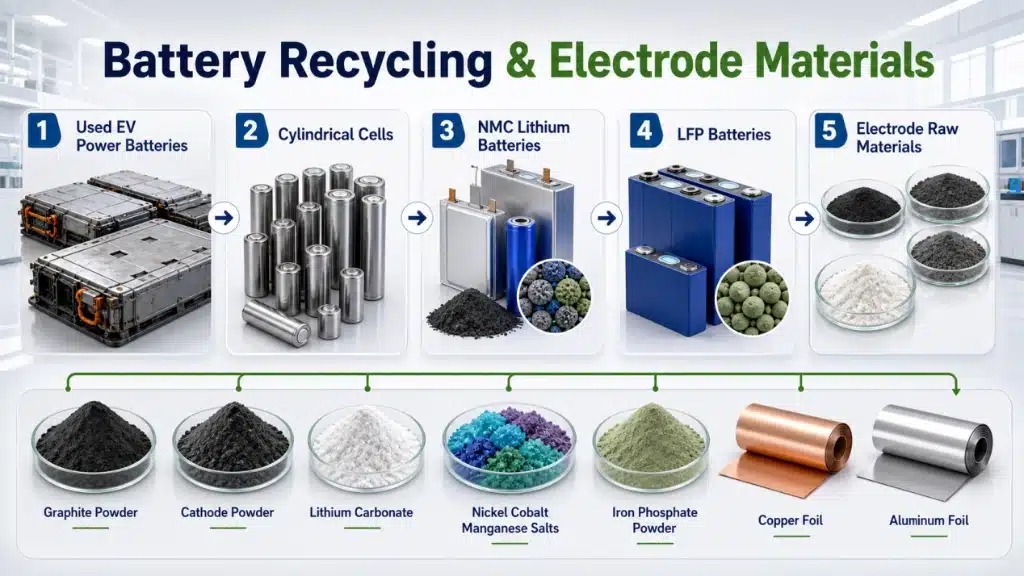
Write down what will arrive at the proposed line, not simply “battery scrap.” A photograph helps when a label hides the physical form. Show scale and packaging. The feed attachment should identify cells, modules, packs, electrode sheets, manufacturing scrap, or a fraction prepared elsewhere. These are different inlet cases for lithium battery recycling equipment. The lithium battery recycling equipment RFQ should carry that inlet case on its feed attachment.
Each stream gets its own line, with chemistry and delivery form followed by size range, condition, contamination, and expected quantity. Add confirmed or forecast. A forecast is not a firm feed mix. If NMC and LFP run separately, say so. If unknown, give a range and ask which case was priced. That beats “handles all chemistries.”
A drawing alone cannot settle scope. The sketch should make one question easy to answer: what happens between receipt and the first priced machine? Label buyer inspection, dismantling, discharge, drying, or preparation on that path. Put the accepted condition beside the handover arrow and name who turns away unsuitable material. Ask the bidder to circle the first step included in its price.
This matters especially when charged, swollen, damaged, or complete batteries are possible; their handling needs project-specific review. The lithium battery recycling equipment RFQ should identify which of those conditions the supplier might see. Name the owner of buyer-supplied preparation shown on the supplier's drawing.
“Capacity: ___ kg/h” is incomplete. Say what crosses the measuring point: accepted feed at the line inlet. Record operating hours and the material case. Ask for the proposed line capacity on that case, with limits or exclusions. A crusher nameplate does not show what the whole process can sustain. Put the measuring point in the lithium battery recycling equipment RFQ.
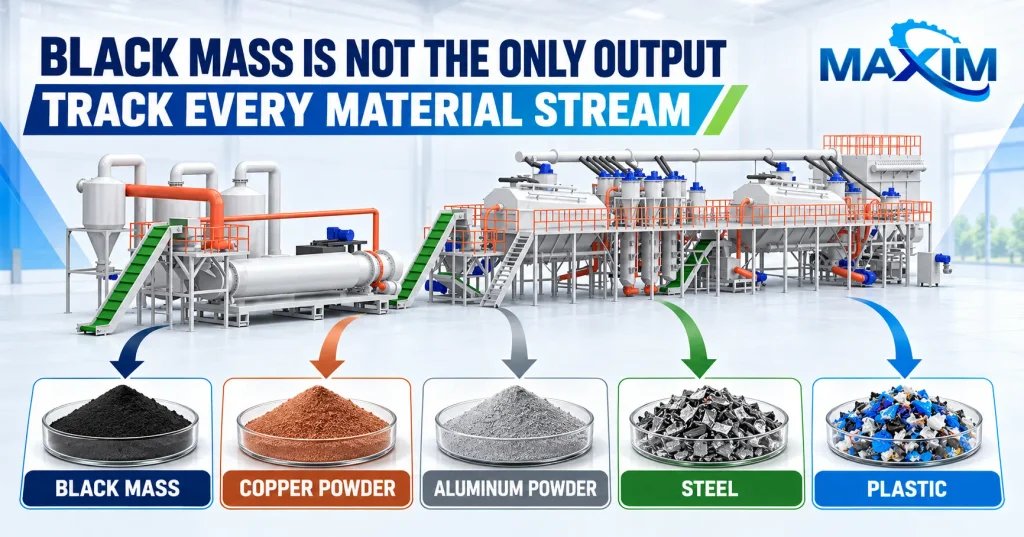
List black mass or electrode powder, copper, aluminum, casings, and other wanted fractions. Beside each, ask where a sample would be taken and what quality measure matters. Moisture and impurity limits need a method and basis. Supplier estimates can then use those same rows.
Recovery claims need a denominator. Record the feed basis, counted fraction, sampling point, and calculation method. See the official recovery-rate definitions for this field. If offers use different bases, keep both assumptions visible. Every percentage in the lithium battery recycling equipment RFQ needs that basis beside it.
The official MAXIM machinery product page names crushing, conveying, screening and sorting. The page also names air separation, automatic control, and centralized dust collection. Feed and wanted fractions determine the equipment specifications. We cannot assess a configuration from “battery scrap” alone: this lithium battery recycling equipment RFQ needs inlet condition and wanted outputs. Keep downstream refining visible as a separate scope row when the project calls for it.
Ask whether each bidder will demonstrate the agreed throughput and output terms. Record proposed feed, duration, sampling, and tolerance for later agreement. The detailed factory acceptance procedure comes later. For the lithium battery recycling equipment RFQ, obtain a written commitment to discuss that later test.
Show unloading and line footprint on the site sketch. Add floor dimensions, clear height, and material flow. Note known voltage, frequency, and ventilation limits in the margin. In reply, ask for the arrangement drawing, installed load, expected demand, service clearance, and dust collection interfaces. A buyer's engineer should review each connection. These equipment procurement inputs tie the lithium battery recycling equipment RFQ to the building.
Scope sheet beside the price sheet. Each scope item needs an answer: supplied, buyer supplied, or optional. Start with site work. At the site boundary, distinguish foundations and electrical connection from extraction ducting, compressed air where relevant, permits, and commissioning consumables. Within the line scope, record who provides feeding, conveyors, controls, dust collection, spares, installation supervision, training, and start-up support. Leave space for third-party units or work ahead of the line.
“Dust collection included” can mean the collector alone, with site ductwork outside the offer. Ask where supply ends. That sentence can explain more of a price difference than a long equipment list. Score supplier capability later.
In a battery recycling machine quotation, missing attachments can look like missing scope. Ask first for the process flow diagram and equipment list. The layout and utility schedule should follow. Beside them, collect feed assumptions and output estimates, plus inclusions, exclusions, and deviations. A price is hard to compare without currency and offer validity. Delivery basis and lead time matter too, along with payment milestones, warranty, spares, and options. Put assumptions in the return schedule, not “as discussed.” The lithium battery recycling equipment RFQ should name every field.
Before issue, assign an owner to each blank in the lithium battery recycling equipment RFQ. Require bidders to identify any value they assumed. Send changes to every bidder and date revised attachments. The same brief can go to MAXIM machinery for a proposal on the stated material and outputs. Compare offered work and exclusions before total price.
A: Begin with a short description of the material and the point where supplier work begins. Give the bidder a feed description and preparation boundary, then a capacity basis and output schedule. Add the site sketch, supply split, and return form. For blanks, require each bidder's priced assumption.
A: A material label alone leaves too much to guess. Describe the feed stream by stream. Each entry needs chemistry, form, condition, size range, contamination, and likely quantity. Say whether streams run separately or together. Use a photograph or sample description when “battery scrap” hides the form, and mark where preparation ends.
A: Use accepted feed at the line inlet, in kg/h, and state the material case and planned operating hours. Ask for a whole-line figure. The trial feed and method for proving the figure can be agreed in the later acceptance plan.
A: Read the price beside the scope sheet. Preparation may sit with the buyer; so may foundations, electrical connection, air and dust interfaces, permits, installation labor, commissioning supplies, or downstream refining. Have each bidder show where its responsibility ends. Show optional work beside the base price in the comparison.
A: Could the buyer email the same package to two bidders today, without adding an explanation? If both get identical attachments and fields, it is nearly ready. Open values need owners; offers need priced assumptions. Supplier scoring and the witnessed factory test can be handled in their own documents.
A layout drawing says little about the awkward scrap that arrives every week. A small metal shredder machine may fit the floor yet struggle with a full shift of that material. Feed, operating hours and the next process all affect the choice. A larger chamber is no automatic answer. Describe one feed mix and duty excerpt …
