
Lithium battery manufacturing generates more than finished batteries. Cathode sheets, anode sheets, electrode trimming waste, and other production scrap can contain recoverable metals and active materials. When these materials are collected separately, they do not always require the same treatment route as complete end-of-life battery packs.
For recyclers and battery manufacturers, the practical question is therefore not simply how to recycle lithium batteries, but how to separate electrode coatings from metal foils efficiently while maintaining stable throughput and controlling fine powder.
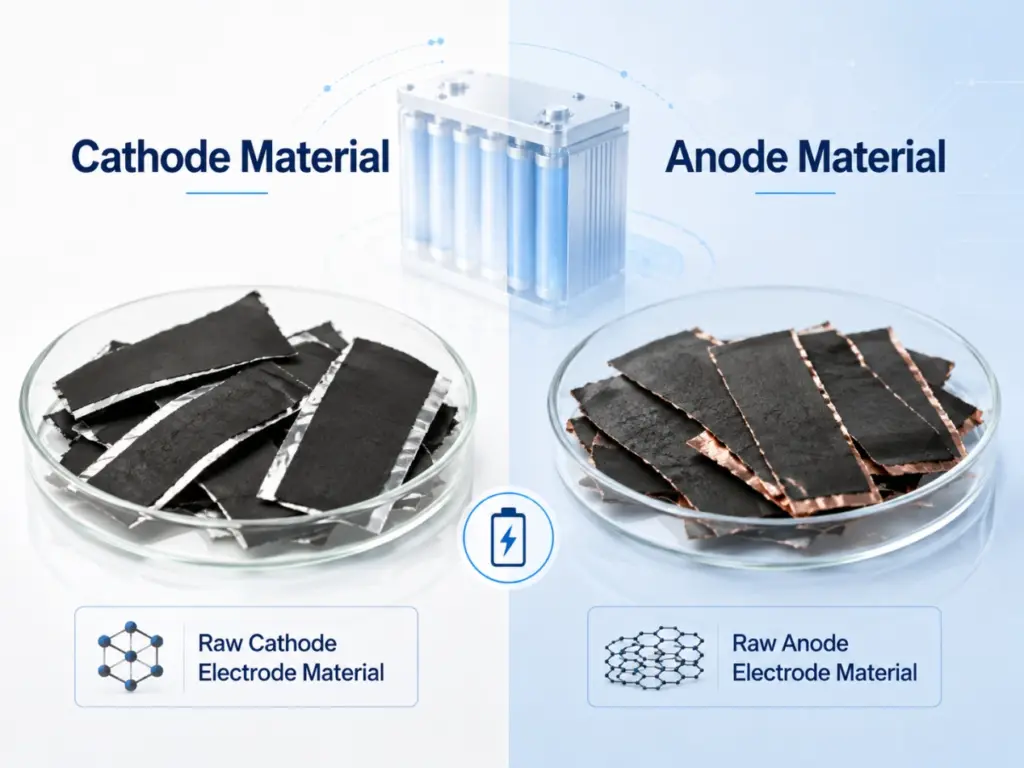
Electrode sheets are already partially processed battery materials. Unlike complete batteries, they do not contain the same combination of housings, modules, separators, and other structural components. This can simplify the mechanical recycling route, but effective liberation and separation are still essential.
A cathode sheet generally consists of active cathode material coated onto aluminum foil. An anode sheet normally contains graphite-based material coated onto copper foil.
From a recycling perspective, the main objective is to separate these attached materials into usable fractions rather than leaving valuable powder mixed with metal foil.
For electrode-sheet processing, the main recoverable outputs can include:
1.Cathode or black powder fractions
2.Aluminum from cathode sheets
3.Copper from anode sheets
4.Graphite-rich material from anode sheets
MAXIM machinery’s lithium battery treatment system is designed to separate aluminum, copper, and positive and negative electrode materials for further recycling.
Whole-battery recycling often requires additional preparation because the incoming material may contain cells, casings, plastics, steel components, and different battery chemistries.
Separated cathode and anode production scrap has a narrower material composition. This allows the process to focus more directly on size reduction, coating liberation, screening, and density-based separation.
Material identification still matters. Our lithium battery recycling equipment can be applied to different lithium battery materials, including LFP, NMC, NCA, LMO, LCO, and other listed battery types.
The purpose of a lithium battery electrode sheet recycling line is not simply to make the material smaller. Each processing stage should help release powder from foil and prepare the different fractions for effective separation.
The first stage reduces cathode and anode sheets into manageable pieces.
A tearing or shredding stage opens and breaks the electrode sheets, while subsequent hammer crushing further liberates coating material from copper or aluminum foil. The process configuration described for our lithium battery recycling equipment combines tearing, wind separation, hammer crushing, vibrating screening, and air separation.
Controlled crushing is important because insufficient liberation leaves active material attached to foil, while unsuitable particle-size distribution can make downstream classification more difficult.
After crushing, the material contains particles with different sizes, shapes, and densities.
Vibrating screening classifies the material by particle size. Air separation then helps separate lighter or finer powder fractions from metal-rich material. Multiple separation stages can be used when greater material cleanliness is required.
A simplified process can be understood as:
| Stage | Main Function | Typical Output |
| Shredding | Reduce electrode sheet size | Smaller sheet pieces |
| Hammer crushing | Release coating from foil | Mixed powder and metal |
| Screening | Classify by particle size | Fine and coarse fractions |
| Air separation | Separate by physical properties | Powder and metal-rich fractions |
| Collection | Recover final products | Copper, aluminum, active material |
Fine battery powder requires careful handling. Crushing, screening, and air classification can generate airborne particles if the line is not properly enclosed.
Our lithium battery production line includes crushing, sorting, conveying, air purification, automatic control, and centralized dust-removal systems. The line operates under negative pressure to reduce dust overflow during production.
For the referenced technical configuration, the specified dust level is ≤5 mg/m³, while the noise indicator is ≤90 dB.
Cathode and anode sheets can share major mechanical processing stages, but their recoverable materials are different. This affects equipment adjustment, separation targets, and product collection.
For cathode sheet recycling, the key task is separating the cathode coating from aluminum foil.
After size reduction and liberation, screening and air classification help separate fine active-material powder from the aluminum fraction. The process should minimize metal contamination in the recovered powder while preventing valuable coating material from remaining attached to the foil.
Anode recycling focuses on separating graphite-rich coating material from copper foil.
Copper has significant recycling value, so liberation efficiency and downstream classification directly influence the quality of the recovered fractions.
The practical difference can be summarized as follows:
| Feed Material | Main Metal Carrier | Main Coating Fraction | Main Separation Goal |
| Cathode sheet | Aluminum foil | Cathode active material | Aluminum and powder separation |
| Anode sheet | Copper foil | Graphite-rich material | Copper and graphite separation |
A 2 ton per hour system should be selected according to actual feed conditions rather than capacity alone.
Before selecting equipment, we normally consider several project variables:
1.Whether the feed is cathode sheet, anode sheet, or a combination
2.Required hourly throughput
3.Particle size and condition of incoming material
4.Target recovered fractions
5.Required separation quality
6.Available workshop layout and operating conditions
MAXIM machinery offers listed lithium battery recycling capacities of 500, 1,000, 1,500, 2,000, and 2,500 kg/h.
This capacity range allows a project to be configured according to actual production demand instead of using a single fixed-size system.
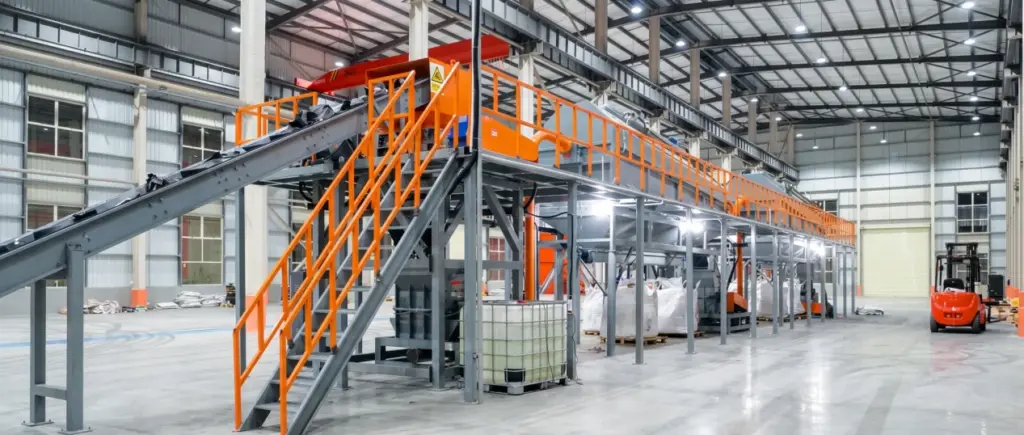
For one customer project in Thailand, the required processing materials were cathode sheets and anode sheets, with a target capacity of 2 tons per hour.
Because the feed consisted specifically of electrode sheets, the project focused on mechanical liberation and separation of coating material, copper, and aluminum rather than treating the material exactly like mixed whole batteries.
The 2 t/h requirement corresponds to the 2,000 kg/h capacity level in our lithium battery recycling line range. The project demonstrates why feed identification should come before equipment selection: two projects with the same throughput can require different configurations when their incoming materials differ.
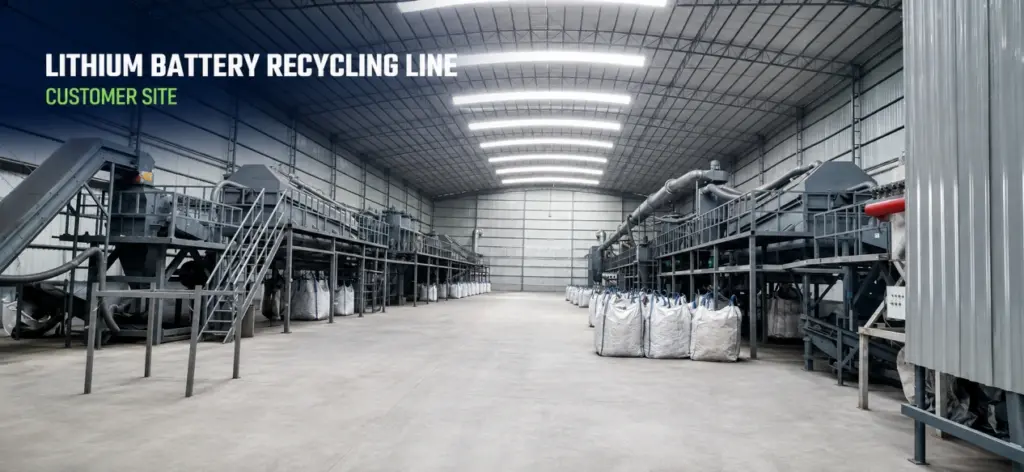
Industrial recycling performance depends on how individual machines work together.
At MAXIM machinery, our customization approach considers production capacity, material characteristics, and site conditions. Our broader equipment solutions also use PLC-based control to coordinate production-line operation and reduce unnecessary manual intervention.
For electrode recycling, customization can influence feeding stability, crushing intensity, screening efficiency, air classification, dust collection, and the final plant layout.
A lithium battery recycling machine should not be selected from throughput specifications alone.
Before purchasing a cathode and anode sheet recycling line, buyers should confirm the feed material, expected daily operating hours, target outputs, available factory space, utility conditions, environmental-control requirements, and maintenance access.
It is also important to evaluate the complete project service process. MAXIM machinery provides support covering preliminary consultation, solution design, equipment production, installation and commissioning, personnel training, and after-sales maintenance.
For customers planning a 2 t/h or other industrial electrode recycling project, providing representative raw-material information at the beginning helps us develop a more appropriate process configuration and equipment proposal.
A: Mechanical processing using shredding, crushing, screening, and air separation can separate electrode coating materials from copper and aluminum foils. The actual configuration should be selected according to feed composition, required capacity, and target output quality.
A: A typical line can include a tearing or shredding machine, hammer crushing equipment, vibrating screens, air separation equipment, conveying systems, centralized dust collection, and automatic controls. Our process uses tearing, wind separation, hammer crushing, vibrating screening, and air separation.
A: Yes. A properly configured production line can process both materials. Cathode and anode sheets have different metal foils and coating materials, so equipment settings and product collection should therefore be designed around the actual feed mixture.
A: The main recoverable fractions include aluminum, copper, cathode material, and graphite-rich powder. The documented working performance of our lithium battery recycling equipment lists copper, aluminum, lithium cobalt oxide, and graphite powder among the main final products.
A: The price depends on feed composition, equipment configuration, separation requirements, automation, dust-control design, plant layout, and supporting systems. For a 2 t/h cathode and anode sheet project, MAXIM machinery first evaluates the raw materials and required outputs before preparing a suitable technical and commercial proposal.
A request such as “quote a scrap metal recycling line” leaves many technical questions open. Similar scrap can still require different feeding, shredding, conveying, sorting, and discharge arrangements. A better RFQ defines the job before asking for a machine. Material, capacity, sorting goals, final product, and site conditions should all be clear. What Information Should a excerpt …
