
An EV battery can leave a vehicle before every cell becomes useless. For recyclers, OEMs, fleet operators, and energy storage businesses, the practical question is what should happen next: reuse, repurposing, or material recovery?
The decision should not rest on age alone. Safety, battery condition, chemistry, remaining performance, and economics all matter. A clear routing method can keep suitable packs in service while directing unsafe or uneconomic batteries into EV battery recycling.
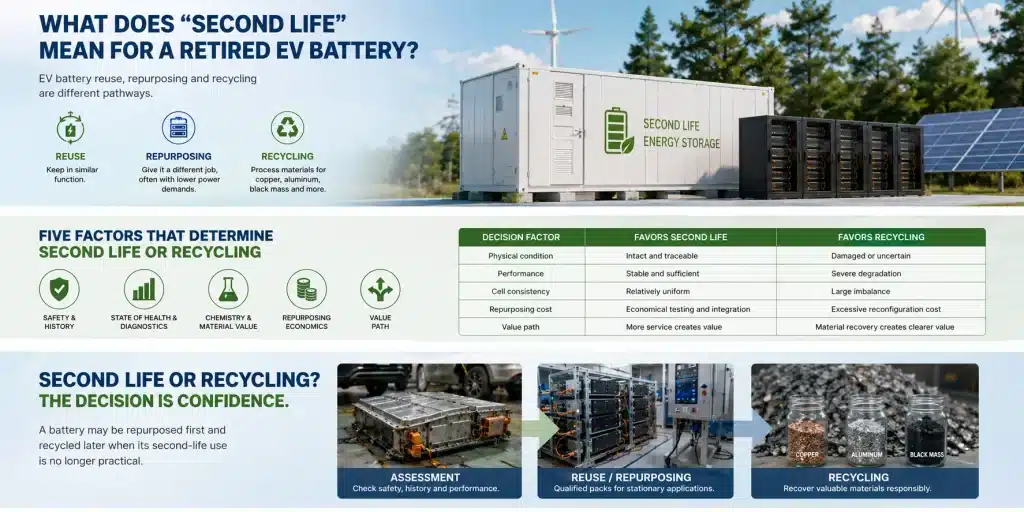
Reuse keeps a battery, module, or cell in a similar function when its condition still supports that role. Repurposing gives it a different job, often with lower power demands than vehicle propulsion. Recycling processes the battery so copper, aluminum, electrode material, and black mass can be separated for downstream recovery.
These routes are not always competitors. A battery may be repurposed first and recycled later when its second-life use is no longer practical.
Vehicle applications demand high power, reliable range, and consistent pack response. A battery that no longer meets those requirements may still work in a less demanding stationary application.
Remaining capacity alone is not enough. Internal damage, unstable cells, water exposure, or unclear service history can make reuse unattractive. Vehicle retirement should therefore trigger assessment, not an automatic second-life decision.
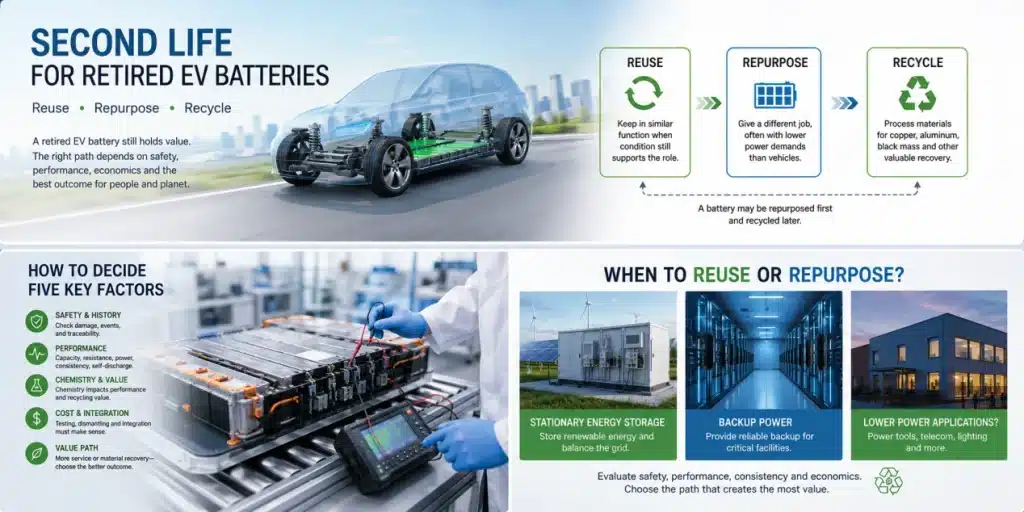
Safety is the first filter. Operators should check for deformation, swelling, leakage, thermal events, crash damage, damaged connectors, and other abnormal conditions.
Battery history matters too. Packs with reliable operating records are easier to evaluate than batteries with unknown storage conditions or incomplete traceability. When safety cannot be verified with confidence, controlled recycling is usually the more defensible route.
State of health helps describe remaining capability, but it should not be treated as one pass-or-fail number. A pack may show acceptable average capacity while containing modules with large performance differences.
Useful assessment should consider:
1.Remaining capacity
2.Internal resistance and power capability
3.Voltage and temperature consistency
4.Self-discharge behavior
5.Diagnostic data quality
The intended application also matters. A pack suitable for stationary storage may still be unsuitable for another mobility use.
Chemistry affects technical behavior and recycling economics. MAXIM machinery recycling systems are designed for multiple lithium battery feedstocks, including scrap automotive batteries and chemistries such as NMC, LFP, NCA, LMO, LNMO, and LCO.
| Decision factor | Favors second life | Favors recycling |
| Physical condition | Intact and traceable | Damaged or uncertain |
| Performance | Stable and sufficient | Severe degradation |
| Cell consistency | Relatively uniform | Large imbalance |
| Repurposing cost | Economical testing and integration | Excessive reconfiguration cost |
| Value path | More service creates value | Material recovery creates clearer value |
No chemistry should be routed on chemistry alone. Condition, testing cost, market value, and downstream use need to be considered together.
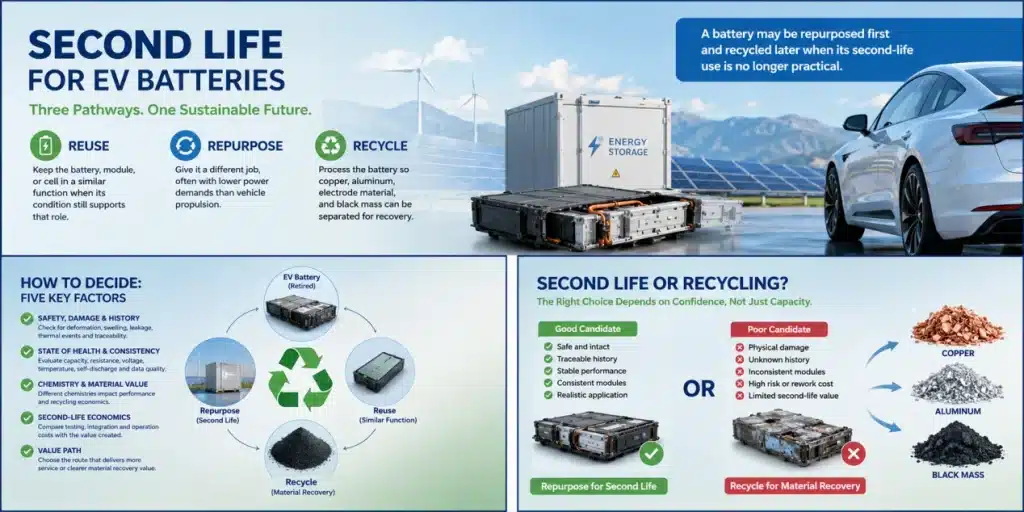
A strong candidate is safe, traceable, electrically stable, and consistent enough to justify further testing. It should also have a realistic application waiting for it.
Operators must account for dismantling, module grading, system integration, battery management, and performance verification. If those steps cost more than the value created, repurposing loses its advantage.
Common second-life directions include stationary energy storage, renewable energy buffering, backup power, and other applications with lower power demands than vehicle traction.
Consider an illustrative case. Two retired packs arrive with similar remaining capacity. Pack A has clean records, no physical damage, and stable module readings. Pack B has an unknown storage history and several inconsistent modules. Pack A may justify grading for stationary use, while Pack B may be better directed to recycling. The difference is confidence, not simply capacity percentage.
Recycling becomes the stronger route when a battery cannot be safely or economically returned to service. This includes serious mechanical damage, major cell imbalance, unstable behavior, poor traceability, or performance too weak for a practical second-life application.
Once a battery enters recycling, controlled pretreatment and separation become essential. MAXIM machinery lithium battery lines integrate crushing, sorting, conveying, air purification, automatic control, and centralized dust removal. The line operates under negative pressure to reduce dust escape during processing.
Different chemistries create different economic priorities. Nickel- and cobalt-bearing batteries may offer stronger material recovery value, while LFP packs can present a different balance between reuse potential and recovered-material economics.
Feedstock classification therefore matters. MAXIM machinery systems can process scrap car lithium batteries and multiple lithium-ion chemistries. The mechanical route uses tearing, air separation, hammer crushing, and vibrating screening to separate electrode material and metallic fractions.
A practical routing sequence can be kept simple:
1.Is the pack safe to handle and test?
2.Is its history known well enough to support reuse?
3.Are state of health and module consistency suitable for the intended application?
4.Will testing, dismantling, reconfiguration, certification, and integration leave a viable business case?
5.If not, can the pack be efficiently routed into material recovery?
This keeps one metric from controlling the entire decision and separates technical feasibility from commercial feasibility.
After a pack is accepted for recycling, the objective shifts from preserving battery function to separating useful material streams.
MAXIM machinery provides lithium battery recycling lines that combine crushing and separation with automated control and dust management. Depending on feed material and configuration, the process separates copper, aluminum, electrode powders, and other battery fractions.
Available models include MX-500, MX-1000, MX-1500, MX-2000, and MX-2500, with nominal capacities from 500 kg/h to 2,500 kg/h. Technical data specifies recovery targets of at least 99% for black powder, aluminum powder, and copper under the stated production-line conditions.
For a new facility, feedstock chemistry, incoming battery form, target capacity, site conditions, output requirements, and environmental controls should shape line design. At MAXIM machinery, we can use these inputs to configure the mechanical processing route around the actual material flow.
A: Second life keeps a battery, module, or cell in service through reuse or repurposing. Recycling ends its functional use and separates material fractions for further recovery.
A: Start with safety, then evaluate battery history, state of health, module consistency, chemistry, diagnostic confidence, and the economics of testing and repurposing. If safe and economical reuse cannot be justified, recycling is the more practical route.
A: There is no universal state-of-health value that determines second-life suitability by itself. It should be considered together with power capability, cell consistency, degradation behavior, safety, and the requirements of the intended application.
A: Not automatically. LFP chemistry can be attractive for certain second-life uses, but the decision still depends on condition, remaining performance, testing cost, system integration, and the value of the recycling route.
A: It can enter a recycling process that includes pretreatment, size reduction, and separation. The goal is to recover useful fractions such as black mass, copper, and aluminum for downstream processing instead of leaving the retired pack as unmanaged waste.
A request such as “quote a scrap metal recycling line” leaves many technical questions open. Similar scrap can still require different feeding, shredding, conveying, sorting, and discharge arrangements. A better RFQ defines the job before asking for a machine. Material, capacity, sorting goals, final product, and site conditions should all be clear. What Information Should a excerpt …
