
Waste circuit boards contain valuable metals, but they cannot be treated like ordinary scrap. Their metals are bonded to resins, glass fiber, solder, coatings, and electronic components. Effective PCB recycling therefore requires controlled liberation, accurate classification, dust control, and a clear downstream route for each recovered fraction.
A printed circuit board is a layered composite rather than a uniform metal product. Copper tracks, solder, connectors, components, fiberglass, and resin are physically joined. Before separation can begin, the material must be reduced to a particle size that releases metal from the non-conductive substrate.
Insufficient crushing leaves metal attached to resin and fiber. Excessive pulverizing creates unnecessary fines, increases energy consumption and wear, and can make classification harder. A practical waste circuit board recycling system therefore uses staged size reduction instead of one aggressive crushing step.
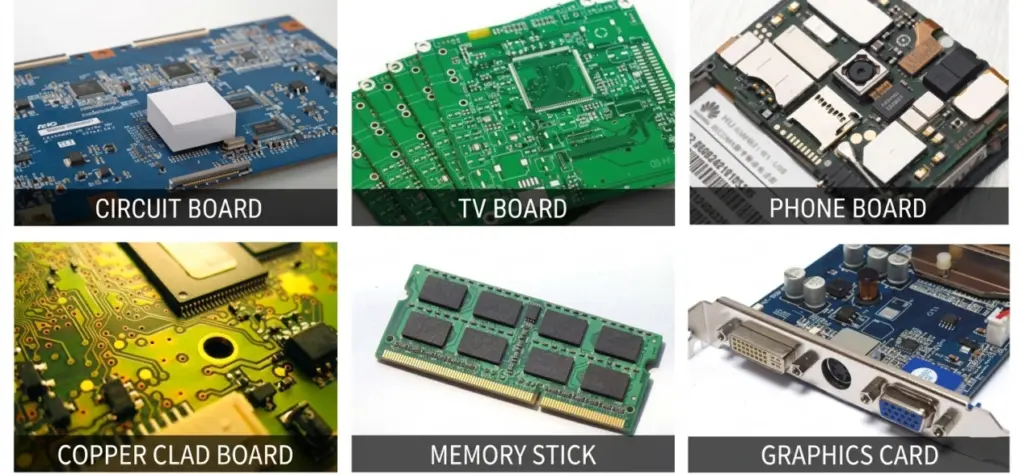
Computer boards, mobile phone boards, television boards, flexible boards, and copper-clad laminates behave differently. At MAXIM machinery, we design systems for several of these feed categories, including PCB and FPCBs, with the objective of separating mixed metals from non-metallic material.
Before equipment selection, recyclers should evaluate:
1.Board dimensions, thickness, and component density
2.Metal content and material consistency
3.Moisture, batteries, oil, and foreign contaminants
4.Daily supply volume and operating hours
Poorly prepared feedstock can reduce throughput and destabilize output. Sorting at the receiving stage often improves the performance of the complete line.
Recovered output can be divided into three commercial groups.
| Fraction | Typical contents | Common next step |
| Mixed metal concentrate | Copper and other conductive metals | Sale, smelting, or further refining |
| Precious-metal-bearing fraction | Gold, silver, palladium, and associated metals | Specialist refining |
| Non-metallic fraction | Resin and fiberglass | Qualified reuse, treatment, or disposal |
The exact composition varies widely. A production line should not be selected from a generic metal-content estimate. Representative sampling provides a more reliable basis for judging recovery value.
Mechanical PCB metal recovery normally produces a concentrated metal fraction. It does not automatically deliver individually refined precious metals, which generally require downstream smelting or chemical processing.
Recovery rate and product purity are related but not identical. A plant may collect most of the metal while producing a concentrate contaminated with resin powder. Overly strict separation may improve purity while allowing fine metal particles to escape with the non-metallic stream.
A useful performance review tracks:
1.Metal concentrate purity
2.Residual metal in the resin-fiber fraction
3.Dust loss and uncollected fines
4.Output stability across feed batches
Particle size, airflow, electrostatic settings, feed consistency, and recirculation determine the balance between yield and grade.
Mechanical processing uses physical differences in size, density, magnetism, and conductivity. It is suited to front-end liberation and concentration. Pyrometallurgy uses high temperatures to recover metals into an alloy or another intermediate product.
| Evaluation point | Mechanical separation | Pyrometallurgy |
| Main role | Pre-processing and concentration | Smelting and metal recovery |
| Key controls | Crushing, screening, airflow, conductivity | Temperature, energy, gas treatment |
| Typical output | Metal-rich and non-metallic fractions | Alloy, slag, and residues |
Mechanical treatment avoids furnace operation at the front end but still requires effective dust management. Pyrometallurgy can handle complex mixtures, although energy use and emission controls are significant considerations.
Hydrometallurgy uses leaching and solution-based separation to recover selected metals. It can achieve targeted extraction, but it introduces chemical handling, reagent control, liquid processing, and wastewater-management requirements.
Mechanical separation can be used as a dry pre-processing step. Hydrometallurgy is generally better suited to treatment as a liquid process where the operator has the capability, permits, and appropriate purification system to safely manage the chemical process. One process concentrates the material; the other process can selectively recover the metals from that concentrate.
A hybrid route can divide the project into manageable stages:
1.Remove batteries, large components, and unsuitable contaminants.
2.Crush and classify the board material.
3.Produce a metal-rich concentrate and a resin-fiber fraction.
4.Send the concentrate to an approved smelter or hydrometallurgical refiner.
This arrangement allows an e-waste processor to focus on stable mechanical preparation without building a complete precious-metal refinery.
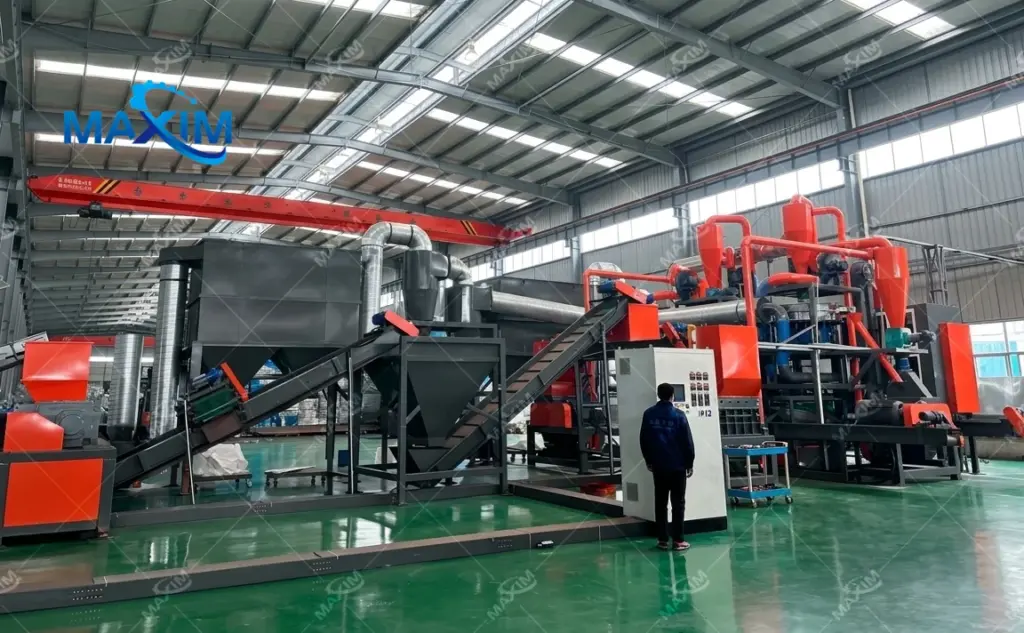
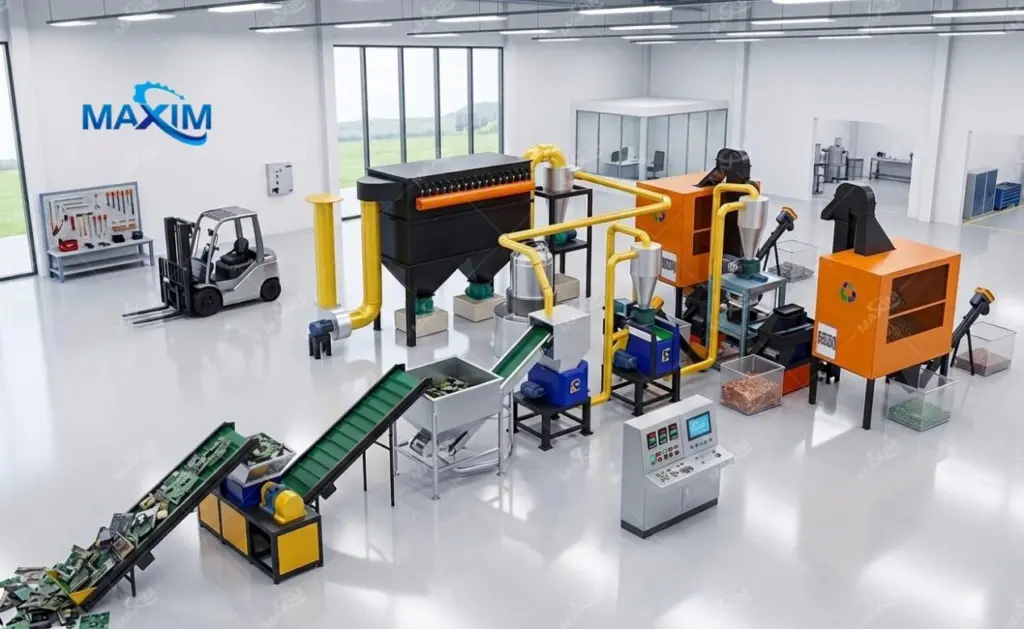
A modern line coordinates feeding, crushing, screening, recirculation, and separation. Our MAXIM machinery configuration uses three-stage crushing, while a recirculation system returns unsuitable particles for further size reduction. PLC control supports uniform feeding and coordinated operation.
The objective is controlled liberation, not maximum fineness. Screen selection and crusher settings should match the board type and the separator’s feed range. Wear parts also require inspection because blade condition can change particle-size distribution.
Each separator has a specific function:
*Magnetic separation removes ferrous material before finer sorting.
*Air classification separates particles according to density and aerodynamic behavior.
*High-voltage electrostatic separation distinguishes conductive metal from non-conductive resin and fiberglass.
In the specified configuration, air classification is rated at over 97% separation efficiency, while electrostatic separation is used to limit non-ferrous metal loss. Actual results depend on feed preparation, particle size, moisture, and operating settings.
Circuit-board crushing generates fine particulate matter, so dust control must be integrated into the process. Negative-pressure conveying helps contain airborne material, while centralized collection captures dust from transfer and separation points.
Our line uses negative-pressure feeding and a pulse dust collector. The specified configuration lists pulse dust-collection efficiency above 99%. Elevated sections can also include walkways and guardrails for inspection and maintenance.
Listed models cover capacities from 200–300 kg/h to 800–1,000 kg/h. Final capacity, power demand, and layout must be confirmed against the actual feedstock and site.
A reliable proposal begins with project data, not a model number. Buyers should provide material photos or samples, hourly input, working hours, target output, factory dimensions, local voltage, dust-control requirements, and the intended downstream buyer.
Illustrative case study: an e-waste processor receives mixed computer and television boards but has limited floor space. The evaluation should determine whether components need removal, whether the board groups should be processed separately, and what concentrate the buyer accepts. Capacity and layout can then be selected around these findings.
At MAXIM machinery, we configure recycling solutions around material characteristics, production requirements, and site conditions. We configure your recycling solution fully. Our services include consulting, process and equipment design, equipment production, assembly and start-up, operator training, and after-sales service.
A: PCB recycling aims to recover as much material as possible from used printed circuit boards. This can be achieved with a dry industrial line of mechanical processing steps. These can include dismantling, stepwise crushing, screening, magnetic separation, air classification, electrostatic separation, recirculation, and dust removal.
A: Waste boards may contain copper, tin, iron, nickel, aluminum, gold, silver, palladium, and other metals. The amount and value depend on board type, source, component density, and the downstream refining route.
A: It can be commercially viable with stable feedstock, suitable capacity, controlled energy and wear costs, efficient separation, and reliable buyers. Profitability calculations should use representative samples and current local sales terms.
A: Use the information about the type of board, the hourly volume of material being run, the time of day the material is being delivered, the target concentrate, the amount of space available, the size of the electrical supply, environmental controls, and downstream route. At MAXIM machinery, we use these inputs to recommend a suitable process configuration and layout.
A request such as “quote a scrap metal recycling line” leaves many technical questions open. Similar scrap can still require different feeding, shredding, conveying, sorting, and discharge arrangements. A better RFQ defines the job before asking for a machine. Material, capacity, sorting goals, final product, and site conditions should all be clear. What Information Should a excerpt …
