
A PCB recycling plant needs to do much more than simply reduce circuit boards in size. The plant must free bonded materials. It must also separate metals from resin and fiberglass. In addition, the plant has to manage dust carefully. This approach delivers steady output for downstream buyers. The main purchasing question is not simply which crusher to buy. The key issue is how to match feedstock, capacity, separation targets, layout, and operating needs with a complete system.
A complete facility combines feeding, size reduction, classification, metal separation, material collection, dust control, and electrical control. Such a facility suits e-waste processors. The same facility also suits electronics manufacturers handling production scrap. Metal recovery businesses, recycling contractors, and investors with a reliable supply of waste boards find the facility useful.
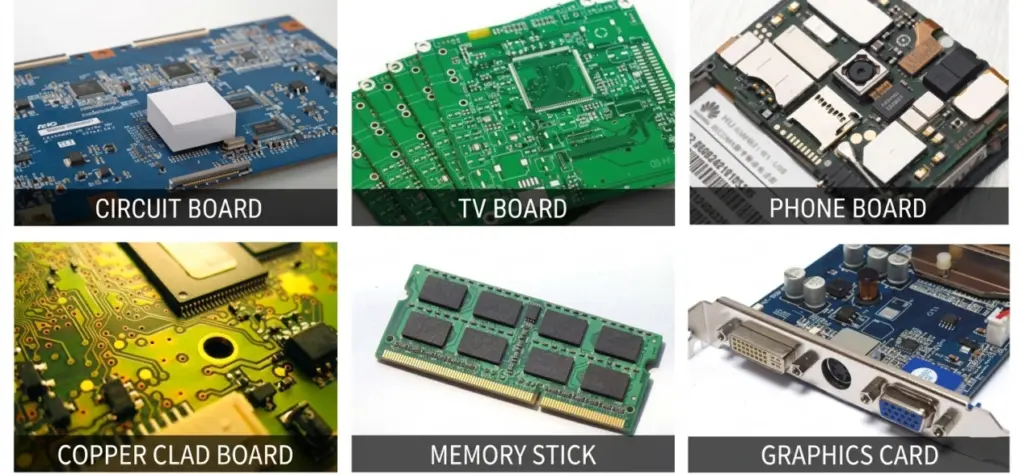
Typical feed materials include computer boards, mobile phone boards, television boards, copper-clad laminates, household-appliance circuit boards, PCBs, and flexible printed circuit boards. MAXIM machinery designs its line to separate mixed metallic fractions from non-metallic material after crushing and sorting.
Feedstock condition still matters. Bare laminates, populated boards, memory modules, and mixed appliance boards differ in component density, thickness, and contamination. Batteries, large capacitors, and unsuitable hazardous parts should be removed before feeding. Consistent sorting improves throughput and separator stability.
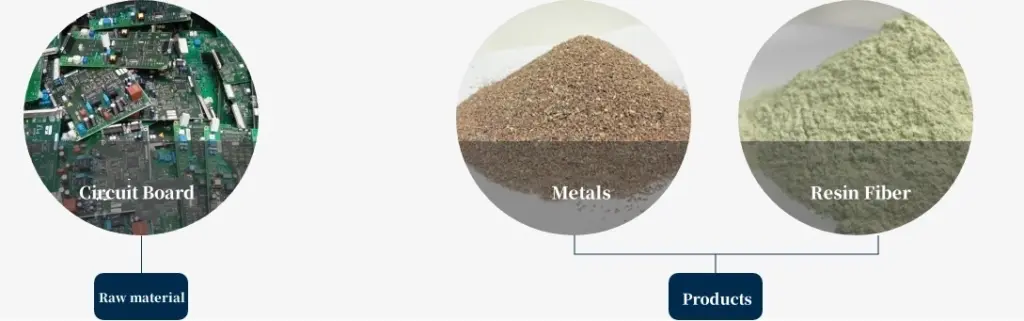
Mechanical treatment normally creates:
1.A mixed or copper-rich metal concentrate
2.A resin and fiberglass-rich fraction
3.Ferrous material removed by magnetic separation
4.Fine dust collected from enclosed processing
The process does not directly produce refined gold, silver, or palladium. Precious metals may remain in the metal concentrate and require downstream smelting or chemical refining. This distinction matters when estimating revenue and selecting an offtake partner.
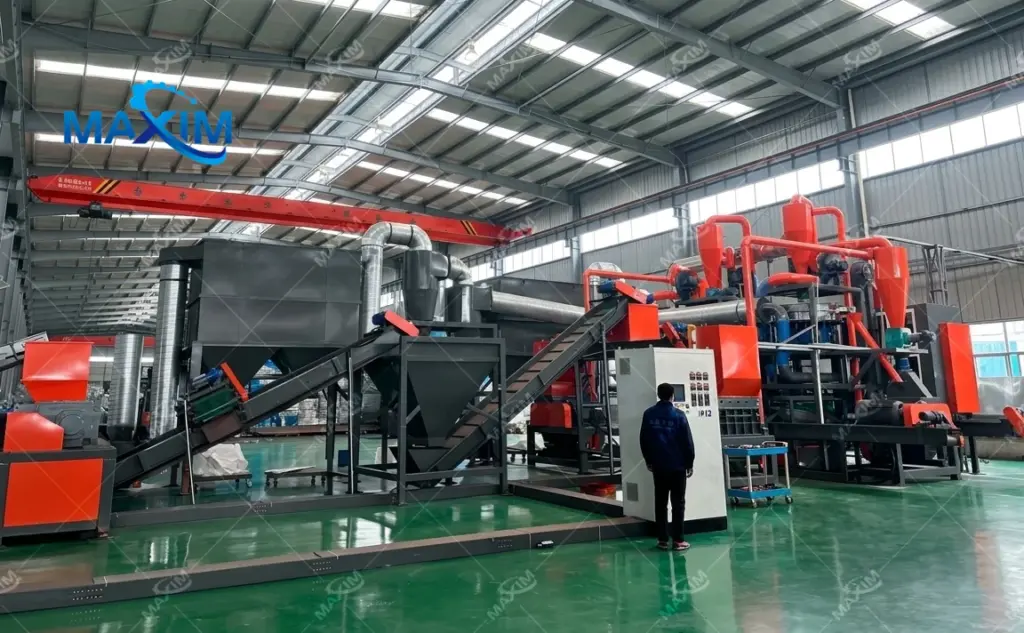
Effective separation depends on liberation. Copper tracks, solder, components, resin, and glass fiber are bonded together. Each stage must prepare material for the next stage.
Operators inspect incoming boards. Operators remove unsuitable items. Operators also classify material where practical. Populated boards may require component removal or primary shredding. Cleaner production offcuts can follow a simpler route. This step reduces safety risks. This step also prevents foreign objects from damaging downstream equipment.
The line reduces material progressively. Primary shredding opens the boards. Secondary crushing reduces particle size. Fine pulverizing improves liberation between conductive metals and non-conductive substrate. MAXIM machinery uses a three-stage crushing arrangement with recirculation for material requiring further size reduction.
Progressive crushing supports steadier feeding. Progressive crushing limits unnecessary overgrinding. Progressive crushing also creates a more suitable particle range for later separation.
Several technologies then work together:
| Separation stage | Main function | Practical value |
| Magnetic separation | Removes iron-bearing particles | Improves product quality |
| Air classification | Sorts by aerodynamic behavior | Divides heavier metal-rich and lighter resin-fiber material |
| Electrostatic separation | Uses conductivity differences | Recovers fine non-ferrous particles |
The MAXIM machinery configuration includes magnetic removal, air classification, and high-voltage electrostatic sorting. The air classification system is specified at over 97% separation efficiency. The electrostatic separation helps control non-ferrous metal loss.
Fine crushing creates airborne particles that must be contained. Negative-pressure feeding limits escape at transfer points. A pulse collector captures process fines. The documented MAXIM machinery line uses negative-pressure conveying and a pulse dust collector specified at over 99% efficiency.
Dust control influences operator conditions, material loss, equipment cleanliness, and output consistency. Final fractions should be collected separately. Final fractions should also be sampled to check metal carryover.
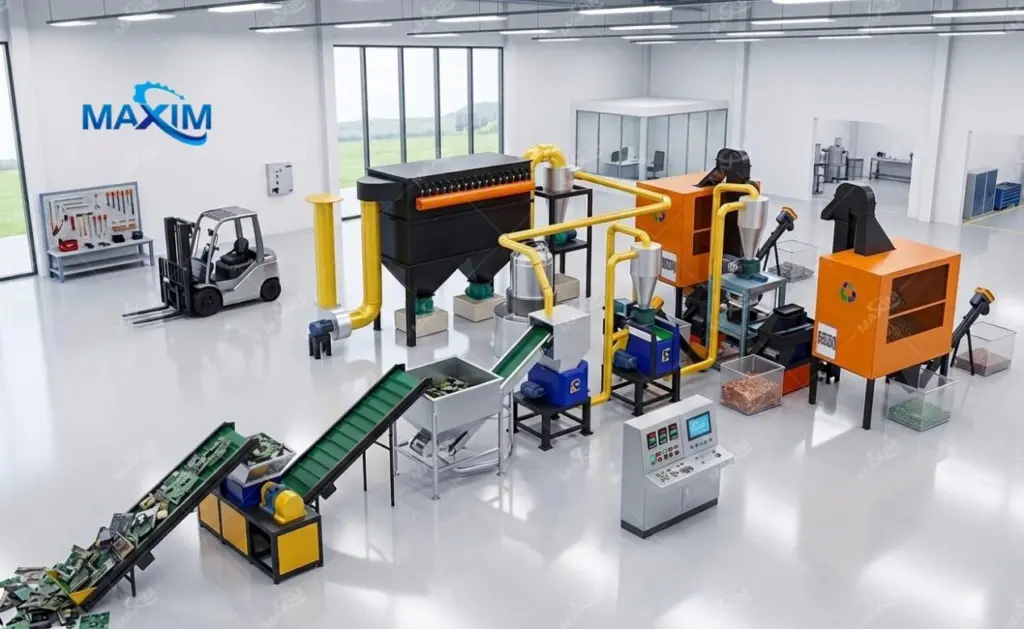
A production line should be evaluated as an integrated system rather than a list of standalone machines.
The core configuration may include a feeding conveyor, primary shredder, secondary crusher, fine pulverizer, classifier, magnetic separator, air separator, electrostatic separator, recirculation route, and product collectors.
MAXIM machinery offers four documented line capacities:
| Model | Rated capacity | Installed power |
| MX-PCB 300 | 200–300 kg/h | 102 kW |
| MX-PCB 500 | 400–500 kg/h | 134 kW |
| MX-PCB 800 | 600–800 kg/h | 194 kW |
| MX-PCB 1000 | 800–1,000 kg/h | 238 kW |
These figures are a starting point. Final selection should also consider feed consistency, operating hours, local power conditions, and required output quality.
Supporting systems include negative-pressure conveying, pulse dust collection, PLC control, electrical cabinets, access platforms, walkways, guardrails, and maintenance points. PLC coordination supports uniform feeding and synchronized operation. Walkways and guardrails help personnel inspect and maintain the line.
Although these systems do not create the final product directly, they affect uptime, labor, cleanliness, and maintenance.
The right solution fits the real project. The right solution is not necessarily the largest model.
Start with verified monthly feedstock rather than optimistic estimates. Convert volume into hourly demand using realistic operating days, shifts, and maintenance time. A 400–500 kg/h line may be more economical than an 800–1,000 kg/h system when supply is limited.
Use this sequence:
1.Confirm average and peak incoming volume.
2.Define operating hours and planned downtime.
3.Estimate feedstock changes over two to three years.
4.Select reasonable reserve capacity without excessive idle capability.
Buyers should define what good separation means for their market. Important targets include metal concentrate quality, residual metal in the resin-fiber fraction, particle size, consistency, and acceptable loss in collected dust.
Consider a recycler processing mixed computer and television boards for a downstream refiner. The objective is not refined copper at the machine outlet. The objective is a stable metal-rich concentrate that meets the refiner’s acceptance criteria. This requirement influences crushing fineness, recirculation, separator settings, and sampling frequency.
PCB recycling plant cost includes more than the equipment quotation. Buyers should evaluate power supply, floor space, material flow, foundations, dust ducting, installation, commissioning, labor, wear parts, maintenance, packaging, and downstream treatment.
| Buying question | Why it matters |
| Is capacity based on my feedstock? | Board composition affects throughput |
| What separation stages are included? | A crusher alone cannot produce classified outputs |
| How is dust contained? | Fine particles influence safety and material loss |
| What service is included? | Installation and training affect start-up |
At MAXIM machinery, we focus on resource-recycling equipment and customized processing solutions. Our engineers consider production targets, material characteristics, and site conditions when configuring equipment and layout. We support projects from consultation and solution design through manufacturing, installation, commissioning, personnel training, and after-sales maintenance.
Before requesting a proposal, prepare feedstock information, expected hourly capacity, operating schedule, available plant dimensions, local voltage, and required output specifications. With these inputs, we can recommend a suitable custom PCB recycling production line instead of applying a one-size-fits-all configuration.
A: Cost depends on capacity, board type, crushing stages, separator configuration, dust control, automation, local power requirements, installation, and service scope. Compare the complete line and operating requirements, not only the crusher price.
A: A complete system normally requires feeding, shredding, secondary and fine crushing, classification, magnetic separation, air separation, electrostatic separation, product collection, dust control, and coordinated electrical control.
A: Choose capacity according to reliable feedstock supply, operating hours, maintenance time, expected growth, and output requirements. Oversizing can increase capital and energy costs while leaving equipment underused.
A request such as “quote a scrap metal recycling line” leaves many technical questions open. Similar scrap can still require different feeding, shredding, conveying, sorting, and discharge arrangements. A better RFQ defines the job before asking for a machine. Material, capacity, sorting goals, final product, and site conditions should all be clear. What Information Should a excerpt …
