
An EV battery may no longer provide the range or charging performance required on the road, yet it still contains valuable electrode materials, copper, aluminum, steel, and plastics. The practical challenge is deciding whether the battery should be reused, repurposed, or processed through a controlled recycling system.
Lithium-ion traction batteries hold materials that offer various physical and financial benefits. You will find copper and aluminum inside current collectors, cables, outer casings, and frame parts. Meanwhile, electrode coatings pack graphite. Depending on the exact battery chemistry, they also include lithium, nickel, cobalt, manganese, iron, or phosphate compounds.
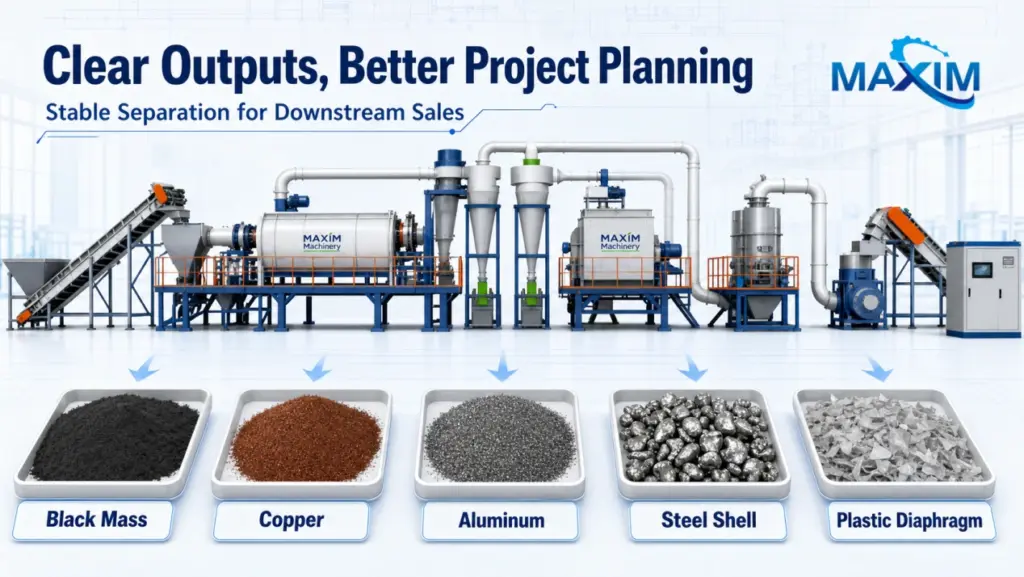
Mechanical pretreatment will not give you ready-to-use battery chemicals. Instead, its main job is to crack open the cells. This step frees up the attached materials. It builds cleaner material streams for the next processing stages. Common outputs from this step feature black mass, copper, aluminum, steel, plastics, and separator sheets.
Black mass is the fine mixture derived mainly from cathode and anode coatings. Its value depends on chemistry, moisture, particle size, and contamination by copper, aluminum, iron, or plastics.
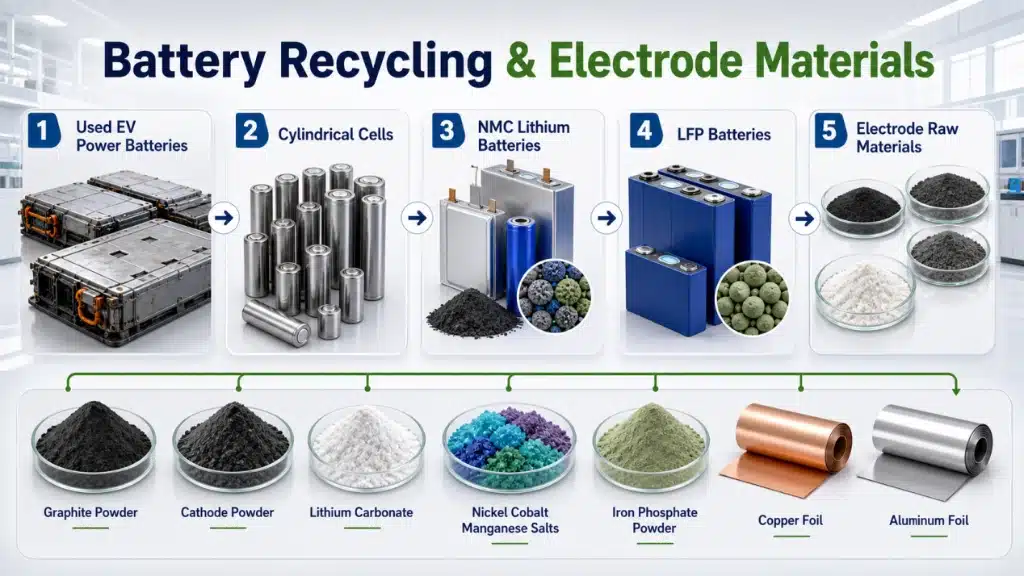
Poor handling can mix valuable materials with general waste while increasing fire, dust, and contamination risks. A planned process keeps the material in a controlled flow:
1.Retired packs and production scrap are collected and classified.
2.Recyclers dismantle, size-reduce, and separate the material.
3.Refiners recover metals or regenerate battery materials.
4.Recovered products return to manufacturing.
This system creates a secondary source of industrial raw materials.
A battery that no longer meets automotive requirements may still have sufficient capacity for stationary storage, backup power, or another lower-demand use.
Second-life assessment requires more than a capacity reading. Operators must consider cell consistency, insulation, thermal history, physical damage, battery management data, and reconfiguration cost. Packs with uncertain safety may be unsuitable.
Recycling is generally more practical when a battery is damaged, deeply degraded, difficult to diagnose, or uneconomical to remanufacture. It is also suitable for production scrap, rejected cells, electrode sheets, and mixed materials.
| Decision factor | Reuse or repurpose | Material recycling |
| Battery condition | Stable and testable | Damaged, degraded, or uncertain |
| Main value | Remaining energy capacity | Recoverable material content |
| Required work | Testing and reconfiguration | Discharge, dismantling, separation |
| Typical output | Second-life system | Black mass and material fractions |
The right route depends on condition, chemistry, format, local requirements, processing cost, and downstream demand. This decision should be made before shredding.
Incoming material must first be identified as complete packs, modules, cylindrical cells, pouch cells, prismatic cells, electrode sheets, or manufacturing scrap. Chemistry and state of charge also affect the process.
A typical preparation sequence includes:
1.Isolating damaged units
2.Identifying chemistry and format
3.Assessing state of charge
4.Controlled discharging
5.Removing housings, cables, electronics, and structural parts
6.Preparing cells or modules for processing
Complete EV packs should not enter ordinary crushing equipment without a defined pretreatment procedure.
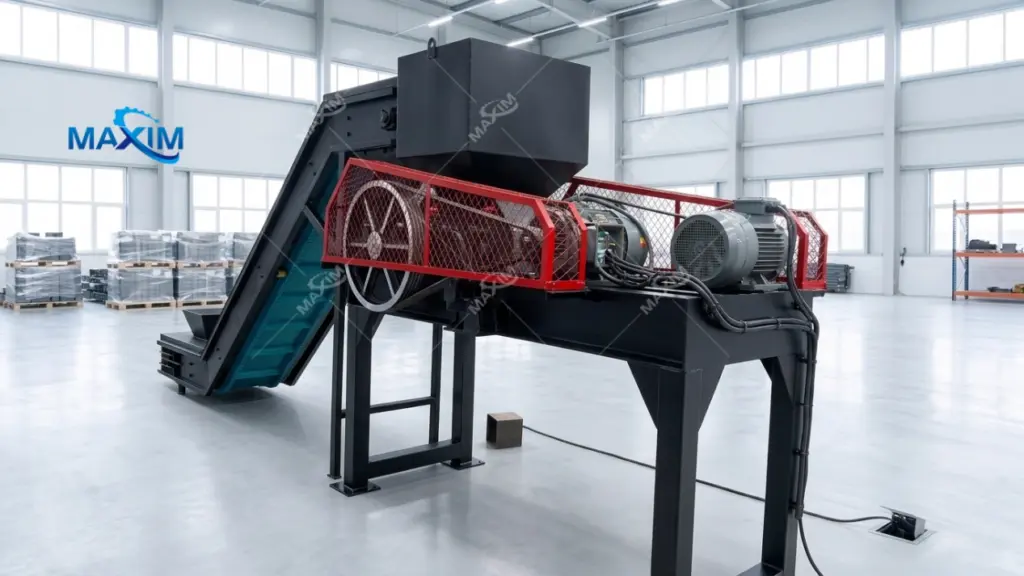
Shredding opens cell structures and reduces bulky material. Secondary crushing or hammer milling further detaches electrode coatings from copper and aluminum foils.
Size reduction must be controlled. Oversized pieces reduce separation efficiency, while excessive fines increase dust loading and metal contamination in black mass. Stable feeding, suitable blades, recirculation, and particle-size control support consistent processing.
MAXIM machinery configurations can combine tearing, hammer crushing, vibrating screening, and air separation. Listed applications include NMC, LFP, NCA, LMO, LCO, cylindrical batteries, electrode sheets, and scrap vehicle batteries.
After liberation, separation equipment divides material by size, density, and physical behavior.
| Equipment stage | Main function |
| Vibrating screen | Classifies coarse and fine particles |
| Air separator | Divides lighter and heavier fractions |
| Magnetic separator | Removes ferrous material where required |
| Dust collection | Captures fine airborne particles |
| PLC control | Coordinates feeding and line operation |
The fine electrode-rich fraction is collected as black mass, while copper and aluminum are separated for further processing. Black mass remains an intermediate feedstock, so downstream testing and refining are still required.
Mechanical separation prepares several output streams. Copper and aluminum can enter metal-recycling channels, while black mass can move to hydrometallurgical, pyrometallurgical, or direct-regeneration processes.
Hydrometallurgy uses leaching and selective separation. Pyrometallurgy uses high-temperature treatment to produce an alloy and slag for further refining. Direct recycling attempts to preserve or restore electrode structure, but it requires more consistent feedstock.
The line must deliver stable fractions that meet the next processor’s requirements.
No equipment layout suits every battery stream. Buyers should define:
1.Chemistry, such as NMC, LFP, or mixed material
2.Input format, from electrode sheets to dismantled cells
3.Required hourly throughput
4.Remaining charge and damage condition
5.Target black mass quality
6.Required copper and aluminum outputs
7.Workshop and utility conditions
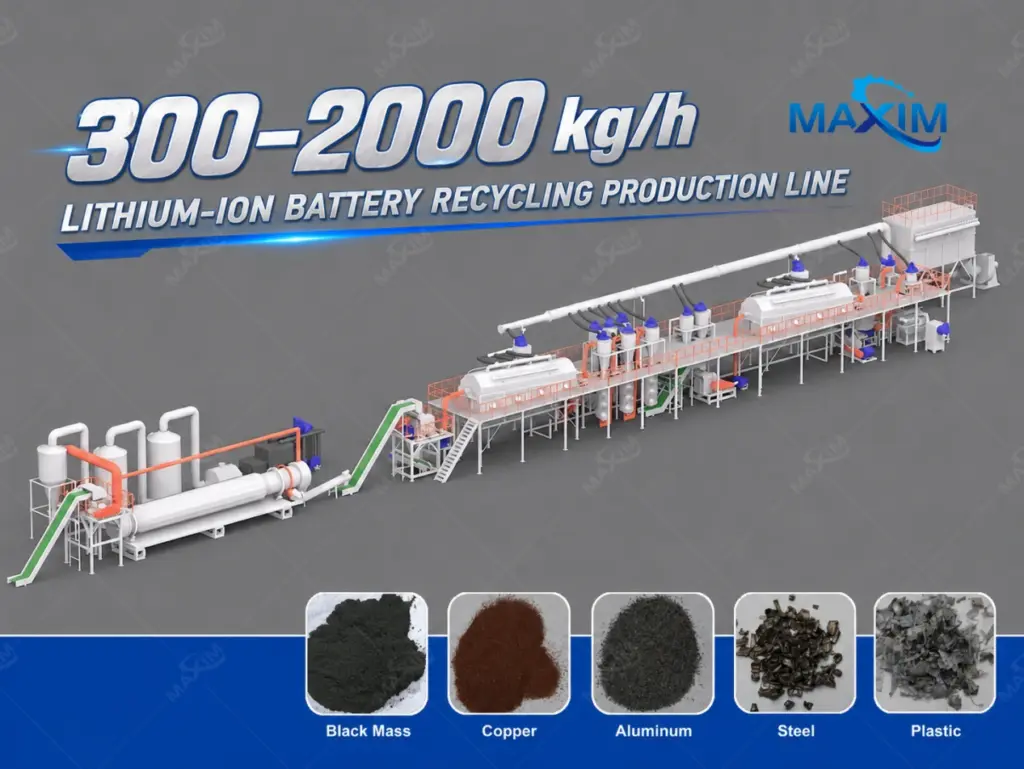
MAXIM machinery lists MX-500 to MX-2500 configurations with capacities from 500 to 2,500 kg/h. Listed output categories include copper, aluminum, lithium cobalt oxide material, and graphite powder.
Consider an illustrative project receiving LFP modules and NMC production scrap. Rather than use one uncontrolled recipe, the operator can classify feedstock, adjust pretreatment, and schedule separate batches. This reduces chemistry mixing and supports more consistent downstream products.
Price alone does not show whether a line will operate reliably. Buyers should assess feeding, interlocks, negative-pressure operation, dust collection, maintenance access, and automation.
For listed lithium battery configurations, MAXIM machinery combines crushing, sorting, conveying, air purification, automatic control, and centralized dust removal. The system is designed to operate under negative pressure to limit dust escape.
Performance must be discussed against a defined feedstock and test method. Technical indicators for one configuration list at least 99% recovery for black powder, aluminum powder, and copper, with copper and aluminum contamination in black powder limited to 1% or less.
At MAXIM machinery, we develop recycling equipment around the customer’s material instead of forcing every project into one standard layout. We review battery chemistry, input form, desired capacity, available space, electrical requirements, and target products before proposing a process.
Our work covers shredding, crushing, screening, and air sorting. We handle the conveyors, central dust catching, and PLC computer controls. We also offer full layout design and machine building. Our team helps with setup, testing, worker training, and long-term support.
If you want a useful quote, please send us your battery type and chemistry details. Tell us the normal feed size and your hourly speed needs. A workshop floor plan, your local power rules, and the required output specs will help us greatly.
A: Yes. After inspection, discharge, and dismantling, batteries can be processed to separate black mass, copper, aluminum, steel, plastics, and other fractions. Further refining is needed to recover individual battery materials from black mass.
A: The usual sequence is receiving and classification, safety inspection, controlled discharge, dismantling, shredding, secondary size reduction, screening, air separation, dust collection, and output packaging. The exact route depends on chemistry and input format.
A: Common outputs include copper, aluminum, steel, plastics, and black mass containing cathode and anode material. Downstream processors may recover lithium, nickel, cobalt, manganese, graphite, or other compounds depending on chemistry.
A: Reuse may suit a battery that is safe, testable, and still has useful capacity. Recycling is generally more appropriate for damaged, heavily degraded, mixed, or uneconomical batteries. The decision should follow technical and safety evaluation.
A: A typical line may include discharge and dismantling stations, shredders, crushers, vibrating screens, air separators, magnetic separation where needed, conveyors, dust collection, material collection, and PLC controls. Final selection should be based on feedstock and required outputs.
A request such as “quote a scrap metal recycling line” leaves many technical questions open. Similar scrap can still require different feeding, shredding, conveying, sorting, and discharge arrangements. A better RFQ defines the job before asking for a machine. Material, capacity, sorting goals, final product, and site conditions should all be clear. What Information Should a excerpt …
